Wednesday, October 27, 2010

We are stardust, we are golden or Rilke's elegies

Close-Up of Light Echo Around V838 Monocerotis (September 2006)
"... We are billion year old carbon" by Joni Mitchell
Image courtesy of Hubblesite.org

The lab results came back.

My dad's cancer was supposed to have been cut out of his lung and life was supposed to continue as it always had. The tumor was supposed to be no more than a hard, tiny rock that would be tossed into the trash. Instead the cancer is like dark matter, dark energy, drawing life away.

I spiral into a place that neither shines nor reflects.


Once
for each thing, only once. 
Once, and no more. And we too,
once. Never again. But this
once, to have been, though only once,
to have been an earthly thing – seems irrevocable.

-- Rainer Maria Rilke, The Ninth Elegy

Lung cancer can spread into the neck and cause a droopy eyelid and sunken eye. It can grow into the esophagus and cause painful swallowing. It can twist itself around the heart and cause irregular beating. Or it can travel through the blood stream to the brain, the liver, the bones. My dad's cancer was found in his lymph nodes, bean-shaped filters that trap foreign particles and are part of the immune system.

I tell everyone I know. I tell everyone I don't know. I tell because I want the news to spread faster than the rogue cells, because I want to imagine that a thousand individual fleeting thoughts focused on my dad's cancer will slow it, halt it, hell, why not erase it?

Want to know the prognosis for lung cancer?

It sucks.

For we, when we feel, evaporate: oh, we
breathe ourselves out and away: from ember to ember,
yielding us fainter fragrance. Then someone may say to us:
‘Yes, you are in my blood ... 

 -- Rilke, The Second Elegy

Cancer is going to change my family's story and it makes me scared and angry. We -- my family -- die from heart attacks. It is written in our genetic code that more than likely death will come with a slow thickening of pipes until nothing but a trickle of blood remains and the heart gasps, shudders and breaks.

I don't want my dad to die. Okay, I know we're all dying, that each change is a sort of death to prepare us for the act of dying, but I don't want him to die. He's a good, strong man and the world's a better place because he's here, so he can't go.

And so I hold myself back and swallow the cry
of a darkened sobbing

Rilke, The First Elegy

I cradle the phone against my ear, bite my lip, and rock back and forth as I listen to my dad describe the chemotherapy's toxic concoction of drugs that would burn his veins, so doctors will put a port into his neck. He tells me another biopsy has been scheduled and a brain scan because doctors are still trying to define what and where they're fighting the cancer. Yet even as the ground falls from under him, he is strong. This is his life right now, fighting cancer, and he's ready for it, wants the fight. Had the cancer ended with the single surgery he said he would've felt a little cheated. Bring it on.

 Engraving of Orion from Johann Bayer's Uranometria, 1603 

I want to live my life like my father, with courage, but I'm stuck in the empty, gravity-sucking space that makes up most of our universe.

When I was a kid and my dad took me camping, he'd hunch over a constellation wheel and then squint at the sky, find some faint cluster of stars and call me over. Then we'd both stare up into the night sky and he'd point out Big Bear and Little Bear, the North Star, Scorpio and the Pleiades, the star-studded belt of Orion, the hunter.

But it's not story, but science that comforts me now. Strength lies in fact, not in prayer, and I think that's okay. Knowing that we are just specks upon specks floating in a lonely corner of an ever-expanding universe doesn't make me feel hopeless because the universe is in us. You, me, my dad, the cancer are composed of the same ingredients -- hydrogen, oxygen and carbon -- in roughly the same proportion as the recipe for the universe.

Does the cosmic space,
we dissolve into, taste of us then? Do the Angels
really only take back what is theirs, what has streamed out of them,
or is there sometimes, as if by an oversight, something
of our being, as well? 

Rilke, The Second Elegy

The other night the rain stopped and the clouds lifted, stars peered down from the heavens, and from my kitchen door I traced the outline of the Big Dipper. I wasn't filled with hope or peace or fear or sadness or anger.

I just was.

Friday, October 22, 2010

Happy man on a happy day

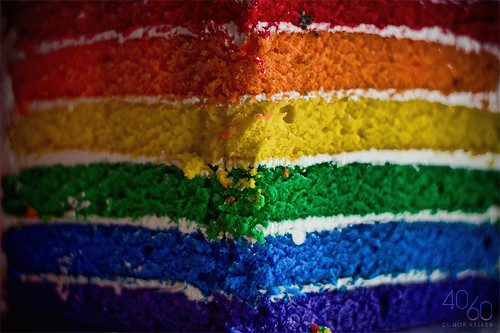
Rainbow Cake Surprise Explored!
Photo courtesy of Conor Keller.

Today's the last day of my thirties, 
and of the aspects of my life I can control, 
I wouldn't change a thing. 

-- Marcel Levy 


Wednesday, October 20, 2010

Breathless

● d e t a i l s ●
Photo courtesy of just.jim.

The weekend's whirlwind trip back to Nevada included three trips to the hospital, a sleepover with my girlfriends, a tea party for thirty, a trek out to the homestead and then we were back in the air again. As the ground rushed away from us and we headed into clouds, Ivan clutched the arms of his chair, leaned back and uttered one word:

Whoa.

You said it, cowboy.

Friday, October 15, 2010

Air

Spring comes
Photo courtesy of Patrick Wilkin.  

I am listening to myself breathe, air rushing in and out of my nose, my chest expanding, contracting, until my concentration leaves me light headed, dizzy with emotions. Wonder, dread, fear, hope rise and fall like hot air balloons.

Somewhere, a doctor breaks my father's rib and carves out a piece of lung sick with cancer.

I sip tea that is strong and bitter, fold clothes, wait.

Have I ever told you that I once held a lung? It was a small set of warm, pale pink lungs that minutes earlier were inside the chest of a rabbit but were now cupped in my child hands. My dad was butchering a rabbit and was explaining to me the animal's innards as he pulled them out. I held the wind pipe up to my lips, breathed and I remember how strangely firm the lung felt, not at all like a light and hollow balloon.

For more than a year doctors couldn't figure out why my dad kept coughing; it turned out he was trying to hack out a tumor. Twice, yesterday, my mother texted with updates.

Message number one: No news. Doing well... just w8ing. I'll let u kno.
 
Message number two: Only did lobectomy - removed lower lobe of rt lung + 1/2doz lymph nodes. Lab results on nodes due nxt week. Going 2 ICU 2nite. Doc says he is doing well. I'll keep u posted.

It's easier to imagine the journey of that piece of tissue than to see in my mind's-eye my father sleeping in a hospital bed, missing one-fifth of his lungs. I imagine a brightly lit operating table and a metal bowl nearby, sterile, antiseptic, cool to the touch even through surgical gloves. Someone drops the chunk of lung into it.

Later, when the surgery is finished and the technicians are on break, they toss the lung to a crow hanging out in one of the cottonwood trees behind the hospital. The crow swallows the lung and catches my father's cough.

Wednesday, October 13, 2010

It makes the world go 'round

 Shel Silverstein's "Hug O' War."

Two-year-old Ivan and I were motoring our way through a morning of errands when we passed two men in their 20s, loping along with rounded shoulder and skinny leg.

"I wuv those guys," Ivan said.

I glanced back at the men who were now glancing back at us.

"You love them?"

"Yeah."

I shrugged.

They laughed.

And everyone had a better day because of it.


I've been listening this tribute to Shel Silverstein for two weeks, straight. Here's where you can preview the entire album. And while we're singing on the subject, why not learn about the mathematics of poetry, enjoy Seattle poet John Olson's love of lines, or pick up some tips from budding author Caroline Starr Rose on telling a story in free verse.

Friday, October 8, 2010

Bilocation or returning home

by-lo-kay-shun
noun
P1010885
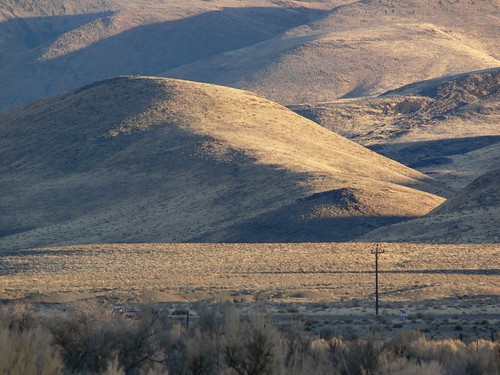
Familiar hills surround Silver Springs, Nevada.

  1. The supposed phenomenon of being in two places simultaneously.

I'm thinking about home, about going home to the desert where a small trailer sits anchored in the sand and bleached by the sun. The wind has blasted off paint, exposing metal that twinkles dully like a dime on the sidewalk. I pick up the dime, rub away the dust and look for the year. It is 1980.

I place my hand on a splintered railing and climb a set of steps that lead to the trailer's front door. I'm careful to avoid the nails protruding from the old planks held together by hammer and story. This is where my sister tumbled down and deadened her front teeth. And this crack between step and trailer was where the coyote-clawed cat hid, died and wasn't found for a month.

I step inside, onto vinyl flooring whose brick pattern is patchy and in some places worn clean away by years of sand ground into it. Like those trails that cut through grass and ignore sidewalk, a serpentine path is etched into the floor beginning at the front door and winding its way between kitchen table and stove before veering left and disappearing down the hall. Here more stories lurk. Stories held in the books lined up on hall shelves, and stories held in my mind.

DSC_0034

But I don't walk down the hall. Instead, I sit at the oval kitchen table that also shows signs of wear. The wood veneer is yellowed and faded where plates are set daily. Within arms reach of the table is the counter and drawers, which open stubbornly and if yanked too hard will tumble out and send forks, spoons and knives clattering to the floor. At this table, I'd meet my mom for late night cups of cocoa and towers of buttered toast. I'd wake and wander into the kitchen, perch on a chair with knees drawn up to my chest and my flannel nightgown tented around me. As I'd dunk toast, we'd talk. Then with a stomach full and warm, I'd wander back to bed. I don't sleep, but lay looking out the window at the stars and the dusty line of the Milky Way. A meteor burns across the darkness.

DSC_0211.JPG
In her mother's house.

Seven hundred miles and thirty years away, my own daughter and I are sharing hot chocolate and  nighttime conversation as we drive home from a meeting. It is a moment of bilocation between mother and daughter, everything at once familiar and foreign, like when I return to the desert. The trailer is still cemented in sand, but the insides are gutted, table and floor have been replaced, dark walls are painted light. I am a different mother and she a different daughter than what my own mother and I shared, but still we're here, together, wrapped in the night. She leans her head against the car window. Outside, a star gleams dull as a dime then falls from the sky.

Wednesday, October 6, 2010

Homage to Sendak and an ushering in of the flu

Illustration from "Alligators All Around" by Maurice Sendak, whose book "Chicken Soup with Rice: A book of months" inspired me despite my sinus headache.
In October,
I've been host
to coughs,
fevers and
a runny nose.
Soup's cured all
but the nasal drip, post.
Sneezing once.
Hacking twice.
Cold season sure ain't nice.

Friday, October 1, 2010

Maunder or writing about writing

mon-duhr
verb
DSC_0076
  1. To talk incoherently; to speak in a rambling manner.
  2. To talk or wander aimlessly.
We all have favorite tools we grab when a job needs finishing. When making soup, I grab one wooden spoon out of a canister full of them because I like the heft of its handle and the shape of its bowl, perfect for slurping from before adjusting the seasoning. I drink my morning coffee from one cup, my afternoon tea from another. Again and again, I reach for the same things because they're useful, predictable, because I'm trying to recapture an experience, like the time I stirred a pot of soup that turned out fabulous, or sipped from a cup and the sun shone all day, or wrote with a certain pen and the sentences sang.

My favorite pen to write with is Paper Mate Flair with a porous point in black ink. The pen is sleek, lightweight, unadorned and unidentifiable but for the company's name stamped into the tiny metal clip on the cap. It's basically a marker, the ink is easy to read, the tip glides effortlessly across the page. The Flair once was a standard in every office supply store, where it came not only in black, but also blue, red and green, and was sold in sets of two or four. But the Flair is harder to find now and my latest box of twelve had to be ordered online for $22.

My favorite notebook is the Moleskin. I carry a pocket one to jot down grocery lists, doctor appointments, the size of my vacuum's replacement bags (RR), instructions on how to knit a sock, bits of eavesdropping, books I want to read and so on. To scribble down longer thoughts, partial stories and poetry, I recently switched from a spiral-bound college notebook to a (5.25 x 8.5 in.) Moleskin Volant and am pleased. The notebook's soft cover folds in two, its pages are large enough so I don't feel cramped while writing, yet the book is small and thin enough to be tucked easily into my backpack or messenger bag. In addition, the sewn binding is far superior to the spiral, which bent, snagged and (most irritating) released its pages.

My habits met with limited success this week: My soup spoon went unused, my morning cup produced only sunny afternoons and my trusty pen maundered across lined paper -- while making fried rice (added soy sauce to my grocery list), while stopped at a red light (wondered about the different qualities of rain), and as my son nursed and napped (began an essay about school). Pages were filled with partial thoughts, bouts of self-pity, bits of truth, maybe a lie or two, but no singing, just my mind humming along, aimlessly, happily, writing about nothing much at all.

Wednesday, September 29, 2010

I like wind

This makes me happy. And nostalgic for my clothesline.

Friday, September 24, 2010

Pears and chocolate

 Mr. Putter and his fine cat, Tabby, 
a series by author Cynthia Rylant and illustrator Arthur Howard.

The pear sings of autumn, with its green speckled skin blushed red, its flesh juicy, sweet and slightly musky. Getting the perfect pear from farm to table is a complicated, risky business, according to chef Alice Waters, and requires knowledge and skill all along the way.

"First the pear must be picked from the tree when it is mature but not fully ripe. It must experience a period of cool storage," Waters writes in "Chez Panisse Fruit." "Then it must be brought out to room temperature to finish ripening. At every step of the way, from tree to market to kitchen, it must be handled gently to avoid bruising. Determining the point of perfect ripeness isn't easy at a glace; most pears do not indicate by their color when they are ready. The signal is a slight yielding to gentle pressure at the neck. And then, what wonderful eating from a carefully tended pear!"

DSC_0022
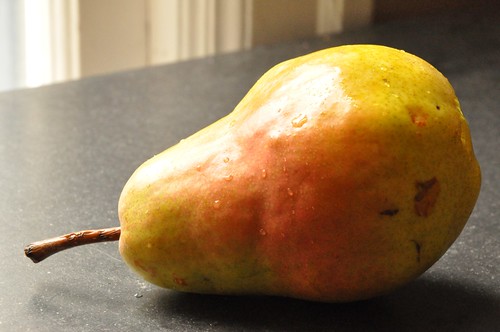
A Bartlett.

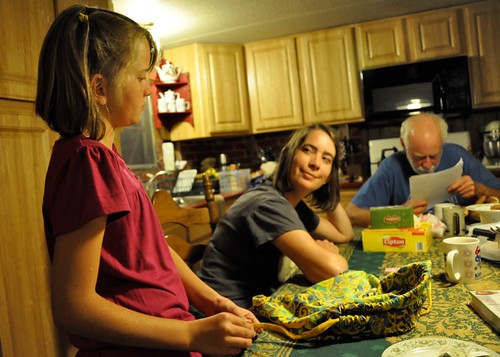
While the experienced farmer and appreciative chef view the pear as a work of art, in my neighborhood they're a bit of a nuisance. Around the corner from my house are three trees whose pears have been ignored by all but the crows and my youngest son. As we picked our way through smashed fruit and pecked cores, 2-year-old Ivan spotted a whole pear.

He picked it up and turned the hard, green fruit over in his small hands. It probably was a Bartlett, the most widely planted pear in North America and one of the most popular pears in the world. The Bartlett, along with most modern varieties like the D'Anjou and Comice, were developed in the eighteenth and nineteenth centuries and are descendants of the European pear, Pyrus communis, cultivated by the Greeks and Romans. The Bartlett is the classic pear, wide in the neck but clearly pear-shaped -- or, botanically speaking, pyriform. And if Ivan's pear was a Bartlett it would need only a few weeks off the tree before its skin turned a golden yellow and its flesh became sweet and buttery.

But I believe that in Ivan's mind this unripe pear already was perfect, fallen straight out of a story he'd become so smitten with that he takes the book with him in the car, in the bathtub, in bed. He reads it sprawled on the floor, curled up in a big chair and with his oatmeal at breakfast. It is "Mr. Putter and Tabby Pick the Pears" and is one in a series by writer Cynthia Rylant and illustrator Arthur Howard about a cantankerous old man and his twitchy cat.

In this story, Mr. Putter has a penchant for pear jelly, but his "cranky legs, cranky knees and cranky feet" prevent him from climbing the ladder and picking his fruit tree. So, he sets to knock the pears out of the tree using a slingshot and apples, but his aim is way off and he spends an afternoon "zinging" all the apples into his neighbor's yard. The next day, the neighbor arrives with pies, jellies and cider. While Mr. Putter feasts, he figures out what he's going to do with his pears: wait for them to fall and then he'll "zing" them into his neighbor's yard and wait for the pear jelly to arrive.


Ivan loves it.

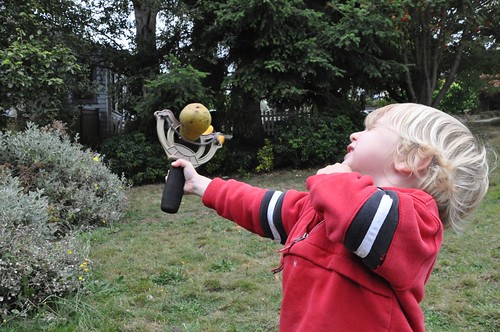
It's hard to explain why one story resonates and another doesn't, why we leave some books half read, yet return to others, again and again. Pages are pawed, spines broken and whole passages become so familiar they can be recited by memory, yet we never grow weary of the tale. I've seen this love affair develop in my three older children, who find a comfy corner, snuggle in and sigh with delight as they open a book. It's an infatuation that spills into real life, so sticks become wizard wands and patterns are purchased for the necessary prairie bonnet. And now it has begun with Ivan, who carried the pear home, found the slingshot and called me to the yard.


DSC_0021

DSC_0011

DSC_0017


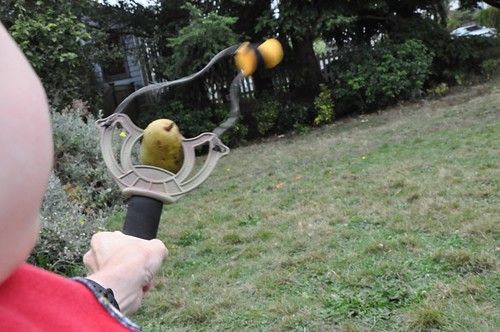
We aligned the smooth, heavy pear against the slingshot's rubber band and released it. Thud. The pear landed on his toe. Again we pulled, the slingshot snapped. Thud. Ivan threw himself on the ground and yelled through angry tears.

"It's not working! It's not working!"

We went inside and returned with a second slingshot (a benefit of having older brothers), and tried again.

More tears.

Again.

Another tantrum in the grass.

Again.

Then -- zing! -- the pear sailed two feet and dropped.

"That," Ivan said, "was awesome!"

In the end, the pear was pocked and bruised, best left for the crows to finish off. For this recipe, we picked our pears from the market, where I followed a few general rules from Alice Waters:

First it's best to buy green pears and ripen them at home because it ensures that they weren't picked past their prime and decreases their chances of bruising. At home, the pears can be stored in a loosely closed paper bag and kept at room temperature, where ripening can take as long as a couple weeks or as little as a few days, so check daily for that slight give in the neck when gently pressed.

"You do not want to miss that moment of perfect ripeness," Waters zings, er, sings.

Chocolate Almond Squares
Adapted from Raley's "Something Extra"
Serves 6

DSC_0033

Ingredients:
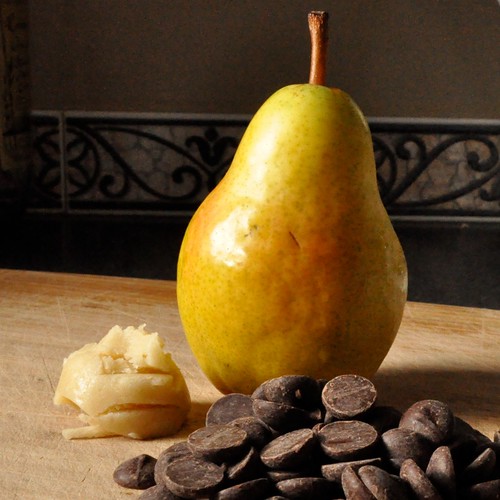
One perfect pear
A sheet of puff pastry
Almond paste
Chocolate chips

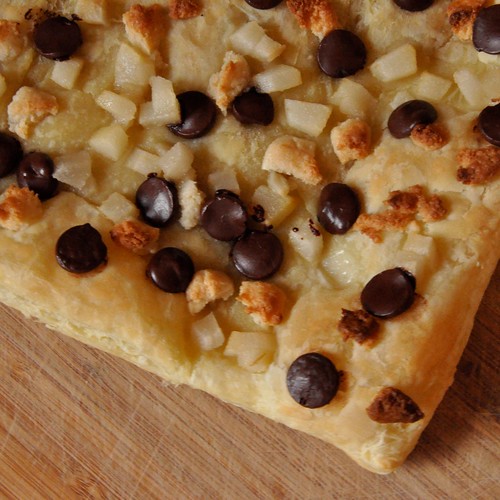
Preheat oven to 400-degrees Fahrenheit. Place a sheet of puff pastry on a baking sheet and fold up a small rim on all sides. Sprinkle about one-fourth of a pear, peeled and diced, 2 tablespoon crumbled almond paste and a few handfuls of chocolate chips in center. Bake for about 12 minutes or until lightly golden and puffy.

Wednesday, September 22, 2010

Three cheers for mediocre

DSC_0038
Across the street.

Monday, September 20, 2010

Beek or what I did on a good sky day

noun

Good sky day

  1. To bask or warm in the sunshine or before a fireplace, stove or bonfire.
*

One son was running a fever and everyone was missing soccer, but my family hasn't come close to filling the summer camping quota, so this was the weekend to go. But then the newspaper promised days of rain and we bailed because if there's one lesson I've learned after four kids it's this: Sick kid + soggy tent = sucky weekend.

But then Saturday arrived with a sky as beautiful as an abalone shell, creamy pinks, iridescent whites and feather blues, and by the time I finished my run and returned to a house, now smelling of coffee cake and bacon, the sun was shining.

There was only one thing to do: take my coffee to the front steps and beek the sun. After swigging the last of my cup, I invited the sun in for a visit and thought you might want to come too.

Or here
Sit here.

Sit here
Or here, the replacement for the couch that refused to fit through the front door (a bench better for practicing perfect posture that curling up with a book).

Look at the light
Look at this delicious light.

more light
Rare shadows in the office lined with bookshelves.

After chores and the smallest son's nap, we headed out for a hike, but in the 20 minutes it took to get there, clouds had rolled in, and by the time we hit the trail home, rain was falling.

That night, while cooking spaghetti and listening to National Public Radio, the local station cut in with the next day's forecast: "And tomorrow's weather is ... wait for it ... rain."

Wet radio flyer

Sigh.

First lesson learned about living in Seattle: Seize the sunshine when it comes.

Friday, September 17, 2010

Tears with my tea

DSC_0064
September afternoon, Seattle.

Long ago my father and I drove the old Chevy pick-up into mountains burned by wildfire. For hours he'd cut and I'd haul the logs, my ears ringing from the whine of chainsaw, my arms aching from carrying blackened wood. At the end of the day, I lay down in the scorched field and watched puffy white clouds blow across the sky.

Faraway in a forest sits the wide trunk of an ancient tree, and from inside this trunk grows a smaller, younger tree, pulling its energy and life from the decaying stump.

Once upon a time a cell smaller than a seed burrowed into my father, took root and grew into a miniature version of the corpse flower, which now blooms in his right lung and has been given a name, cancer.

Yesterday it rained inside the trees. I stood under the branches and drops hit my head and I listened to the patter of water on leaves, but when I walked out from under the trees and into the street, it wasn't raining. All around me I heard water falling, but not where I stood in open space, under a heavy sky.

Wednesday, September 15, 2010

Lacuna or wandering through negative space

luh-kyoo-nuh
noun

September morning, Seattle.
  1. A blank space or a missing part.
  2. Small cavity, pit or discontinuity in an anatomical structure.
*

There is much to say. And little. Since I put down my pen and stopped recording my thoughts, summer has slipped by, minutes ticked off in traffic, at the beach, under the dull skies and mist of Seattle, a cool summer, short on warmth and sunshine that surrendered early to autumn.

When I moved, I packed all I love and now it surrounds me -- husband and children, books and pictures -- but when I open the door to our house an unfamiliar smell greets me and I've yet to learn to avoid the squeaks while walking across the wood floor.


All images by Molly Bang, author of "The Grey Lady and the Strawberry Snatcher," a 1981 Caldecott Honor Book.

A friend sends sagebrush in the mail and I open the bag and inhale the pungent, tangy, dry scent. I pass it to one son and he buries his face in it, breathing, breathing until he blinks back tears and pinches his nose.

Oh, he says, I've missed this.

I say nothing. There is nothing to say.

"A hole can itself have as much shape-meaning as a solid mass."
-- Henry Moore


The place I love is not the place I live, and so there is a cavity, a lacuna, in my life. I mislead you if I sound sad, for I'm not, nor am I suffering from a shortage of sun (which, when it shines on Seattle, turns it into a glorious city). No, I'm just acknowledging that for which I yearn, what couldn't be boxed and loaded into the U-Haul, clear blues and burnished golds, night skies sugared with starlight, and the familiarity between old friends.


The days spent in Seattle have felt like a vacation. I marvel at the mist that soaks me, at the clams that spit and the plankton that sparkle in dark waters. I inhale the forest's smells of rotting leaves, soft moss and lush ferns. I eagerly climb aboard the bus to lose myself in the city. But I cannot return home.
Walls with windows and doors form the house,
but the empty space within it
is the essence of the house.
-- Taoist philosopher Lao Tse
As a stranger, I invite in all that's foreign, opening the windows of my brain to the morning fog, which smudge the names and places that leave me smarting with loss. This move erased me around the edges and I've yet to fill what is empty.


One morning I run through damp streets and discover where the world ends. Road and sidewalk meet grass, then fence, then blackberry bush, then cliff, then tree in the woolly tangle of gray that whispers the secrets of salt and gull and the growl of fishing boats. And for a moment I imagine leaping off, tumbling through negative space, that part of the world that lies around and between things, the pause, the gap, or, in Japanese the ma, falling through the muted world until I'm snared by the brambles' thorns where I'd stay, eating berries and crunching tiny seeds.

Friday, July 23, 2010

A summer siesta


Courtesy of Casa de Queso.

I'm needing time to

think
write
read
discover
prepare
settle.

The Slow-Cooked Sentence will be on hiatus while I build a new life for myself and my family in Seattle.

Friday, July 16, 2010

A lesson with fire or how words ignite


Courtesy of Daniel Y. Go.

I've kissed one Indian in my life, a bartender named Ray who served me shots of tequila and pitchers of cheap beer when I was a younger, single and (often foolishly drunk) woman living in Idaho.

One night Ray ended up at my apartment, which was a stumble up the hill from a favorite bar. Did we walk there together? Did he show up at my door? All I remember is us in my living room, me sitting on top of the furnace, him standing between my thighs, and his brown face and black hair smelling of alcohol and cigarette smoke.

I wanted his kiss to crackle like a forest fire: pine trees bursting into hot, bright torches, while the forest floor's carpet of dry needles smoked. Instead of burning ember, my lips touched powdery ash and I pushed him away, tired, annoyed that he was there, that he was keeping me awake when my boyfriend would be calling soon. My boyfriend, a penniless intern, and I had an agreement: He'd call collect, I'd refuse the charge, and then call the payphone back so we could talk for an hour or more on my dime. What we never talked about were the flames I stoked.

It was my dance, first with fidelity, then freedom, that sprang to mind when I read a poem from Sherman Alexie's newest book. "War Dances" is an excellent collection of short stories and poems that refract on the stories' themes of race, religion, sexuality and family, and it won the PEN/Faulkner Award this spring. But with this poem my memory shifted like a kaleidoscope and the pieces rearranged themselves and seared me. Here's an excerpt:

... I was working the night

Shift at a pizza joint and you were away at college. You dated a series of inconsequential boys. Well, each boy meant little on his

Own, but their cumulative effect devastated my brain and balls. I wanted you to stop kissing relative strangers, so I called you at midnight as often as I could afford. If I talked to you that late, I knew

(Or hoped) you couldn't rush into anybody's bed. But, O, I still recall the misery of hearing the ring, ring, ring, ring

Of your unanswered phone. These days, I'd text you to find you, but where's the delicious pain

In that? ...

Friday, July 9, 2010

Diving into traffic


Seattle street sign, 1956. Courtesy of Seattle Municipal Archives.

I aimed the nose of my minivan in the general direction of Green Lake, which promised respite from the record heat, but my optimism at navigating Seattle's rush hour traffic and finding this shimmering lake evaporated when I swung onto Aurora Avenue. Instead of seeing cool water and shaded paths, I was squeezed between bumpers and inching closer to the Space Needle.

This was the wrong view.

So I did the next thing that came to mind, I made a sharp right into a row of apartments, opened a map and turned on the GPS unit. Seattle should be a simple city to learn; most streets are governed by the compass, running either north-south or east-west. It's an hourglass, its middle cinched by a ship canal connecting Elliott Bay to Lake Washington. It's a city of rolling hills, speckled by lakes and ringed by tall mountains. But as I scanned the map for a street close to Green Lake, a conversation outside my window caught my attention.

"When she threatened to stab you, was she holding a knife?"

"Yes, but not today."

I looked up.

There was a cop. There was a man

And then there was me and my four kids in a minivan, just a knife's throw away.

I punched in the first street I could find, hit "GO!" on the GPS screen and sped off.

The kids flung questions as I followed the directions on the mini computer screen.

"I didn't really understand what was going on Mom."

Turn right.

"Someone wanted to stab that man."

Then slip under Aurora Avenue. Turn left.

"But why?"

Turn right.

"I don't know."

Turn right, again.

Then right, again.

"Something's wrong with the GPS, Mom. We're driving in a circle."

We laughed. Apparently, the street I typed in was a small stretch of road linking longer streets. We looked around, saw signs pointing the way to Green Lake and our nerve-jangling trip came to a safe end.

Divers at Green Lake, 1936. Courtesy of Seattle Municipal Archives.

The water cooled us, the shade soothed us, and (bonus!) there was a diving board. But no one tried a jack knife.

Tuesday, June 29, 2010

Sun-soaked strawberries in Seattle


"Jamberry" is a favorite book about a boy and a bear
and their adventures in a land of berries.


In the middle of all the unpacking and rearranging, but after we had discovered that the couch couldn't fit through the door, the TV cabinet couldn't stand upright in the basement and the mattress box springs couldn't fit upstairs, we stopped.

Let's go pick berries, we thought.

So away we drove, leaving the couch in the basement, the box springs in the yard and the TV cabinet in pieces. We returned with 40 pounds of strawberries, 4 pounds of raspberries and 25 pounds of sugar, and, ignoring all the that begged to be unpacked and rearranged, we made jam.

Because, really, what is the more important creature comfort -- a couch or a jar of homemade jam, saved until winter when sunshine is but a memory?

Monday, June 21, 2010

Words from the road

Link
Courtesy of Jasmic.

We honked, neighbors waved goodbye, and the caravan of mini-van, tent-trailer and U-Haul swung around the corner and our home was out of sight. A block down the street, the walkie-talkie crackled and the voice of one son filled the cab.

"Hi, Mom. I wanted to make sure your radio was working."

Crackle. Hiss. "It's working. How's it going? Over."

"Good."

"Where's your dad going? Over."

Crackle. Hiss. "I don't know."

"I thought we were going to Seattle."

"So did I."

Silence, followed by crackle and hiss.

"Yeah, Dad says we're going to Seattle, too."

After four weeks of solo parenting, I was looking forward to the kid-less time in the U-Haul. I'd gladly take one yowling cat and one mother (hitching a ride to visit my sister and her new baby), in exchange for my husband taking the kids, their complaints and the newborn bunnies. I'd thought the bunnies, nestled in fur next to their mother's cage, would be the biggest hassle on this trip, but 10 miles into the 700-mile trip I learned otherwise.

The air of the U-Haul filled with a stench that forced me to roll down the window, hold my nose and swerve off the road. The cat had crapped.

Crackle. Hiss. "I'm pulling over to clean up the cat," I radioed my husband.

A half-hour spent at the gas station and we were back on the road, the cat wet, the air a tad fragrant but breathable again.

At first, I tried to decipher the cat's meows by rating its frequency and pitch. Once they reached what I believed was an urgent level, I'd swing off the road, pull the cat out of the carrier, snap on a leash and wait. The cat would cower at my feet, then gingerly cross the foreign landscape and hide under a bush, where the whites of its eyes glowed in the shadows. Apparently, it was too scared to move let alone relieve its bowels, because twenty minutes down the road ... sniff, sniff. Ugh.

Crackle. Hiss.
"I'm pulling over to clean up the cat," I radioed my husband, again.

Urine splashed over the snacks and drinks, shit smeared across a shirt and the next half-hour was spent swearing, swabbing and spraying bleach. I gave up second-guessing the cat and just responded to the scent in the cab.

Crackle. Hiss.
"I'm pulling over to clean up the cat," I radioed my husband, yet again.

After the third clean-up, I happily exchanged my seat in the U-Haul for one behind the wheel of our minivan, infused with kid sweat and bunny fur, but, sniff, sniff, mercifully free of cat.

Wednesday, June 9, 2010

My heart, plucked


Courtesy of adwriter.


Three men arrived at my house Monday and packed 17,000 pounds of stuff. The zip of packing tape and the sounds of Duran Duran filled the air, while I ate brownies and drank lemonade in the shade.

Oh, the sweet life of a company man and his family.

Eight hours later, the men left, my desk was wrapped in plastic, the piano crated and 122 boxes all numbered and labeled. It's funny, seeing my things reduced and defined to boxes. Written on one box are the words "Wicker Basket Water Marker," and on another reads "Pillows, Light Reducer." Light reducer? Light reducer? That stumped my family for a little while, and then we figured it meant a lamp shade.

As I countdown the days until we leave for Seattle, I'm realizing that the last time I did something -- walk by the river, hike in the mountains, see a friend -- was the final time and I didn't know it or mark it as significant. To counter this, we went to the park one final time with friends. Toddlers hung out on the slides, bigger kids headed down to the pond to catch polliwogs while the adults visited around the barbecue. As the sun went down we all met in the sandlot for a game of kickball and then went back to the table for cake, thermoses of coffee and goodbye.

I hugged the husband of a best friend and the tears fell.

"Wait!" I complained. "I'm not supposed to be crying over you!"

I hold my friends for a little longer and really hug them, smell them, feel their soft bodies, aged from children yet strong enough to rebound for the backpacking trip in the Sierra Nevada Mountains that we planned for the summer and now won't take. There's no time to formally say goodbye to my mountains with their carpet of dry pine needles and the vanilla smell of Jeffrey pines.

As we drive home I try to burn onto my mind's eye the sherbet sunset, melting pinks and oranges into the corners of my brain. Do they have sunsets in Seattle or does the sky just turn from downy gray to black?

The curve and color of the hills that bored me suddenly are so dear. After years, I've memorized their peaks and valleys, stared dully at them through the dry, brown winters and brightened when spring crayons them a pale sage green. I know where the scorpion waits, the hare hides, and can sing the song of the coyote, that trickster who came one night and nipped a bit of my soul and carried it away to its den.

Since I was 10, I've driven these streets, so familiar I forget who I am, how old I am, what I am. I am a child in the backseat, tired of a day of errands with my mother who has hauled me from grocery store, to fabric store, to laundromat. I am a mother, tired of a day of errands with my children whom I've dragged to grocery store, to library, to yarn shop.

Home is empty but for the echoes. My youngest son runs in big circles, bounces off bare walls and giggles. The air smells of secrets, of lovemaking and a baby born, of children growing, growing, growing. There are more secrets buried in the garden, nourishing the roots of the lilac and the crab apple. Love decays, providing food for the blossoms that tempt my children who bury their noses in the petals and whose fingers find the strawberries, barely red but still, they insist, so sweet.
Blog Widget by LinkWithin