 |
| Tears. |
In my head is a list of female writers who inspire and fortify me when life gets to be too much -- too harried, hectic, boring, busy. When I feel adrift, I cling to them like a life boat, mentally running through what I know about these women, and always taking note whether or not they're mothers.
I'm comforted by the knowledge that these aren't uncharted waters, but have been crossed before by authors I admire and love. Louise Erdrich has a similar list in her book "The Blue Jay's Dance," which chronicles her life as a writer and new mother. Jane Austen -- no children. Charlotte Bronte -- died of severe morning sickness. Harriet Beecher Stowe -- children. Louisa May Alcott -- adopted a child. Alice Walker, Alice Munro. Children. Joan Didion. Children. Madeline L'Engle and Anne Murrow Lindbergh. Children. Sandra Cisneros -- no children. Barbara Kingsolver -- child.
"By having children, I've both sabotaged and saved myself as a writer," Louise Erdrich said in an interview with The Paris Review. "I'd probably have become obsessively self-absorbed, or slacked off. Maybe I'd have become an alcoholic. Many of the writers I loved most were alcoholics. I've made my choice, I sometimes think: Wonderful children instead of hard liquor."
I hadn't read Erdrich, but following the interview I picked up "The Blue Jay's Dance" and "Love Medicine," a novel that is a sad, cruel and beautiful portrait of Native American families. What I found interesting were the seeds of real life that Erdrich planted into the novel. This ability, to let fiction take root in fact and blossom, is a struggle for me.
Erdrich wrote in long-hand with a baby in her arms, not just once, but for years, through dozens of books and three babes. Harriet Beecher Stowe wrote at the kitchen table. Madeline L'Engle at a typewriter with her family nearby. What it takes is the ability, the determination, to see what is possible.
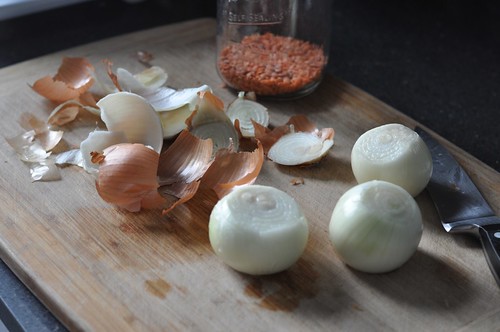
As I saute onions, I think about writing. Between stirs, I jot down observations, ideas, bits of conversation. This isn't trance-like writing, the kind where I forget myself, the writing that is pure inspiration, a gift from my muse. Honestly, I'm embarrassed to share the stuff written in my notebooks because it's just one word awkwardly placed next to another, messily written and food-splattered as I keep the lentils from burning on the stove.
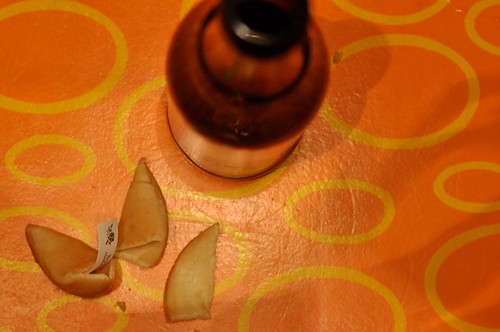 |
| You will have an opportunity. |
After dinner, we finish off the fortune cookies. Mine holds what I know, but need to be reminded of, that there is time, that somewhere in the swirling daily roil are moments to be discovered and claimed. I don't need a room of my own; I have a notebook and pen. Life doesn't need to stop, but can continue around me, like a rock in the middle of a river engorged with snow melt.
And then, in the middle of this paragraph, what happens? I'm interrupted by my children who want, demand, desire, need me, and my thought, my sentence are forgotten as I'm carried off in the swift current. I resent them. I resent Marcel. I think life is grinding me down like the rock eroding under rushing water.
Later still, the house is quiet. I've paged through Erdrich's books and found my life preserver, someone who loved their family and survived it. "Women writers ... must often hold their mates and families at arm's length or be devoured," Erdrich writes. "We learn how to conserve our energy, buy time, bargain for the hours we need."
Buoyed, I return to the computer and pick up where I left off.
 |
| Dinner. |
Spiced Red Lentil Dal
Adapted from The New York Times, January 4, 2010
Serves 4
2 tablespoons peanut oil (I used olive)
1 large onion, chopped
1 cup dried red lentils, picked over and washed
2 tablespoons minced fresh ginger
1 tablespoon garlic
1 tablespoon mustard seeds
2 cloves
1 teaspoon black pepper
Salt
2 tablespoons cold butter (optional)
Chopped fresh cilantro for garnish (I also added plain yogurt and caramelized onions)
Heat oil in a skillet over medium high heat; when it's hot, add onion and cook until it begins to soften. Add ginger, garlic and cloves and saute for a few more minutes. Set aside.
Meanwhile, put the lentils in a soup pot, cover them with an inch of water and bring to a boil. Adjust heat so mixture bubbles gently and cook, stirring occasionally and adding water if needed, until lentils are tender, 15 to 20 minutes. Add the onion, garlic and ginger, salt, pepper. Pour a little more oil in the skillet and cook the mustard seeds until they begin to pop. Add them to the dal, too and keep cooking until desired tenderness. Lentils should be saucy, not soupy.
Remove cloves. (I couldn't find them.) Stir in butter. Taste and adjust seasoning, then garnish with cilantro, yogurt and caramelized onions. Serve.






 Posts
Posts

