Tuesday, December 16, 2008

Hot heads

Bento art courtesy of Sakurako Kitsa.


One of my sons was feeling puny.

"I don't think I should go to school," he said.

"Hmmm," I replied. "How about you get dressed and eat some breakfast, and then we'll see how you feel."

In between spoonfuls of cereal he took his temperature four times; the last one read 102-degrees. He thrust the digital display in my face and announced he had a fever.

"Hmmm," I said, and pointed out that each time a different number came up. "You're going to have to go to school."

His response was five minutes of wailing -- the last three from his bedroom -- and then a return to the kitchen and a request that I take his temperature. I held the thermometer to his temple and after the requisite number of beeps it displayed 101-degrees.

"I'm sick," he said, beaming.

"Hmmm," I said, digging around in the medicine box and unearthing another thermometer. "Let's try this one."

The suggestion triggered more howls, but (with protest) he opened his mouth and I slipped the thermometer under his tongue. More waiting, more beeps and then a reading of 99.4.

"Again," he pleaded.

98.9.

"Let's try the other one."

99.6.

"One more time."

99.2.

"You changed it!" he shouted. "You promised I could stay home and now you changed the thermometer so it's different!"

He screamed and stomped. I snapped lids and slammed cupboards.

"Enough!" I roared. "You're going to school because I don't want you to stay home! We've taken your temperature ten-fucking-times and you're not sick! Now get your jacket on!"

Ten minutes later I pulled up to school and he hopped out, face wiped free of tears. As he headed for the playground, he turned and blew me a kiss. I sent one back and hollered that if he felt crummy to go the nurse and she could take his temperature.

Wednesday, December 10, 2008

Guaranteed

Photo courtesy of Ana oMeLeTe

Catching a cold is one of the few things I can count on during the month of December. So while I sit on the couch with my cup of lemon-honey tea and box of tissue, I'm sending you elsewhere.

To chuckle: If You Give the Federal Government $700 Billion is a delightful parody of that insipid mouse-and-cookie book.

To change your habits: Polar bears aren't the only ones feeling climate change according to the National Arbor Day Foundation's
New Garden Zone Map.

To chuck your Christmas cookie-making plans: The sweets in the comic strip Questionable Content are loaded with more than just chocolate chips.

To challenge President-Elect Obama to appoint a secretary of agriculture who will address our nation's nutritional and environmental deficits, aka corn consumption, sign the petition sponsored by Food Democracy Now.

Friday, December 5, 2008

Kaleidoscope

Photo courtesy of Travels in Italy.

One of the things that first enchanted me about my husband was his foreignness. When I met him he was a wild-haired art major who had transferred to a university filled with tobacco-chewing cowboys. While dating we shared a joint filled with sweat-soaked marijuana that he had hidden in his shoe on a return flight from Amsterdam. And when we married he taught me how to say "I love you" in throat-scraping Dutch.

Our only daughter embodies not just our love for each other, but also our love of Holland, where she was conceived. We fill her with stories of a past she can't remember: How as a tiny seed inside of me, she made me so sick I puked into the Prinsengracht. How she grew and I became so heavy and awkward that I fell off the back of a bike while riding sidesaddle.

And although we live a world away from Amsterdam now, we help her create her own Dutch moments. Sometimes they are planned, like tonight's coming of Sinterklaas. Other's are serendipitous, split second shifts in reality and suddenly The Netherlands is in Nevada. Below my husband tells of one moment this morning when his daughter -- with eyes the color of the North Sea and hair as warm as a rare puddle of Dutch sunshine -- overslept.

I was going to walk her to school because she had an early choir practice at 8 a.m. I look at the clock at 7:25 and realize I haven't seen her around downstairs. I go up and sure enough she's still out cold. So I wake her up and she rushes through breakfast and chores. But it's two minutes to eight by the time we get going. She gets mad when she realizes I'm taking my bike (which usually means a 10-minute walk to school), because she was hoping we'd take the car so she wouldn't be too late. So I say, "C'mon, hop on," and get on my bike. She's hesitant at first, but she sits sidesaddle on the rack and we make it to school in record time.

Ik voelde me weer echt Hollands. Een leuk moment.

This time, my husband reassured me, she didn't fall off.

Thursday, December 4, 2008

A winter's tale or how I fell in love

The results of a pogonip, or "ice fog." Photo courtesy of English-Word Information.

It was way past midnight and a thick, cold fog encircled us. Perhaps it was our first date or maybe our second, I can't remember now. What I can recall is the warmth of his hand through my glove as we walked down the street, and how ice crystals sparkled under streetlights. I breathed in the sharp air.

"We're in a pogonip," I said as clouds of my warm, moist breath froze in his mustache. He chewed a crystal and I laughed.

"Pogonip," he said, repeating the Indian word for ice fog, shaping lip and tongue around unfamiliar letters, owning them, owning me.

For more winter tales, go to Sunday Scribblings.

Wednesday, December 3, 2008

Seasonal SNAFU*

Illustration by Richard Scarry. Image courtesy of Mykl Roventine.

"Does this mean we'll only get two Christmas presents?" one son asked.

The family was sitting at the kitchen table, discussing ways to shift the focus away from the glorious pile of presents under the tree to a season of giving. Already, our children had agreed to choose from their own toys and books an item or two to give to a child who will not receive much, if anything, on Christmas morning. But now things were getting dicier: We wanted our kids to each pick a nonprofit group so that friends and family had a choice of giving a donation in lieu of a gift.

"Does this mean we'll only get two Christmas presents?" he asked again.

"I don't know if people will do this or not," I said.

Banking on Santa always pulling through, the kids made their selections and a family letter explaining our effort to chip away at the commercialization of Christmas was sent. Story finished, right? Hah! Our invitation to help shrink this season of excess was read by some as offensive and judgmental. Why, family asked, were we telling others how to give?

My first reaction was disbelief that we were being criticized for trying to teach our children charity and moderation. Then anger: Fuck you and fuck Christmas! I thought. I poured myself a glass of wine, grabbed a chunk of fudge, and hid in a bubble bath until the Buddha found me. Or, more accurately, words from "Buddhism for Mothers," by Sarah Napthali.

"Anger in fact paves the way for future difficulties. For starters, it's not good for our karma: every time we act angrily we increase the chance we'll act angrily again, conditioning ourselves to become belligerent."

I got out of the tub, dumped the wine down the sink and chocolate in the trash. The phone rang. It was one of my sisters, and I as shared my story, she shared what she was learning from the classic self-help book "How to Win Friends and Influence People" by Dale Carnegie: That I had everything to gain from saying sorry, from seeing how our letter had hurt feelings, generated stress and forced others to defend themselves.

"Never begin by announcing 'I am going to prove so-and-so to you.' That's bad. That's tantamount to saying: 'I'm smarter than you are. I'm going to tell you a thing or two and make you change your mind,'" Carnegie wrote.

"Tomorrow, before asking anyone to put out a fire or buy your product or contribute to your favorite charity, why not pause and close your eyes and try to think the whole thing through from another person's point of view? Ask yourself: 'Why should he or she want to do it?' True, this will take time, but it will avoid making enemies and will get better results..."

I needed to say sorry -- not for trying to make do with less at Christmas (which I believe to be a worthwhile goal) -- but for our insistent invitation that others join us. So, still feeling bruised, I called and apologized.

"When you feel hurt but do not hurt the other, you are truly victorious," Buddha said.

And for the night, the true spirit of Christmas triumphed.

*Definition found here.

Wednesday, November 26, 2008

Corn people

Photo courtesy of boopsie.daisy. Photographer's work is available for sale at Etsy.


I've been gobbling up Michael Pollan's "The Omnivore's Dilemma: A Natural History of Four Meals," but thought I'd take a break from my reading binge and share why I'm grateful for this good read.

The book begins by examining the conquest of corn and industrialization of the food chain. Pollan argues that we are walking, talking stalks of corn -- or more precisely, processed corn. How's this possible? Apparently, corn is incognito: It's in the syrup that sweetens soda and the wax that coats our apples. Corn feeds the steer, the chicken, the pig, the turkey, and even salmon.

How do scientists know we are "corn chips with legs," as one biologist put it? There's an isotope in corn that allows it to be tracked within our human tissue, much the same way scientists can determine the ancient diet of mummies using a piece of fingernail. But is the triumph of corn so terrible? Pollan believes it's to blame for America's growing waistline and our sickening environment.

A quarter century of government farm policies has encouraged the overproduction of this crop, and the industrialized food chain has made processed foods the cheapest in the supermarket. Corn-made calories can find our way into our bodies as a sugar, a starch or as a form of animal fat. "Very simply, we subsidize high-fructose corn syrup in this country, but not carrots," Pollan writes.

Growing only corn has ruined the farmer's soil, the quality of local water, the biodiversity of the Midwest, and the health of all the creatures living downstream. Cheap corn created the feedlot, where steer are fattened up before slaughter. Surviving on corn diets, many suffer from bloat and develop ulcerated livers.

Given such sobering news, I'm going to propose a game of hide and seek. Spend a little time searching for the corn in the products you eat and use. Involve your kids, keep a running tally, write down the ones that really surprise you, and, finally, share what you've discovered. Click here for a printable list of corn aliases, courtesy of Corn Allergens.

"There are some forty-five thousand items in the average American supermarket and more than a quarter of them now contain corn," Pollan writes. "This goes for the nonfood items as well -- everything from the toothpaste and cosmetics to the disposable diapers, trash gas, cleansers, charcoal briquettes, matches, and batteries, right down to the shine on the cover of the magazine that catches your eye by the checkout: corn."

The hunt is on!

Tuesday, November 18, 2008

A stranger in the neighborhood

Photo courtesy of meaduva.

Something streaks across the driveway. My eye catches a fleeting image of a man, a naked man, rounding the corner of my house and heading into the backyard. In the kitchen I freeze. Adrenaline races. Brain screams. Oh, God! I'm alone! The door is unlocked!

I crouch down and dart for the door, turn the lock, and skitter into the hallway where there are no windows. I grab the phone and dial.

"911. What is your emergency?"

"There's a naked man in my yard."

"What?"

"There's a naked man in my yard!"

"Do you know him?"

"No! No! He's naked!"

The dispatcher tells me police are coming. She asks me if I can still see him. I slip to a window. Peek out. He's there, in the corner, peering over the fence. He's got something red wrapped around him. He moves toward the house. I duck.

"He's coming closer to the house!"

The dispatcher keeps me on the line until I see a cop walk across my lawn and another slip around the back of the house. Minutes pass. I peer out a window and see police with a man, shirtless, wearing jeans, no shoes. There's a knock at the door.

"Is this the man you saw in your yard?"

"I think so, but he was naked."

"Well, he's wearing pants now."

"Wait! I had some clothes on the line. Let me see if they're still there."

In the backyard I can't find the jeans my sister loaned me. I am four months pregnant and have outgrown my clothes, so she was sharing her maternity pants, the kind with the elastic panel that replaces zipper and button. I tell the cop the pants are mine. He tells me to wait.

Inside, I pace. My heart quiets. I take deep breaths.

The cop returns and tells me a story. Apparently, the man and the high-school girl next door had been fooling around when the girl's father came home and discovered them in bed. The father started beating up the guy and so he fled, naked, into my yard.

"I've had plenty of calls for people running naked in public, but this is the first time it actually made sense," the officer said.

Did I want to press charges? I laugh and shake my head no. The jeans are returned, but I never wear them again.

Epilogue

Late this summer I spotted the girl in her own pair of maternity pants. She walked slowly down the street, heavy with the burden she carried. Holding her hand was a man. I didn't recognize him, but then again, he was wearing clothes.


Prompted by Sunday Scribblings' topic "stranger."

Friday, November 14, 2008

Anniversaries

Photo courtesy of *PaysImaginaire*

My youngest son and I have reached milestones.

Last November, he slipped into this world, the youngest of four, the final child, our grub. A year has brought metamorphosis: The squishy and portable baby has become an squawking, walking boy. About the same time our last larvae was born, I began blogging regularly, turning thoughts into words, sometimes poetically, sometimes awkwardly, but writing, all the same. This commitment has been a major accomplishment for I am as proud of my 69 posts as I am of my four children.

What does this second year bring for the two of us? For my son, I know it will bring an explosion of communication, and the deciphering and decoding of those first words will delight and confound us. (Curious about my own vocabulary, I entered my blog into Wordle, an online toy that created a word cloud out of my paragraphs, giving greater prominence to those words I use most frequently.) So, what does the new year hold for me? An exploration of fiction, a return to freelancing, and a continued commitment to this blog and to those who read it. Thank you for your interest, encouragement and love.

Tonight, my son and I celebrate our accomplishments by eating cake. And because we should all celebrate and eat cake more often than we do, I hope you raise a fork wherever you are on this earth and join us. Huzzah!

Monday, November 3, 2008

The perfect cup of cocoa

Photo courtesy of chatirygirl.

I have sipped my way to hot chocolate heaven and found the perfect steaming mug. During this quest I have sampled many a cup, and taken many a detour into foreign recipes that had me mixing egg into the chocolate milk, adding dollops of dulce de leche, creating instant mixes, and whirring scalding concoctions in my blender. And in the end I found it, a recipe that achieves the perfect balance of chocolate and sugar, and it's so damn easy you'll want to kiss me.

Pour some milk in a pot. Toss in a few handfuls of chocolate chips, more if you want a richer chocolate taste. Heat. When the chocolate begins to melt, whisk until your happy with the results.

While I may have found my perfect cup, I urge you to get a little cocoa crazy and try out some of the drinks I sampled in my mug madness. Recipes can be found at Rediscover Hot Chocolate. If you find one that's particularly delightful, please share it!

Wednesday, October 29, 2008

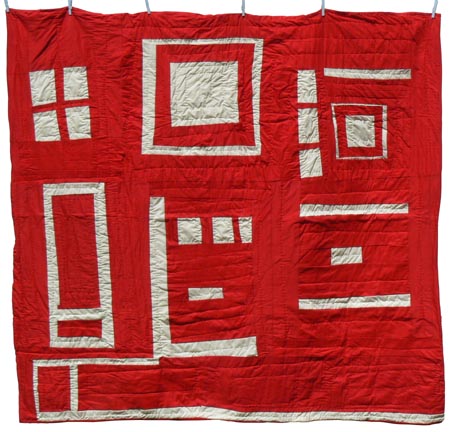
A house, divided

An abstract version of the "house" quilt pattern, circa 1950s or '60s.
This quilt and others can be found at Folk Artisans.

Really, the yard signs tell the story.

There, among the fading petunias, were the plastic signs in navy and white, their respectful, conservative white lettering spelling out support for the Republican ticket. And in between them, looming over them, was a piece of plywood three times as large, and sprayed on the front in florescent pink were the words "Nader/Gonzalez."

"Don't expect to see that sign still standing when you come home tonight, boy!" the father said.

The young man only shrugged, and left his father standing in the drive way. In the past few years the man had turned old, strong still, but now old. His beard and head were filled with gray, and he spent many warm autumn afternoons sitting in a plastic lawn chair watching the traffic head home. He'd raise one hand in recognition of a neighbor's car, while the other rested on his belly, balanced between his thighs, suspenders slung over broad bare shoulders.

When I first moved onto H Street, the father mowed his postage stamp yard shirtless, sitting atop one of those riding lawn mowers. When he was done, he'd climb into his semi-truck and ease it around the block while checking out the neighbors' yards. But as his shoulders stooped and his son's broadened, the boy took over the lawn care, and the neighborhood inspections came less frequently.

His McCain signs were the first to go up on the street, divided -- almost house by house -- over the country's political future. The neighborhood has been written up in the International Herald Tribune. The city's been spotlighted on National Public Radio. Pundits say that who wins the county, wins the country. And while he could wave and smile to the Obama supporter, his son's homemade sign -- now dominating the yard -- mocked him.

"It's been World War III around here," his wife told me one evening as we chatted in the street.

Fists banged the table. Accusations flew. Someone threatened to put an Obama sign in the yard as well.

"Everyone's entitled to their own opinions," the mother said, taking a long drag on her cigarette. "First Amendment, you know. But me? I'm like Switzerland. I'm staying neutral. My vote is gonna remain private."

The young man stomped off to work. The old man stomped off to get another McCain sign. And that evening and the many since, the sun's orange rays glowed on both plywood and plastic.

Wednesday, October 22, 2008

Coloring a cold

Photo courtesy of Stryker w@sp

A nasty head cold, a persistent cough and a rollicking stomach bug are making their way through the family this week. This tiny poem came out of committee.

Sharp pencil hits floor.
Baby grabs. Mom squawks, "No! No!"
Mom grabs. Baby squawks.

Thursday, October 16, 2008

Wednesday, October 15, 2008

My skin or my soul

Photo courtesy of amazonactivist.

Shelly followed me around the playground, not close enough for anyone to imagine we were friends, but behind me like some mangy, maggot-eating dog with its tail between its legs, and behind her came a cloud of stink, the smell of old, stale dirt melted with sweat to form a crust over the skin. The other kids were beginning to notice.

"Why's she following you?"

"Who?"

"Shelly. Are you friends?"

And the word was spit out like dirt. For even here, where everyone lived in trailers and most backyards included a junk car, there was a pecking order among us children, a ranking built on insults and exclusions, and at the bottom of the hierarchy was Shelly. She was the fifth-grade version of the thick, polluted froth found along the seashore. She was the brown foam of fat that collected at the edges of a boiling soup pot. She was scum.

And I was her secret ... something -- not friend, though. I felt sorry for her, sorry that she lived in a dirty family with dirty brothers who ate their boogers. I felt sorry for her when I saw her mother, whose skin was gray-brown as the cigarette smoke that hovered around her, and who smelled like B.O, sorry that she had a mother who bought cigarettes instead of soap for her children, lots of smooth, white, clean bars of soap to wash dirt out of matted hair and grime out of clothes. I felt sorry for Shelly, but I didn't like her.

She was surly and sour, stomping on the bus every morning and throwing herself into an empty seat where she'd stare out the window. She had dirt on her neck and knees, her arms, her face, everywhere. I wanted to take a fingernail and scrape the skin, erasing the dirt and leaving a white streak on her arm and crud under my own nail. Her stink settled around her and kids held their noses and moved. Some gagged and choked. Shelly scowled, eyes narrowed to slits and teeth bared, yellow and fuzzy for lack of a toothbrush.

"You have to be kind to her," Mom said, "like Jesus loved the poor and outcast."

I wrinkled my nose and breathed into my jacket for the rest of the bus ride, but I didn't change seats.

I'd been secretly writing notes to Shelly for a little while now, letters penciled, then folded and slipped to my teacher, who slipped them to Shelly. The teacher had approached my mom and me with the idea after her own efforts to share soap and clothing went unused. Maybe, she said, another child would have more success with this angry, filthy girl.

Shelly's only friend was a tape deck and a stack of Beatles tapes. She'd cradle the tape deck against her ear and listen to it on the bus. She listened to it on the playground as she walked the perimeter. But the music that warbled from the small microphone was an insult to the headbangers, ready to pound and pump head and fist for AC/DC. And so when she walked near some boys, one -- David, skinny and round shouldered, face coming to a nosy point like a rat's -- stuck out a leg and tripped her.

She sprawled into the gravel, tape deck bouncing out of her hand, popping open, tape flying. She jumped up, snarling, smarting, palms scraped and bleeding, blinking away tears. David tossed his sheet of hair out of his eyes and laughed.

"Leave her alone," I said.

"Shut up, scum-bag. She's scum, and her music's scum, and you're scum, too."

He kicked at the cassette-recorder, sending small rocks and dirt flying, and spit. Shoulders hunched, he walked away. But David remembered. Shelly remembered. And as kids began to avoid me, Shelly slunk closer, shadowing me during recess, shuffling behind me, not looking, not talking, but there all the same. My fall within the school hierarchy was clean and quick as a knife cut.

I had never been popular, but I had a true friend, a best friend I thought would shield me against the pecking order, but instead she stood back and let me bleed. First, she avoided me at lunch, then at recess, too. I phoned her after school one day to ask why, and she said kids were calling me scum.

"Do you want one friend that loves you, or a lot of friends who just like you?" I asked her.

"I want to have a lot of friends."

I hung up the phone and cried.

Most of the kids in the school were poor, and many of us ate meals bought with Food Stamps. I wasn't scum, I was clean, took a bath, used soap. But now, like Shelly, I was alone -- she with the Beatles and I with my books.
I burrowed into books in order to forget I had no one to talk to. I carried them on the bus, took them on the playground, hid them in my desk. This was my routine until a new girl arrived and chose me as her friend. Once again, I had someone to share lunch with and talk with during recess, and, once again, I was being shadowed.

"Why's she following you?"

"Who?"

"Her. Are you friends?"

I turned and looked at Shelly, stared at her dirty clothes and tangled hair and her cloud of stink, and then spoke to her for the first and last time.

"Go away!" I said. "Stop following me. I'm not your friend."

Blog Action Day is an annual nonprofit event that aims to unite the world’s bloggers, podcasters and videocasters, to post about the same issue on the same day. It aims to raise awareness and trigger a global discussion. Global issues like poverty are extremely complex. There is no simple, clear answer. By asking thousands of different people to give their viewpoints and opinions, Blog Action Day creates an extraordinary lens through which to view these issues. Each blogger brings their own perspective and ideas. Each blogger posts relating to their own blog topic. And each blogger engages their audience differently. For others, click here.


Tuesday, October 14, 2008

Time warp

Photo courtesy of jared.

If I could live at a different time in history, I would choose to watch the universe give birth to itself. I would like to see stars explode, spewing hot gases and dust into a dark, cold space. I would like to watch great swirling clouds of gases cool and glom and wring themselves of water. I would like to see particles of dust congeal into solid ground that I would one day stand upon, and I would like to be blinded by the shafts of light and warmth from the first rays of our sun.

Particles of stardust reside in my body, in my children's body, and in yours. In our dark flesh, we carry the glitter and gas that marked the dawn of time, when the universe heaved and shook with infinite possibility.

To read other people's choices for living in a different historical time, check out Sunday Scribblings.

Thursday, October 9, 2008

Forbidden

Photo courtesy of mywoods.


Buried deep under her blankets, Connie woke to whooping and hollering from her little brother, who was clomping down the hall in boots, pajamas sticking out from the end of his snow pants.

"Connie! Get up! Get up! It snowed!"

Jason tugged at the blankets, and Connie poked her head out. Snow! She jumped up and scratched at the frost on the window until she could see outside. The snow was deep enough to cover sagebrush and clumps of cheatgrass, turning the desert into a giant version of Connie's own lumpy bed. With snow this deep, she knew the bus wouldn't make it down the long dirt road and school would be canceled.

It didn't take long for Connie to join Jason on the hill, really just a bump no bigger than the family's Honda Civic, but steep enough to ride a sled onto the alkali flat. When they got tired of sledding, they took turns pulling each other across the hard-pan until the sled tipped Jason into a tumbleweed. When Connie tried to help him up, he screamed that she had done it on purpose and began chasing her across the desert with part of the sticker bush until he gave up and went inside.

Connie slipped around the side of the trailer and in through the back door, and called her best friend, Michelle. They liked to say they lived on the same street, and they did, technically. Connie lived at one end of Shadow Lane and Michelle lived at the other, and between their homes were four miles of washboard road, two stop signs and one abandoned sheepherder's shack. Nothing else. Besides sharing a street, they both had annoying little brothers, they both were skinny, and neither had started growing breasts like some of the girls in fifth grade. Michelle's mom had given her a training bra, which Michelle used to sling pebble-sized jackrabbit turds at her brother.

Holding the phone to her ear, Connie stretched its cord down the hall and into the kitchen where her mom was pulling stickers out of Jason's forehead.

"Mom, Michelle invited me over. Can I go?" Connie asked.

"Only if you take your brother, and only if you walk," her mom said. "Dad had to take the truck because of the snow, and I'm not driving the Honda on these roads."

Jason grinned and Connie glared.

"Did you hear that, Michelle? I can go! But you better find your slingshot, because my brother has to come."

The whole walk there, Jason complained. By the end of the first mile, he had pulled off his hat and gloves, and by the second mile, Connie was carrying his coat. When they reached mile three (the sheepherder's shack), the snow on the road was beginning to melt.

"Come on, Jason! If the snow melts, we can't go sledding."

She yanked on his arm and squinted. Sunlight bounced off the snow, bright and sharp as diamonds, stinging her eyes and making them water. Far off she could see the second stop sign, which meant Michelle's home was close. Unlike Connie, Michelle lived in a real house, not a trailer, a two-story house nestled in hills that flattened into fields of alfalfa. From Michelle's house they could walk to a ditch, choked by tule and cattails, and follow that finger of blue through the fields and into the cottonwood trees that lined the Carson River until it dumped into the Lahontan Reservoir.

But now bare tree and dry tule were cloaked in snow. The four children sledded until the boys complained of the cold and went inside, leaving the girls to follow the tracks of rabbit and quail down to the frozen ditch. A small bird pecked at cattail fluff. Connie stepped onto the ice and feathery cracks spread under her feet. Michelle snapped off a column of tule and its dry husk released a small cloud of dust. She held it in her fingers like a cigarette.

"Do you think you could smoke a tule?" Connie asked.

Michelle shrugged. "It looks like a cigarette," she said.

"Let's try."

They smiled at each other. Michelle ran back to the house for matches. Connie walked further out into ice and cattail, looking for tule as thin and round as cigarettes. The tall dry stalks folded and bent creating small chairs and couches to sit on, and that's where Michelle found her.

Connie shook the tule free of snow and Michelle held the match to one end. It smoldered, embers glowing and then fading out.

"You have to hold it up to your mouth," Michelle said. "That's what my grandma does. When she lights it, she breathes in."

A second match. Connie took a deep breath and exhaled through the tule, blowing ash and dust at Michelle. They threw themselves back into the tule and snow and hooted.

"Noooo! Breathe in, not out. Here, let me try," Michelle said.

She put the end of the tule in her mouth, took a big puff as the match was lit, and spit out dust. Coughing and laughing she tossed the tule onto the ice.

"This is dumb," she said.

The girls lay on their backs in the snow and looked up at the sun, at birds darting overhead, at the dusty snake of smoke from the house slithering across the sky.

"Wanna try and kiss?" Connie asked.

"Okay."

"Just for practice. So when a boy wants to, we know what to do," she said.

"Okay."

They rolled over so their faces were inches apart.

"You have to close your eyes," Connie said.

They inched closer and bumped noses, red and a little runny from the cold.

"Ouch!"

"I think we have to tilt our heads a little so our noses won't bump," Michelle said.

Lips puckered, pressed, parted.

"Eeeew!"

"That's what you're supposed to do!" Connie said, giggling.

"That's gross. I'm never going to kiss a boy."

They rolled away from each other, and stood up, eyes searching for something to settle on, something other than each other. They locked onto their brothers making angels in front of the house, and headed back through melting snow and scabby patches of desert.

Prompted by
Sunday Scribblings' challenge to write about something forbidden.

Wednesday, October 1, 2008

A wedding

Photo courtesy of WTL photos.

Ellie couldn't get married in her father's church. Not the Father, just her father, God's enforcer of commandments, confession and communion, said it couldn't be done. Never mind that six months earlier her uncle, married 40 years, paid a priest to annul his marriage in order to remarry. Never mind that his six adult children, now all bastards in the eyes of the Pope, weren't there to watch him stand at the altar with a wafer of Christ stuck to the roof of his mouth and kiss his wrinkled bride. No, her dad said, no matter what the state said, in the eyes of God, Frank was still married, and therefore couldn't marry Ellie in the family church with his two small sons as witnesses.

Ellie's dad had built the church right next to her grandfather's mobile home and just 50 feet from her own family's double wide. It was a squat building with a steeple that cast a long, wavy shadow across a desert ruled by dust devils, fierce, erratic winds that tore at their trailer's tin siding, and blew sand through the window cracks so that Ellie woke in the morning with grit in her teeth.

But once when she was nine she woke to a miracle of angels' wings, of a wind that carried sand from the four corners of the desert and built a mountain in her yard. She ran outside in her nightgown and joined her brothers and sisters climbing the slope, bare feet sunk deep into the mountain's soft sides until, breathless and hot, she reached the top where she was high enough to see over the roof of the family's trailer.

Eventually the mountain melted into hill, then puddle, and finally was nothing but a shovelful of sand that her father mixed with cement to form the foundation of the church. Figuring that the mountain was a sign from God, the church was built on the same spot. They filled it with statues of the Virgin Mary, hung a crucifix of Christ writhing in agony upon the cross, and hired a retired priest to come out once a month and mumble a service in Latin.

Ellie loved the church. She loved the black lace she pinned to her hair, loved the narrow, creaking stairs to the loft where she and her sisters, and sometimes an aunt and cousins from Carson City, sang Ave Marias and Kýrie, eléisons, their clear, high notes disturbing the fine sand blown in by the wind so that music and dust floated down onto the bowed heads of the (forgiven!) sinners. But she wouldn't be married there. Instead, she was getting married at the Senior Center, built a few months ago but already smelling of old people. She had risen early and driven over to the center to air it out.

She opened the door and wrinkled her nose at the smell of fish sticks and peppermint and urine. Quickly, she walked past tables and folding chairs that had been set up the night before, past the D.J.'s equipment, and the long table where the wedding party would sit and face the guests. As she went, she opened windows to let the wind in, the sand in.

She inhaled the hot air, sweetened by sage and tumbleweed, and stopped at the card table where the wedding cake would sit. She lifted the heavy silver knife that she and Frank would use to cut the cake. Frank and his boys. The three had to sample every cake in the bakery before settling on spice. Spice cake with cream cheese frosting, she had won that round at least. She locked the door and headed home to get ready for the wedding.

The ceremony was over in 10 minutes. Ellie had spent the whole time trying to remember the name of the man marrying them. Frank had introduced her a week earlier, told her who he was, but now as she stared at his red nose and cowboy shirt, smelling whiskey, she missed her cue, and Frank had to squeeze her hand to prompt her. "Oh!" she cried. "I do." And the guests laughed and the county commissioner? Judge? Bartender? laughed too. And she smiled up at her husband as he bent down and kissed her.

Friends filed past her and Frank and the boys, a family now. When her new sons grew tired of the compliments and handshakes, they joined the other children sliding across the dance floor in their socks, amusing the women who tapped their feet in time to the music and eyed their men, who were tipping back their chairs, tipping back their beer bottles. Ellie danced, with Frank, with her father, with her sons, holding their small hands and dancing in a circle, her dress swirling about their feet, tripping them so they fell in a fit of giggles to the floor.

And then it was time, the D.J. said, to make a toast and cut the cake. Children squeezed through the crowd to get to the front of the cake table. Couples who had slipped out in search of dark corners of the desert and soft sand to push their bodies into wandered back inside. Frank and Ellie wrapped their fingers around the knife and cut the cake.

"Should she be nice, folks?" the D.J. asked as Ellie tossed back her head and laughed, smooshing the cake into Frank's face.

Frank didn't wait for the D.J.'s prompts. He took his own piece and pushed it into Ellie's face, her head snapped back, she stumbled and was caught by her dad. Smiles. Glasses. Eyes. Laughter. All froze. Ellie's father pushed her behind him and turned back to Frank.

"Touch my daughter like that again and you'll regret it."

"Oh, Dad. It was my fault. I did it first."

Ellie moved past him, reaching for napkins to wipe away the frosting, praying she could erase the angry look on her husband's face, praying for the wind to bury her in sand.

In response to Sunday Scribblings' writing prompt: Weddings.

Tuesday, September 30, 2008

Hoops and hoppers

Because I recently shared my memories of gold earrings and small frogs, I thought I'd include their references in Luis Alberto Urrea's "The Hummingbird's Daughter." The first involves Huila, the medicine woman, and Teresita, the Hummingbird's daughter.

"Huila told Teresita to peirce her hears. Teresita was thrilled that Huila was interested in making her pretty. But Huila didn't care if she was pretty or not. Huila told her: 'You must pierce your ears to show God you are no longer deaf. You have not only been blind, but deaf. Punch holes in your ears to show God they are open, and you are ready to listen. God doesn't care if you think you're pretty!' But she gave her two beautiful gold hoops to wear once she had done the ritual."

Here is the reference to toads:

"In the summer, the rains came, and the magical event of toads bursting from the ground followed: toads started to shoot up from the soil, blinking their happy yellow eyes, excited by the first drumming of rain. Wildflowers were sure to follow. First toads, then flowers."

Monday, September 29, 2008

Still life

Henri Matisse (French, 1869–1954). Woman Before an Aquarium, 1921–1923.

I think I'm pretty good at painting a vignette with words. I can set a mood, sketch a character, but try and make that portrait come to life and my brain bogs down, its wheels sink into sand and spin, spin, spin in place. I'm stuck, and I'm stuck good. All that journalistic training to act as the impartial observer has me creating still lifes instead of stories.

Right now I'm thinking about the passionate woman I created a few months ago, and her terrible streak of bad luck. What's she going to do about this curse? I ask myself in the shower as I shampoo my hair. I ask as I pour my first steaming mug of coffee and sweeten it with cream. What's she going to do? Do. Do. Do. Do. The word thuds in my head as I walk home from the kids' school. It slaps against my skull as my sneakers hit the sidewalk, beats out a rhythm, a tribal calling to circle the fire and listen to a tale.

But what is my story?

Friday, September 26, 2008

Muscle memory

Photo from Duke University Archives, courtesy of Duke Yearlook.


Twyla Tharp, one of America's greatest choreographers, offers real justification for copying another's words, brush strokes or dance movements. "Traveling the paths of greatness, even in someone else's footprints, is a vital means to acquiring skill," she writes in "The Creative Habit: Learn it and use it for life."

She calls it "muscle memory," a skill learned through practice and repetition, which becomes embedded in our physical bodies and can be called upon decades later. It's what allows the dancer and the musician to perform pieces that they haven't thought about in years. It's what allows any of us to hop on a bike and pedal away, even if we haven't ridden one since childhood.

But how can muscle memory -- the calling upon of an automatic, unconscious skill -- be of use to the writer? Tharp argues that typing someone else's words forces the writer to pause and study the craft, and points to Raymond Chandler as an example. Chandler considered Hemingway the greatest American novelist of his time, and so wrote imitations of Hemingway's style to absorb what he loved about it.

"In this case, the exercise is less about muscle and more about perceiving structures and harmonies anew -- from the vantage point of the author rather than the reader," Tharp writes. "If there's a lesson here it's: get busy copying."

Wednesday, September 24, 2008

Writer's envy


Sometimes a writer leaves me coveting their words, wishing to see the world through their eyes so I may own their descriptions and phrases. Fruitless thoughts, I know, but sometimes I'm so overcome with a yearning for ownership that I copy them into my notebook, hoping that by forcing my hand to write another's words it will fire different synapses in my own brain.

Lately, I've been filling pages of my Moleskin with passages from Luis Alberto Urrea, a 2005 Pulitzer Prize finalist. He's the latest author I admire for his magical realism, the fusion between physical and psychological reality that also defines the gritty, lyrical prose of Gabriel Garcia Marquez and whimsical storytelling of Laura Esquivel's "Like Water for Chocolate." The fact isn't lost on me that these three writers are Latino, and that their countries and cultures infused my own childhood. It was in Oxaca, Mexico that I tasted my first Twinkie (yum!) and had my first taste of exhibitionism (at school, curious brown-faced girls stood in the door of the bathroom stall to watch me peel of my black leotard and bare my tiny white ass to pee). I was 5, and reality was magical: Rain-soaked roads bounced and bubbled to life with small frogs, and loops of red thread dangling from my earlobes (recently pierced with a sewing needle) promised to one day turn to gold.

Here is some magic from "The Hummingbird's Daughter." Enjoy!

Tomas rode his wicked black stallion through the frosting of starlight that turned his ranch blue and pale gray, as if powdered sugar had blown off the sky and sifted over the mangoes and mesquites.

But I like this, too:

"What are you eating?" she asked.


"Cherries."

"Cherries? What are cherries?"

He held one up. In the faint fire glow, it looked like a small heart full of blood.


And this:

As the light poured out of the eastern sea and splashed into windows from coast to coast, Mexicans rose and went into their million kitchens and cooking fires to pour their first rations of coffee. A tidal wave of coffee rushed west from the land, rising and falling from kitchen to fire ring to cave to ramada. Some drank coffee from thick glasses. Some sipped it from colorful gourds, rough clay pots that dissolved as they drank, cones of banana leaf. Cafe negro. Cafe with canela. Cafe with goat's milk. Cafe with a golden-brown cone of piloncillo melting in it like a pyramid engulfed by a black flood. Tropical cafe with a dollop of sugarcane rum coiling in it like a hot snake. Bitter mountaintop cafe that thickened the blood. In Sinloa, cafe with boiled milk, its burned milk skin floating on top in a pale membrane that looked like the flesh of a peeled blister. The heavy-eyed stared into the round mirrors of their cups and regarded their own dark reflections.

Share your beautiful sentences, whether you own them or not.
Blog Widget by LinkWithin