Showing posts with label little neighborhood. Show all posts

Friday, February 26, 2010

Quotidian

Today I am lucky2
Minutes before our daily walk.

kwoh-tid-ee-uhn
adjective

  1. Occurring or returning daily
  2. Of an everyday character; ordinary; commonplace
*
It was a rainy morning meant for comfort, for rocking chairs and baths followed by menthol rubs. It was a morning for letting go, so that a mountain of clean clothes rose up from the couch, dirty dishes stacked like stalagmites in the sink, while chicken bones simmered on the stove.

It was an afternoon of sunshine, of snow melting, water running in rivulets down the driveway and into the gutter. The drip, drip, drip beckoned us outside, so despite runny nose and cough, we took off on our daily hike, a wander down city streets, some days here in the neighborhood, other days far from home.

The quotidian nature of the walk disappears with a 2-year-old on my back, and this sleepy suburb trembles with possibilities. Look! A dog barks frantically at the window. Smell! Fumes from a city bus whip around us. Listen! To the promise singing from the ice cream truck outside the school. To each exclamation, I murmur the appropriate response.

Then, I slip.

Boots slide through slush. Feet splay and throw me off balance. The twenty-five pounds on my back shifts too far to the left and I throw out my arms as snow, sidewalk and a pile of steaming, thawing dog shit come racing toward me. In a split second, I will fall or balance will be restored.

Then, our walk continues.

But like my son, I am certain: Today is not commonplace. Today is not routine. Today, I am lucky.

Wednesday, February 17, 2010

Priorities


He was late for school.

But he wasn't hurrying.

Mohawks can't be hurried.

Each strand of the boy's hair stood perfectly upright, creating a razor's edge. He looked to be about nine years old, and I had to wonder, was someone helping this little rooster with his comb or had he mastered the art of gel at a young age?

As he neared, I stopped studying him and glanced away. He was wearing one sneaker.

Just one.

On his other foot was a white tube sock. He carried nothing in his hands, no backpack slung over his shoulders. I wanted to ask, but what was there to say? Excuse me, you're missing a shoe. Sometimes my husband accuses me of stating the obvious as if it were profound, so I remained silent as I passed the boy.

Friday, October 23, 2009

We met in line at the fabric store

"DiscountFabrics" by scallywagsf.

He looked like a Vietnam vet, bald with a roll of fat at the back of his neck and a paunch. He was in the fabric store, alone with ten bolts of fleece in a riot of colors and motifs: giant watermelon slices, over-sized holly berries, polka dots, tie-dye, sunflowers, polar bears.

He took off his hat, a floppy fleece-y thing that bunched at the top, and showed it to the employee. It reminded me of something ... a head cozy, the blob of frosting on a cupcake ... I couldn't put my finger on it.

"I'll have 27 hats when my wife finishes these. One for almost every day of the month. My wife says I sweat a lot and the hats stink."

The employee cutting the fabric nodded. I smiled weakly.

"I have a pink one for Valentine's Day and an orange one that looks like a pumpkin for Halloween."

"Where will you wear the polka dots?" I asked.

"New Year's or my birthday."

"Or the circus," I suggested.

The employee slid the stack of cut fleece across the counter and he walked away. But we met again in the cashier's line, where he shared more about his hats: The wife sells them in Apple Hill; they're modeled after the old-fashioned ice bags.

"Of course!" I said.

And beamed at him for solving the niggling question of the hat's familiarity.
The ice bag has a new occupation.

Wednesday, October 14, 2009

Breakfast

"Woosh" courtesy of Rowan Atkinson.

It was morning and the hip hop blasting from the tan Buick's trunk was cheery as a bowl of sugar cereal:

Thump! Thump! Ka-Shhhh! Clink!
Thump! Thump! (Box on counter)
Ka-Shhhh!
(Milk poured)
Clink! (Spoon hits side of bowl)

The Buick yawned and the man reached deep into the trunk's recesses to futz with the woofers or something. Music shook the windows of the sleepy house next door and a yellow school bus turned onto the street. Leaves as crunchy and brown as Frosted Flakes danced in its wake.

Wednesday, July 8, 2009

Saving the farm

"MarketFallout" by bepop717.

My street bristles with signs -- a short sale, an estate sale and a foreclosure -- all in a row just east of my home. If this were Monopoly, you'd buy the set and put a hotel on the properties, but this ain't no game. Everyone on the block is watching these homes, checking out the prices on Zillow and wincing as our castles crumble. (My Zip Code area had the second-highest decline in value according to a Reno Gazette-Journal comparison between housing values in 2005 and 2009.) When I play make-believe, my monopoly isn't a row of rentals nor a hotel, but a little bit of suburban anarchy. I'd buy all three houses, raze the buildings, and expand my yard to include a flock of chickens and maybe a goat.

Photo courtesy of Pingu1963.

Wednesday, April 22, 2009

The bird lady, round 2

The sparrow hawk and its prey.
By Alexander Wilson and Charles Lucien Bonaparte, 1876


The bird lady was out in her driveway this morning with binoculars, searching the skies for a sparrow hawk. In her other hand she clutched a spray nozzle and planned to blast the bird with water if she could only find it. She'd been working in the yard when she spotted the hawk spotting the sparrows in her lilac bush, but before she could hook up the hose, it escaped. She was certain it was nearby.

"The damn thing is good at camouflaging and now I can't get anything done."

Friday, April 17, 2009

The keeper of the keys

Illustration from "Laurel's Kitchen"
by Laurel Robertson, Carol
Flinders and Bronwen Godfrey.


One February day I committed to making a weekly stone soup, a promise to feed my family and one other. My pledge was made in alarm over the number of people lining up in the neighborhood to receive free food each week. Since then, I've made seven pots of soup, sharing the recipes with you and sharing a second set of ingredients with the local food bank.

Between this week's bookends of warm days, it snowed and I made soup, a pea soup the same dusty green as the awakening apple tree and flavored with the ham bone from Easter. It was a deliciously thick with baby lima beans and chewy barley, and we ate it all before I could take a picture. As I thumbed through "Laurel's Kitchen" to pass the recipe along to you, I was diverted by the essay in the front of the book. It's an essay I've read many times, but this time it resonated in a new way given the uncertainty of our world, our jobs, our homes. Written in the 1970s, it was arguing that American women held the key to the food and resource crisis.

A neighborhood that meets its needs cooperatively takes a much smaller bite out of the world resources. Car pools form naturally; a communal garden springs up. Joint wholesale food purchasing comes easy; families may even find they can live under one roof. One lawnmower, one Rototiller, one sailboat does for a whole block. The barter system can flourish: fresh-baked muffins for minor car repairs, knitting lessons from the elderly lady down the block in exchange for a lift to the grocery store. ... Outgrown clothing gets passed around among the children until it's threadbare and gradually, in the evening, people can even be seen out-of-doors, visiting with one another... Women are the people who can best accomplish these changes, by bringing warmth, self-sufficiency, and interdependence to our homes and communities.

Soup weather's thawing, days are warming, lengthening, and so is the food line. I'm getting pulled away from recipes and into the garden where seeds are hidden. What does this mean for me and my promise? Why not turn that future crop of zucchini into a cold ratatouille, you ask? Because I hold serious doubts about my abilities as a farmer. Like a ground squirrel I bury seeds only to forget about them for weeks and then later wonder why the squash isn't growing. But I will forge (or forage) ahead into the world of lighter soups, cooler soups, soups that still hold a stone in the bottom of their bowls.

(What would have been)
in the bowl:

Hearty Pea Soup
(had we not eaten it)


Hearty Pea Soup
adapted from "Laurel's Kitchen"

Note: While the original recipe is a delicious vegetarian soup, I couldn't resist using the ham bone from Easter dinner.

Makes 8 to 9 cups

1 onion, diced
2 tablespoons oil or bacon fat
1 bay leaf
1 teaspoon celery seed
1 cup green split peas
1/4 cup barley
1/2 cup lima beans
10 cups water
ham bone (optional)
2 teaspoons salt
dash of pepper
1/2 teaspoon basil
1/2 teaspoon thyme
1 carrot, chopped
3 stalks celery, diced
1/2 parsley, chopped
1 potato, diced

Saute onion in oil until soft, along with bay leaf and celery seed. Stir in peas, barley and lima beans. Add optional ham bone, 10 cups water and bring to a boil. Cook on low heat, covered, for about one hour and 20 minutes.

Add salt, pepper, vegetables and herbs. Turn heat down and simmer another 30 to 45 minutes. Thin with additional water or stock if necessary.

Friday, April 3, 2009

Turning up the heat

"Sexy Scissors" courtesy of HeadOvMetal.


Five minutes from my house a barber shop offers topless haircuts, or at least that's what the sign said. The word was scrawled in large black letters on cardboard and posted above a painted barber shop sign. It caught my eye as I drove home with groceries.

Topless usually doesn't raise eyebrows in Nevada, but this one apparently was operating in a strip mall that included a Christian bookstore, an H&R Block, a supermarket and a laundromat. I had to investigate. So I bundled up the toddler, deposited the big kids at school and headed toward the strip mall, all the while thinking about boobs and buzz cuts. This was the conversation in my brain:

Is it really that erotic to receive a haircut while checking out titties in the mirror? Would I offer to cut my husband's hair while topless? Hah, I'd probably end up with a chest hairier than his! How much can you charge for such a cut, anyway? Wait a minute. I have given topless haircuts -- to my sons when they were very small. Remember chasing them around the yard with scissors, until I grabbed one of them, stuck a boob in his mouth and, as he nursed, quickly snipped his hair.

The first point of investigation on my walk was Razor's Edge Barber Shop, located across the street from where I spotted the sign. As I passed, I glanced inside: Two men were getting their hair cut by two other men. They all wore shirts.

So I crossed Pyramid Way and headed north to New Image and The Establishment, both located in the strip mall. At New Image, a sleepy woman sat like a lumpy potato in a barber's chair waiting for the first customer of the day. Could I imagine her taking off her shirt? Uh-uh. I kept walking, past a bar, a laundromat, an empty store-front, and then came to The Establishment. The dark tinted windows prevented me from seeing inside.

I took a deep breath.

I opened the door.

My face flushed.

"Hi, I'm looking for the topless barber shop."

"Oh, that was an April Fool's joke," a woman said. "One of the barber's played it on the other barber. We cut men and women's hair while wearing clothes."

"Oooh, I wondered about the sign. Did you get any reaction?"

"Nah. You'd think there'd have been a long line, but nothing. Must be the economy."

Face sizzling, I slipped outside. My cheeks radiated heat, my brain harangued:

What was the point of that, Rach? Heat. Heat. Heat. Embarrassing heat. Erotic heat. Spicy heat. Like this week's soup with smoky chipotle chilies, sliced thin, like lines of burning filament in a bowl, in a blog post.

In the bowl:

Chipotle Turkey Stew

Chipotle Turkey Stew
Adapted from Sunset magazine, January 1999

1 pound cooked turkey or chicken (I used smoked turkey)
6 cups chicken broth
1 onion, chopped
2 tablespoons olive oil
1/2 cup masa or flour
15 ounces tomatoes, diced
2 teaspoons dried oregano
2 tablespoons canned chipotle chilies, minced
sour cream and cilantro (optional)

Saute the onions. Pour in the broth and bring to a simmer. Ladle out about a cup and whisk the masa into the broth. Then slowly whisk that thickened broth into the main pot. Add tomatoes, oregano, turkey and chilies. Garnish with sour cream and cilantro.

Monday, March 2, 2009

The bird lady

"Red-tailed Hawk on Arm" courtesy of Jim Frazier.


Pat stood in her yard and glared at the sky. Clutching her drink, she gestured at a small spot high in a tree more than a half-block away. The ice rattled in her glass and she took a long drag on her cigarette.

The spot was a Red-tailed Hawk, a fierce predator of the dozens of sparrows, finches, doves and quail that visited her yard. She loved these birds, their daily visits to her feeders, the splashing they made in the pan of water she put out for them.

"And then this drip came along," she spat out. "I called animal control, but they said he was doing exactly what God meant for him to do. Well, he's not going to do it in my yard. I wish I had a BB gun. But I can't shoot him because he's protected."

I met Pat just a month ago, though I'd been walking past her home daily for more than a year. My footsteps would startle dozens of birds, busy stealing seed from the feeder just a few feet from her front door. The cloud of feathers and the excited fluttering of wings always caught my eye. And I would wonder why anyone would put a feeder so close to the front door, wouldn't it make the walkway a mess of seeds and shit?

Pat's a short woman with pointed nose, eyes that have yet to smile, and long, gray hair that she pulls into a loose nest on top of her head. The morning after our introduction, she hurried to her fence to catch me as I walked past. She was anxious, agitated, because the hawk had killed a dove and was eating it in her yard. There were feathers everywhere, she said.

I bit my lip to stop myself from smiling, from lecturing her for creating the situation she now loathed. I can't understand her passion, but I can appreciate its intensity, the way it defines her. I listened to her struggle with the sorrow and guilt she felt because her joy in the birds brought about one's death.

Friday, December 5, 2008

Kaleidoscope

Photo courtesy of Travels in Italy.

One of the things that first enchanted me about my husband was his foreignness. When I met him he was a wild-haired art major who had transferred to a university filled with tobacco-chewing cowboys. While dating we shared a joint filled with sweat-soaked marijuana that he had hidden in his shoe on a return flight from Amsterdam. And when we married he taught me how to say "I love you" in throat-scraping Dutch.

Our only daughter embodies not just our love for each other, but also our love of Holland, where she was conceived. We fill her with stories of a past she can't remember: How as a tiny seed inside of me, she made me so sick I puked into the Prinsengracht. How she grew and I became so heavy and awkward that I fell off the back of a bike while riding sidesaddle.

And although we live a world away from Amsterdam now, we help her create her own Dutch moments. Sometimes they are planned, like tonight's coming of Sinterklaas. Other's are serendipitous, split second shifts in reality and suddenly The Netherlands is in Nevada. Below my husband tells of one moment this morning when his daughter -- with eyes the color of the North Sea and hair as warm as a rare puddle of Dutch sunshine -- overslept.

I was going to walk her to school because she had an early choir practice at 8 a.m. I look at the clock at 7:25 and realize I haven't seen her around downstairs. I go up and sure enough she's still out cold. So I wake her up and she rushes through breakfast and chores. But it's two minutes to eight by the time we get going. She gets mad when she realizes I'm taking my bike (which usually means a 10-minute walk to school), because she was hoping we'd take the car so she wouldn't be too late. So I say, "C'mon, hop on," and get on my bike. She's hesitant at first, but she sits sidesaddle on the rack and we make it to school in record time.

Ik voelde me weer echt Hollands. Een leuk moment.

This time, my husband reassured me, she didn't fall off.

Tuesday, November 18, 2008

A stranger in the neighborhood

Photo courtesy of meaduva.

Something streaks across the driveway. My eye catches a fleeting image of a man, a naked man, rounding the corner of my house and heading into the backyard. In the kitchen I freeze. Adrenaline races. Brain screams. Oh, God! I'm alone! The door is unlocked!

I crouch down and dart for the door, turn the lock, and skitter into the hallway where there are no windows. I grab the phone and dial.

"911. What is your emergency?"

"There's a naked man in my yard."

"What?"

"There's a naked man in my yard!"

"Do you know him?"

"No! No! He's naked!"

The dispatcher tells me police are coming. She asks me if I can still see him. I slip to a window. Peek out. He's there, in the corner, peering over the fence. He's got something red wrapped around him. He moves toward the house. I duck.

"He's coming closer to the house!"

The dispatcher keeps me on the line until I see a cop walk across my lawn and another slip around the back of the house. Minutes pass. I peer out a window and see police with a man, shirtless, wearing jeans, no shoes. There's a knock at the door.

"Is this the man you saw in your yard?"

"I think so, but he was naked."

"Well, he's wearing pants now."

"Wait! I had some clothes on the line. Let me see if they're still there."

In the backyard I can't find the jeans my sister loaned me. I am four months pregnant and have outgrown my clothes, so she was sharing her maternity pants, the kind with the elastic panel that replaces zipper and button. I tell the cop the pants are mine. He tells me to wait.

Inside, I pace. My heart quiets. I take deep breaths.

The cop returns and tells me a story. Apparently, the man and the high-school girl next door had been fooling around when the girl's father came home and discovered them in bed. The father started beating up the guy and so he fled, naked, into my yard.

"I've had plenty of calls for people running naked in public, but this is the first time it actually made sense," the officer said.

Did I want to press charges? I laugh and shake my head no. The jeans are returned, but I never wear them again.

Epilogue

Late this summer I spotted the girl in her own pair of maternity pants. She walked slowly down the street, heavy with the burden she carried. Holding her hand was a man. I didn't recognize him, but then again, he was wearing clothes.


Prompted by Sunday Scribblings' topic "stranger."

Wednesday, October 29, 2008

A house, divided

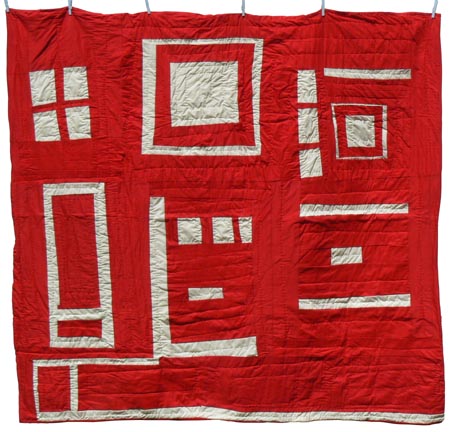
An abstract version of the "house" quilt pattern, circa 1950s or '60s.
This quilt and others can be found at Folk Artisans.

Really, the yard signs tell the story.

There, among the fading petunias, were the plastic signs in navy and white, their respectful, conservative white lettering spelling out support for the Republican ticket. And in between them, looming over them, was a piece of plywood three times as large, and sprayed on the front in florescent pink were the words "Nader/Gonzalez."

"Don't expect to see that sign still standing when you come home tonight, boy!" the father said.

The young man only shrugged, and left his father standing in the drive way. In the past few years the man had turned old, strong still, but now old. His beard and head were filled with gray, and he spent many warm autumn afternoons sitting in a plastic lawn chair watching the traffic head home. He'd raise one hand in recognition of a neighbor's car, while the other rested on his belly, balanced between his thighs, suspenders slung over broad bare shoulders.

When I first moved onto H Street, the father mowed his postage stamp yard shirtless, sitting atop one of those riding lawn mowers. When he was done, he'd climb into his semi-truck and ease it around the block while checking out the neighbors' yards. But as his shoulders stooped and his son's broadened, the boy took over the lawn care, and the neighborhood inspections came less frequently.

His McCain signs were the first to go up on the street, divided -- almost house by house -- over the country's political future. The neighborhood has been written up in the International Herald Tribune. The city's been spotlighted on National Public Radio. Pundits say that who wins the county, wins the country. And while he could wave and smile to the Obama supporter, his son's homemade sign -- now dominating the yard -- mocked him.

"It's been World War III around here," his wife told me one evening as we chatted in the street.

Fists banged the table. Accusations flew. Someone threatened to put an Obama sign in the yard as well.

"Everyone's entitled to their own opinions," the mother said, taking a long drag on her cigarette. "First Amendment, you know. But me? I'm like Switzerland. I'm staying neutral. My vote is gonna remain private."

The young man stomped off to work. The old man stomped off to get another McCain sign. And that evening and the many since, the sun's orange rays glowed on both plywood and plastic.

Friday, September 19, 2008

Plants and politics

Poster by Scott Hansen, a participant in the Artists for Obama series.

There was a time not too long ago when my life was lived in stop motion, seasons slowly slipping away as I sat on the couch and breastfed my twin sons. From my living room window I witnessed my neighbor's yard burst in bloom, daises and tickseed unfurling petal by petal. Months later I was still on the couch nursing and watching as flowers faded and trees dropped their curled, yellow leaves into the cool grass.

On those days that nursing sessions melted into hours, and I feared my brain was being sucked out through my breasts because I couldn't remember what day it was, my neighbor's Thursday habit saved me. She'd emerge from her cottage to care for her yard, and when I saw her I'd breathe, remembering the week was almost over and soon my husband would be home to help. Then I'd settle back down into the couch, nurse some more, and sing my daughter the nursery rhyme "Mary, Mary, Quite Contrary," because by then I'd learned it was also my neighbor's name.

When my babies began to toddle, I pulled myself out of the permanent dimple I'd made in the couch and went outside to dig in my own garden. With one baby on my back, the other fenced in the grass, and my 3-year-old daughter equipped with her own small shovel, I moved rosebushes and toppled fences, wreaking havoc in the yard and sowing sanity in my mind. The crash and splinter of rotten wood, the ripping of root from its earth made me smile, and I'd wave at Mary from across the street and ask her opinion on where to plant my catmint and whether grapes would fare as well in my yard as they did hers. Life was no longer tick ... tick ... ticking in slow animation. I could leave the house with three small children and not panic, as long as I confined my errands to stores with shopping carts (to contain the kids) or to garden shops (where they could run freely without attracting attention or disapproval).

Today there's no time to sit on the couch and watch Mary's yard grow, although it's still as quaint as the nursery rhyme's. No, it's not her marigolds that catch my eye now, but her political signs. Her irritation with the Bush administration has grown to weed-choking proportions she told me the other day after I put a Barack Obama sign in my yard. So I penned this one for her because we share a love of plants and politics:
Mistress Mary, quite contrary,
How do the Democrats grow?
With precinct swell and cash in the till
And Obama signs all in a row.

Monday, September 8, 2008

My neighborhood

"little neighborhood"
courtesy of everything.in.blue


"What's boyhood?" my son asked.

"The time you are a child. A boy's childhood is called boyhood."

"Oh," he said.

"When you grow up and become a man, it's called manhood."

"And after that you're a neighborhood?"

"Nah," I laughed. "A neighborhood is a place, not a state of existence."

But later, I got to thinking about my neighborhood, my street and my place on it, and decided that my son had hit on something. A neighborhood is more than a series of streets and houses and businesses. It can be its own living entity. Just like a corporation can assume human qualities imbued by the people who run it and work there, or a nation take on characteristics of its citizens, we become the neighborhood we live in. Our individual personalities shape the collective character of our street.

This became apparent over the summer when the rental across the street housed a family that was painfully out of sync with the block. Why did the neighborhood reject this family? Firstly, money -- the family had noticeably less than the rest of the street based on the number of broken cars in their driveway, and the number of times they knocked on doors asking for the phone, food, tools or rides. Secondly, (and this is harder to admit) I think they didn't fit in because of race, despite a diversity of ages and ethnicities existing on the street. In "Taking Care: Understanding and Encouraging Self-protective Behavior" Neil D. Weinstein cites a number of studies that have found that neighborhoods need a certain amount of homogeny to function. We need to share something other than just fence lines, and finding that link is getting harder in a neighborhood like mine with its shrinking percentage of elderly and expanding populations of immigrants and rentals units.

So I'm challenging myself to find the common denominator that defines my street. I want to develop a map of my neighborhood that not only employs physical boundaries and statistical spreadsheets, but uses the medium I feel most comfortable in: stories.

Monday, June 23, 2008

Throw some spice in that sentence

Photo courtesy of another sergio

I can set my clock by the curses and obscenities heard along Fourth Street every school day. The trickle begins at 2:05 p.m. and quickly turns into a churning river of spicy language and sluggish teens that dries up by 2:40 p.m.

I love it.

There is something wonderful in spying on these young teens migrating home in packs. They hold hands, block foot traffic for awkward kisses, and try on and throw off language like they do clothes. It reminds me of a story about my littlest sister, who, when she was 12 or 13, was caught standing with a friend at the busiest corner of our small town yelling "Fuck you!" to cars passing by. She was just trying the words on for size.

"If you're using the word in a way to heighten the impact of a sentence or season the stew -- they are after all great seasonings ... they have a proper place in language," said comedian George Carlin in a 2004 interview on Fresh Air. "And in my case, I just like them because they are real and they do have impact and they do make a difference in the sentence."

Another who knew how to pepper her sentences was my grandma. This rotund little woman loved fine meals, gay men, and Cadillacs with the air-conditioning so cold it froze her grand-babies. But nothing brought her more joy than knowing she shocked people because she was a blue-haired woman cussing a blue streak.

So today I honor the many foul-mouthed people in my life, and comedian George Carlin, who loved the English language and its seven dirty words. He died Sunday at 71.

Tuesday, May 13, 2008

Rules to weed by

Photo courtesy of stonebird, Creative Commons

Standing at my door was the neighbor kid, a skinny girl with her purse weighing down her shoulder, pulling her T-shirt tight enough for me to see the outline of her changing chest.

"I'm trying to earn $20 so I can go roller skating with my class," she said. "I can babysit. I've done jobs round the house, mainly inside, you know. But I've mowed lawns and pulled weeds, too."

Her family's new to our street, moving into the rental across from us a few months earlier. She's the youngest in this extended family, who live life loudly, whether hanging out on the stoop or pacing the sidewalk while talking on cell phones. More people keep moving in and the mountain of shoes grows next to their front door, which is rarely closed.

I learn her name, that she's in sixth grade, and invite her and her mother to take a look at our back yard. I've seen the two walking down the street, the girl a block ahead of the mom, who is hollering her name and commanding her to "Wait up!"

"I'm Old School," the mother tells me, while I point out what's a weed and what's a flower. "I want my children to earn their own money." And so we agree that her daughter can return tomorrow to tackle the foot-high weeds. If she can get the whole yard cleared, I'd gladly pay her the 20 bucks.

This was my first mistake.

Day two brings another knock, and there she stands in jelly shoes, purse at her side. I hand her gloves and tools, and she weeds and talks while I hang laundry and listen.

"I asked to go the bathroom during class and the teacher said no, so I went anyway. And then she said I had to apologize, so I said 'I apologize' and she said, 'You have to say you're sorry,' and I said, 'I apologize. That's the same as saying I'm sorry.' And when I tried to walk away she grabbed hold of my arm and left a bruise and red marks."

"Hmm," I respond.

"We went to the office and the principal gave me a citation and called my parents, and they're going to have a meeting. I could sue her."

She weeds. Asks for water. Asks me to check her work. An hour and a half role by, and I explain that I have to run an errand and she'll have to return later. She says she's almost done, and I say O.K.

That was mistake number two.

It's now 7 p.m. My husband's doing dinner dishes and the kids are getting ready for bed, when her mother and father cross the street and come up to our door. They explain that their daughter hasn't returned home yet so they'll finish the weeding for her.

Our mouths drop, and before we know it, we've made the third mistake, and led them to the backyard and handed them shovels. Two adults pulling my weeds.Ugh! A half-hour later, I'm $20 poorer and yard's still not weed-free.

Hiring a neighbor kid is just like weeding a garden -- hard work. I hire not only to avoid an unpleasant chore, but because I hope the kid learns a little responsibility. But my mistakes made it impossible for this girl to learn the value of job done well. Instead, I contributed to her entitlement, the flip side of responsibility. So, I've come up with some guidelines when it comes to hiring kids:

Rule1Keep the job small (weed this flower bed) and specific (pull the weeds by the root). Never outline the whole job and agree to pay the full amount because the kid might get overwhelmed by the task and begin to do quick, shoddy workRule2Hire for a half-hour and then judge the work. If pleased, have the kid continue. If not, say it's not working out, pay them for the time, and ask them to leaveRule3Never, ever let the parents finish the job.

The neighbor girl learned the wrong lesson, but I didn't. A half-hour later, her older brother knocked on my door and offered to mow the lawn for $15. Which brings me to the final rule: Don't make the same mistake twice. I told him no.
Tuesday, February 5, 2008

Living with shadows


She lived in darkness and shadows. Long-forgotten memories possessed the shadows around her and flitted along the walls. The smaller shadows along the living-room wall took the form of her two children...(They) crawled and fought silently as slivers of moonlight filtered through them. In the kitchen, a larger shadow slouched back in a chair and kicked up his heels.


Excerpt from "Saints Alive" by Scott Alan Anderson, published in Glimmer Train, Winter 2008


There's an old lady across the street living in the darkness and shadow that Anderson writes about. Her name is Betty and I can see her house from my kitchen window. It's a house that draws no breath, heaves no sighs. It's old, quiet, the opposite of mine where there's so much frustration and laughter and tears that the house can't contain us, so the energy spills outside and runs crazy-cat through the yard and up a tree and then back inside where it sprawls across the couch, and pants.

Nope, Betty's house is hidden behind heavy drapes that are never opened. Maybe she's just too damn weak to pull them aside. She wears turtle necks in July and looks thin enough to snap, like one of the cigarettes that she smokes. Her stoop smells of an ashtray and her door doesn't open willingly. She's never answered my knocks at Christmas time, so I leave the cookies or jam on her porch, and she'll totter over a few days later with a bag of walnuts or M&M's in its own plastic candy dish.

"My son gave me too many nuts," she'd say. Or "Thought your kids would enjoy these. Mine use to."

Then she'd slip back inside her house and I wouldn't see her for weeks, maybe a month. No smoke from the chimney, her pale blue sedan idle in the driveway, not a footstep across the snowy lawn, and I'd start to wonder if she were dead and if she was, how would anyone know?

In the summer, Betty's next-door neighbor waters and mows the lawn. In return, she lets her poodle shit in the yard next to Betty's car and never cleans it up. Is that their agreement, or is it the price the neighbor has decided her goodwill is worth? In the middle of the lawn is a bush that bursts into bloom, and I imagine there's a link between Betty's life and its lacy pink flowers. That the sap that warms in the sun knows of the house's shadows and darkness, that it listens to the familiar old thump-thump of Betty's heart, so if she were to die, it would stop blooming.

And I would shrug my shoulders and mention at dinner that Betty had died. And Marcel would say, "Ah, that's too bad." And the kids would ask, "Who's Betty?"

"You know, the old lady who lived at the corner? The one with the blue car?"

"Oh."

And they'd jump up from dinner and run outside, where'd they play until I yelled at them to come in and do the dishes.

Tuesday, January 22, 2008

Spoilsport

State lawmaker wants to cancel caucuses because of fighting and hurt feelings.

The Reno Gazette-Journal reported Tuesday that Senate Minority Leader Dina Titus plans to sponsor a bill that would cancel future caucuses and reinstate presidential primaries.

"This notion of neighbors getting together with neighbors to talk about politics, that's just not Nevada," Titus said. "What I found in my caucus is that the meeting didn't lead to collaboration, cooperation and a good discussion. It led to hostility."

Jeez! Is Titus a boob or what?

The caucus was an awesome thing. Voter interest was so high that precincts such as mine ran out of ballots and voters had to write in their candidate's name on slips of blank paper. Why would Titus want to squelch such enthusiasm?

And where does she get off saying that Nevadans can't talk politics? Two weeks before the caucus I got together with a group of loosely connected friends to share information on the candidates' positions on key issues like foreign policy, health care and the environment. This was a group consisting of Democrats and Republicans, small business owners and liberal intellectuals, and no, we didn't all agree, and yes, sometimes people sounded kinda uninformed. But we enjoyed each other and learned a little too.

A caucus is hyper-local politics, and in a society as digitized and disconnected as ours, it's refreshing to physically sit in one spot and talk face-to-face. Caucuses dredge up the lost art of political discourse and encourage civility. I'm all for 'em.

To tell Titus to get a clue, email her at dtitus@sen.state.nv.us.

Monday, January 21, 2008

Grassroots politics

After all the hype leading up to Nevada's Democratic caucus, it was kinda a let down. For two hours, I sat on a bleacher in a middle school and cast first one vote and then another for Barak Obama. We cheered and clapped when someone from another political corner defected and joined ours, but there wasn't any raucous debating or even polite persuasion for entertainment. No. Just neighbor meeting neighbor so that next summer we can wave and chat over lawnmowers.

But it's the local connection that makes a caucus so cool. While it's great that a caucus empowers voters and amplifies Nevada's voice at the national level, it's the community that was created Saturday that really mattered. I met people who were interesting and funny and thoughtful, and learned that we shared not just party lines but property lines too.

Sunday, November 11, 2007

Insomnia

Photo courtesy of neil-san.

To walk my street, alone at 12:30 a.m., is exhilarating, which isn't the emotion I should be striving for at this hour of night, but when one can't sleep... I had awakened to the dripping of rain off the eaves and couldn't get back to sleep, so finally pulled on a coat, hat and scarf and walked outside. The trees are dripping and the streetlights glitter on the grass. Our cat crawls out from beneath the minivan and meows before slipping into shadow.

I walk through the steady patter of rain hitting pavement, the occasional plink of a heavy drop falling into the gutter, the gurgle of the two outdoor fountains from the house four east of mine. I walk through patches of darkness and then into the glare of a streetlight, allowing the neighbor's dog to spot me from its front window and bark furiously through the glass.

I listen to the faraway whistle of a train, the whir of cars speeding down Pyramid Highway, my breath as a contraction seizes my belly. I walk up and down the middle of the street, forgoing sidewalks because the shrouds of shadow make me nervous. I am a horse at the track, warming up for the big race, steadily finding my pace as contractions grip and release. Two, three, four times, I walk along this stretch of H Street between G and 4th. H for home, for hope, for hurry. The rain lets up and I come inside for a mug of steamed milk with sugar and nutmeg, my eyes heavy and ready for sleep.
Blog Widget by LinkWithin