Showing posts with label Stone soup. Show all posts

Wednesday, November 17, 2010

You get what you get

DSC_0039

It was an extravagance, turning a whole chicken into stock, but I wanted a rich, fragrant, meaty broth with shimmering droplets of fat, a soup that cured. It bubbled on the stove all day long.

I don't like caring for sick kids. I resent their neediness, the tether they become, the disruption they cause, but I am their mother and this is what mothers do: They measure cough syrup, brew cups of herbal tea, take temperatures, rub backs, then wake in the middle of the night to do it all again. Yesterday, I did this but not well, for in between the good-mother stuff, I lost my temper, cursed my children, rudely hung up on my husband and ate handfuls of chocolate chips straight out of the bag. I feel guilty that I'm at my worst when my kids need me most, but there it is.

I needed this chicken broth to work magic and restore not only health but also good will, which was asking a lot from a bowl of soup, but I can wish, can't I?
  
"It's not simply its warmth, aroma or digestibility that makes you feel better. Chicken soup really is good for you, but only if it has those pools of golden fat floating on its top," Jennifer McLagan writes in the cookbook "Fat: An Appreciation of a Misunderstood Ingredient." "All poultry fats contain the monosaturated fatty acid palmitoleic acid, which is believed to boost our immune systems. Chicken fat has more palmitoleic acid than other types of poultry fat."

I seasoned the broth, added thin coins of carrots, dill and plump matzo balls. But some days can't be saved. Some days are bitter, a struggle to live through, a slog. My daughter continued to whimper that her chest hurt when she coughed and my sons didn't return my smile when they returned from school. Although beautiful flecks of fat glittered on its surface, this soup didn't cure what ailed the day, although it made it taste a little better.

DSC_0058

Chicken stock

One whole chicken
Enough water to just cover it
A couple bay leaves
A handful of whole peppercorns
One onion, quartered
Salt and pepper, to taste

Bring to a boil, reduce heat to a simmer and skim the foam off the surface. A whole chicken simmered a long time will yield the richest and most flavorful stock, but you also can use the bones from a couple roasted chickens. About one hour into the process, I pull the chicken out and cut off the breasts, saving them for another meal. Typically, I simmer the chicken until it falls to pieces or about four hours, then strain through a colander.

Friday, November 5, 2010

Cancer cracked me open and I weep

One Basket
Courtesy of Kent Landerholm.

I drive through the intersection of an emergency.

I hear sirens. I see the red flash of a fire truck, a policeman directing traffic, people looking up. So I slow down and I look up, too. From the roof of a tall building is a woman balanced on her belly, legs dangle, waiting.

I drive past a man praying next to man taking a picture on his smart phone. I drive through two lights then join a crowd of cars on a freeway where no one knows that blocks away a woman is deciding whether to live or die.

***

I cry as as I wash dishes, as I run, as I write. Two months ago, my father was healthy; now he fights for his life. Life is painful, resentful, but also, strangely enough, beautiful. The discovery of cancer reminds me how fragile and gorgeous and fleeting is my life, my dad's life, my children's. 

Cancer cracked me open and I weep.

Until I laugh.

At the absurdity of life because it wraps a suicide in a good sky day. Because on the way home, my 2-year-old pukes all over himself and his car seat. Because I go to the grocery store and buy things I don't need and forget things I do. Because two months ago, my father was healthy and now he fights for his life.

At home, I pull the soiled clothes off my son and he walks, naked, into the house. We rock in the sun until my eyes close and my head drops, jerks. I wake. Then nod off again.

egg
Courtesy of Deja Photo.

I don't know what to  make for dinner. I never know what to make for dinner anymore. Yesterday I came home with leeks and a pound of dried currants. I forgot bread. Four days ago, I bought five pounds of spinach. I forgot milk. Now I stand before the refrigerator and am uninspired. I pour cans of chicken broth into a pot. I saute spinach with garlic. I boil water and begin poaching eggs. In bowls I ladle broth over spinach and egg and hand it to my children. 

I've never had this before.

Not eggs. Please, Mom, not eggs.

I sing.

I do not like the way they slide. 
I do not like their soft insides. 
I do not like them many way,
and I could do for many days 
without eggs.

It's a song they know from the many hours spent listening to the story of a young badger named Frances who refuses to eat anything but bread and jam. They take their bowls. Ten minutes later, one son is halfway through his bowl and looks up stunned. 

What's wrong?

Nothing. I just realized this was dinner.

I smile ruefully and finish my own bowl of soup, salty, garlicky, thickened with the sweet yolk. I get up from the table, walk into the bedroom. It's 7:30 p.m. and I'm so tired. I pull off my clothes, crawl into bed and sleep.

Friday, March 5, 2010

Linus, limits and a liberal sprinkling of Parmesan


I feel guilty about the cat.

But not guilty enough.

Every morning he scratches at the door separating the kitchen from the garage. I sigh, open it a crack and a cartoon bubble with the word meow floats in as the cat makes a dash for his bed in the living room.

He curls up there and I ignore him until the afternoon, when the squeaks and squawks from clarinet practice drive him back to the door. A second meow rises from his throat, more insistent than the first, and drifts to the stove where I'm making chicken minestrone soup. I crack the door, he slips through and I kick it closed.

clarinet
Ivan and Chaja making music.

Every night, just after the last child is tucked into bed, there's a scratching at the window. Now that the house is quiet and peaceful again, the cat wants back in. He sits at my feet, looking up, anticipating an invitation, a hand, but I ignore him and the third meow that hovers above my head.

Of the many things I say no to regularly -- the washing of dinner dishes (after all, I made the meal), the diaper change before my morning coffee (no explanation needed), the request to referee a knockdown kid fight that I hadn't witnessed -- it's the cat that gets shortchanged. Always.

I say it's because he makes me sneeze, and that's true. In fact, most of the family won't touch him because of allergies, which begs the question why we own a cat. The answer: He adopted us. One night, during one pregnancy, a skinny, scruffy Tom tabby scratched at the door and wouldn't leave.

He's a house cat who hasn't lost his street smarts, managing to live for another day with a torn ear, abscessed scratches and bloody tail. We clean him up the best we can, then turn him loose again. It's all I'm capable of doing: I can care for my children, my husband, my friends, myself. But I cannot care for the cat.

What are your limits? Learn to say no 20 different ways.

chicken minestrone soup
Caring through a cold ...

In the bowl:

Chicken Minestrone Soup

On the side:

An orange and an enthusiastic sprinkler of Parmesan


Chicken Minestrone Soup
adapted from Chinaberry's now defunct newsletter and its customer Tara Pieron

10 cups chicken broth
1 tablespoon tomato paste
1 1/2 teaspoons Tabasco sauce
1 teaspoon dried rosemary
1 cup fresh basil, sliced into thin ribbons
1 1/2 cups butternut squash, peeled and diced
1 tablespoon olive oil
1 large onion, chopped
1/2 pound fresh spinach, cut into strips
15-ounce can of chickpeas or garbanzo beans, with their liquid
3 cups fresh tomatoes, chopped, or 2 15-ounce cans
2 cloves garlic, crushed
2 cups chicken, cooked and cubed
6 ounces bow-tie noodles, cooked
Salt
Pepper
Parmesan cheese

In your soup pot, saute onion, garlic, rosemary, oregano in olive oil until soft. Add tomatoes and tomato paste and cook a little longer. Add chicken broth and squash. Bring to a boil, then lower heat to a simmer and cook, covered, for 10 minutes. Add tomatoes, chickpeas, spinach and simmer for 10 more minutes. Finally, add the basil (which I almost never have, so never do) and chicken. Salt and pepper to taste. Just before serving add cooked pasta. (If you plan to freeze the soup, add the pasta to individual bowls rather than the pot.) Ladle into bowls and top with Parmesan.

Friday, February 19, 2010

Billet-doux

billet-doux

bill-ay-doo
noun

1. A love letter or note. In French, billet-doux means sweet note or short note.

*

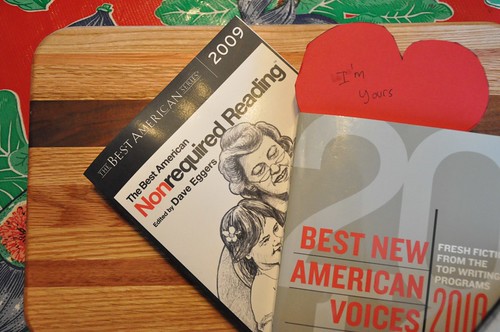
I am one lucky woman. My billet-doux came on Valentine's Day, but the gifts piled up though the week. First to arrive were two books from the Best American series I had on my wish list: "New Voices" and "Nonrequired Reading." Fittingly, the first two short stories I read from "New Voices" were about love, the loss of it and the attempt to regain it.

The editor, Dani Shapiro, promises the stories will be "daring acts of both head and heart -- the intellectual high wire of craft combined with that elusive thing: the capacity to make the reader feel something." With such expectation, I launched into the first two stories. "Bethlehem is Full" by Boomer Pinches is about a man deeply disturbed by his girlfriend's abortion, while David James Poissant explores a father's mistake and the monster he must set free in an effort to set things straight in "Lizard Man."

The arrows sang as they flew through the air and landed with a resounding thwack! in my heart. I'm in love with this book and was deep into it when my husband came home from his woodworking class and offered me the third gift: A freshly planed, routed, sanded and oiled piece of wood.

"It's the most beautiful thing I've ever made," he said. "Beautiful and functional."

The cutting board is solid, smooth as satin and striped with walnut, maple and eucalyptus. I'm a bit shy about cutting on it, so, instead I used an old board -- stained red where strawberries had bled and scarred by many knives -- to make him Pile-it-On Chili as one of many thank yous for the Valentine's Day that lasted an entire week.

In the bowl:

Pile-It-On Chili

Pile-it-On Chili
Serves eight

2 pounds stew meat, cut into 1-inch cubes
1/4 cup oil
1 teaspoon cumin
1 teaspoon oregano
2 teaspoons garlic, chopped
1 teaspoon salt
3 cups onion, chopped
4 ounces green chili, chopped
15 ounces tomatoes, diced
4 cups water

refried beans
cheddar cheese, shredded
cilantro
green onion
jalapenos
salsa
sour cream or toasted cumin seed crema, if you're feeling fancy
peanuts (I kid you not. Before I had a son with a nut allergy, I'd toss a handful of peanuts on top. It was good. Really.)

In a large pot or dutch oven, brown meat in oil. Set aside. Toss onion, cumin, oregano and garlic into the pot and cook until onions are softened. Return meat and juices to the pot. Add the green chili, tomatoes and water. Bring to boil and then lower heat and simmer for at least an hour, two is better.

Shortly before the chili's ready, heat the refried beans. In a bowl, plop some beans, ladle chili over it and then pile on the toppings.

Wednesday, January 13, 2010

A palette for the palate

Winter walk
Two on a night walk.

I like the washed-out colors of winter. The sky's broad brushstrokes of pale blue, pink, yellow and gray, the dark silhouettes of bare trees, the muted greens and rusts. I like the way winter smells of wood fires and oranges, and how the cold air burns the insides of my nose during night walks with my daughter. I like that days lend themselves to bowls of creamy cauliflower soup drizzled with browned butter, tasting as pale as the world outside and toasty as a handmade quilt.

Ivan naps
Ivan under his Christmas quilt.

In the bowl:

Cauliflower soup
Cream of cauliflower soup
garnished with brown butter and toasted walnuts


Cream of cauliflower soup
Adapted from a recipe by Top Chef finalist Carla Hall on National Public Radio
Serves 4

1 head cauliflower
3 tablespoons unsalted butter
2 leeks, white part only, washed and cut into half-moons
1/4 cup white flour
1 quart, plus 1 cup chicken stock
1/2 cup cream
Salt and freshly ground pepper, to taste
Nutmeg

Garnish: Optional but for the browned butter because it's so good.

1/2 cup walnuts, toasted
parsley, chopped
4 tablespoons butter
12 tiny cauliflower florets

Wash and core the cauliflower. Reserve about 12 tiny florets and roast them in the oven at 400 degrees until tender. Roughly chop the remaining cauliflower and set aside. In a pot, heat the butter over medium heat. Add the leeks and cook until soft, but not taking on any color. Sprinkle the flour over the leeks and stir to combine. Gradually whisk in the stock. Bring to a simmer. Add the chopped cauliflower and return to a slow simmer. Season with salt and pepper. Simmer, stirring occasionally with a wooden spoon to keep the bottom from sticking or burning until the cauliflower is fork-tender.

Remove the pot from the heat and puree the soup in a blender until silky smooth. Once processed, pour back into the pot. Place the pot over medium heat. Add 1/4 cup of heavy cream and bring to a simmer. If the consistency is too thick, add milk. Adjust the seasoning with salt and pepper. Add in a few sprinkles of nutmeg.

In a small skillet or pot, melt the 4 tablespoons of butter over medium heat. Keep the butter on heat until it turns a nutty brown. Remove from heat and set aside.

Mix the tiny cauliflower florets and the toasted walnuts in a small bowl. Portion the soup into four bowls and top with the garnish. Drizzle with the brown butter, then chopped parsley.

Friday, December 18, 2009

Happiness by the spoonful

A school lesson.

More than a week of snow, bitter temperatures, ankle-deep slush and freezing fog forced a new routine on my family: At 8:30 a.m., the six of us pile into our one car and I make a giant loop -- kids at school, husband at work, milk or eggs at the grocery store and home again.

One morning we passed a boy that left me feeling punched in the stomach.

He was running to school wrapped in a fleece Spiderman blanket, which loosely covered his T-shirt and backpack and flapped about his ankles. He looked about 10.

Is this a kid who rejects a jacket on the grounds of style? Is this a parent practicing tough-love and natural consequences? Is this poverty?

My children's friends come over to play in the snow and have no boots, jackets or mittens. They're fingers are bright pink, their shoes soaked when I invite them inside for hot chocolate.

The school hands out jackets, backpacks, some children regularly receive bags of groceries, and weekly all students get a healthy snack thanks to the federal Fresh Fruit and Vegetable Program.

"Why do they give you that?" my son asked his friend, peeking inside the bag at the juice boxes, cereal and cans of soup.

"Because my family's poor."

It's not always easy to tell, but I know some of my neighbors struggle to survive because I've been mistaken for being in their shoes. Twice cars have stopped me as my children and I walked down the street. The first driver handed me a flier about a church event involving food. (We'll have hot dogs, lots of them and they're free!) The second driver wanted to give me groceries.

"No, no. I'm good, thank you. Take them to the food bank," I said.

And I walked on feeling humble and grateful for our steady income, warm clothes and food. Gifts, indeed.

In the bowl:

white bean chili

White bean chili with salsa verde

White bean chili with salsa verde
Recipe by my friend Heather at Yo Mama en Espana

Serves 6 to 8

1 teaspoon lemon pepper (I used black)
1 teaspoon cumin seeds
4 chicken breast, halved and skinned
olive oil, non-stick cooking spray or 1 teaspoon oil
1 clove garlic, minced
1 onion, chopped
2 (9 oz.) packages frozen corn
2 (4 oz.) cans diced green chilies, undrained
1 teaspoon ground cumin
2 to 3 tablespoons lime juice
2 (15 oz.) cans great Northern beans, undrained
2/3 cup crushed tortilla chips
2/3 cup shredded Monterey Jack cheese

In a large saucepan, combine 2 1/2 cups water, pepper and cumin. Boil. Add chicken. Reduce heat to low and simmer 2o to 30 minutes or until chicken is fork tender and juices run clear. Remove chicken from bones, cut into 1 inch pieces. Return chicken to saucepan.

Spray skillet with oil. Over medium heat onion and cook until tender. Add garlic and cook one minute. Add cooked onions, corn, chilies, cumin and lime juice to chicken mixture. Bring to boil. Add beans. Cook until thoroughly heated.

To serve, place tortilla chips and cheese in bottom of the bowl. Ladle chili over top and serve with salsa verde. (In my case, I only had fresh jalapenos.)

Friday, October 16, 2009

Melon soup

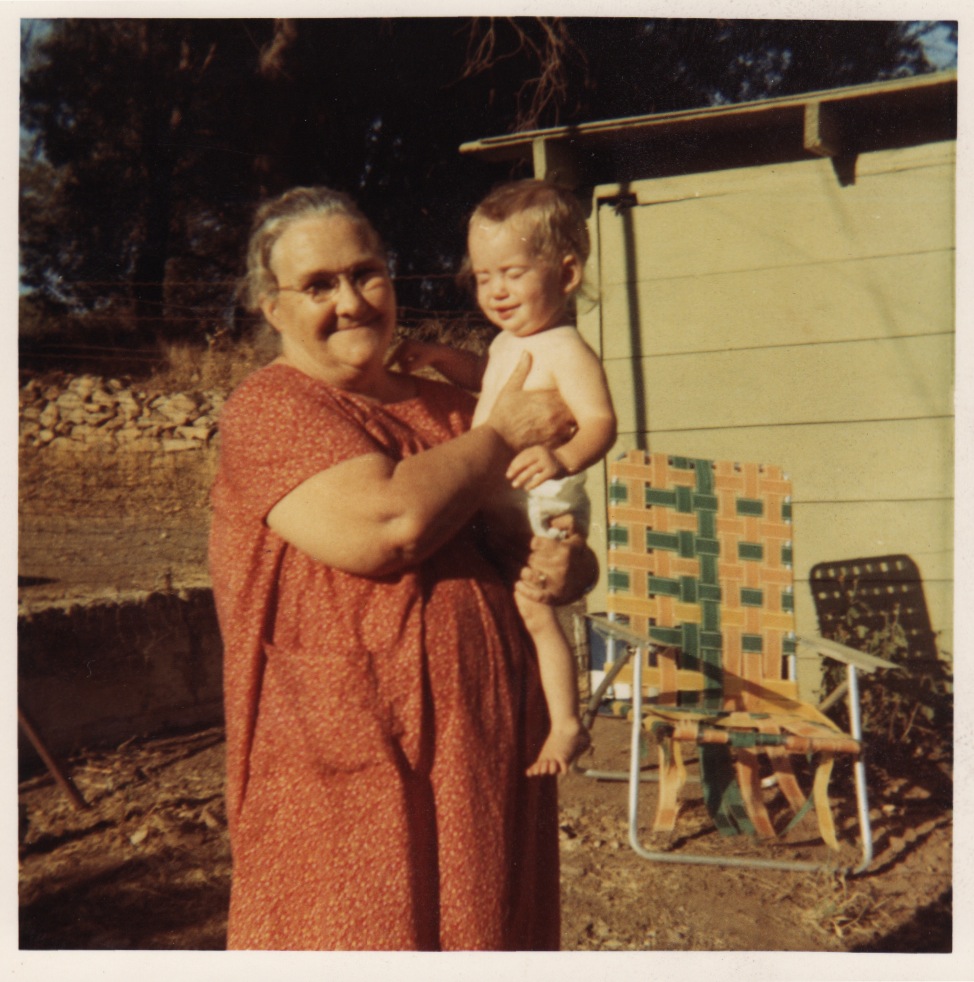
Grandy and me
Grandy and me.

My Great Grandma Peggy was a woman with no verifiable past.

She once told my mother that she had a twin brother, and that she was one of eight children, among them were two sets of twins and a set of triplets. When my mother related this to her mother, the response was silence followed by hoots of laughter. No one had ever heard of the twin, nor name him. No one had met any of the siblings. Nor her parents, for that matter.

Grandy's past may be as wind-swept as the desert in Stagecoach, Nevada, where she lived, but I remember her vividly:

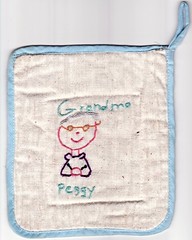
Grandy potholder 4

She was a round little woman with a face wrinkled and cracked as the desert floor she lived on.

She was a fast, sloppy seamstress, and her gifts were received with hidden hesitation because a shirt may have sleeves that dangled to the knees or a nightgown come with cuffs that pinched circulation at the wrist.

She was an excellent baker. Her rolls disappeared off the Thanksgiving table, and everyone clamored for her pie. But as a cook? Well, born in Boston, she boiled everything.

And when my family gathered for a night of silent, flickery home movies, a favorite was watching Grandy in her garden, in reverse. Oh, how we'd laugh as she re-attached melons to their vines, shoved carrots back into the soil, and then waved goodbye, walked backward into her trailer and shut the door.

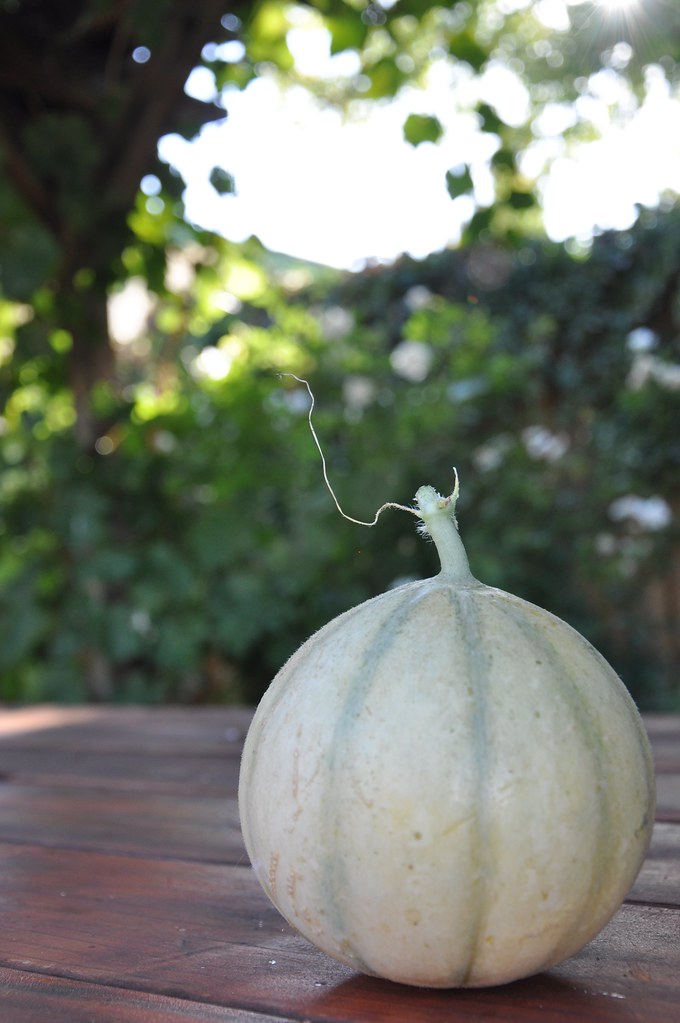
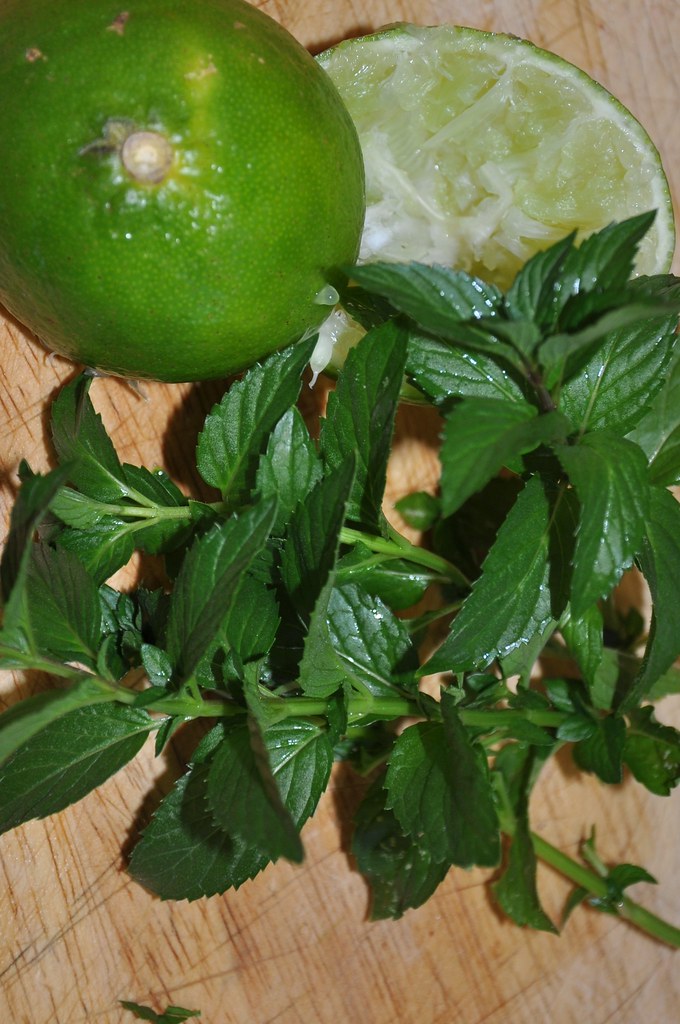
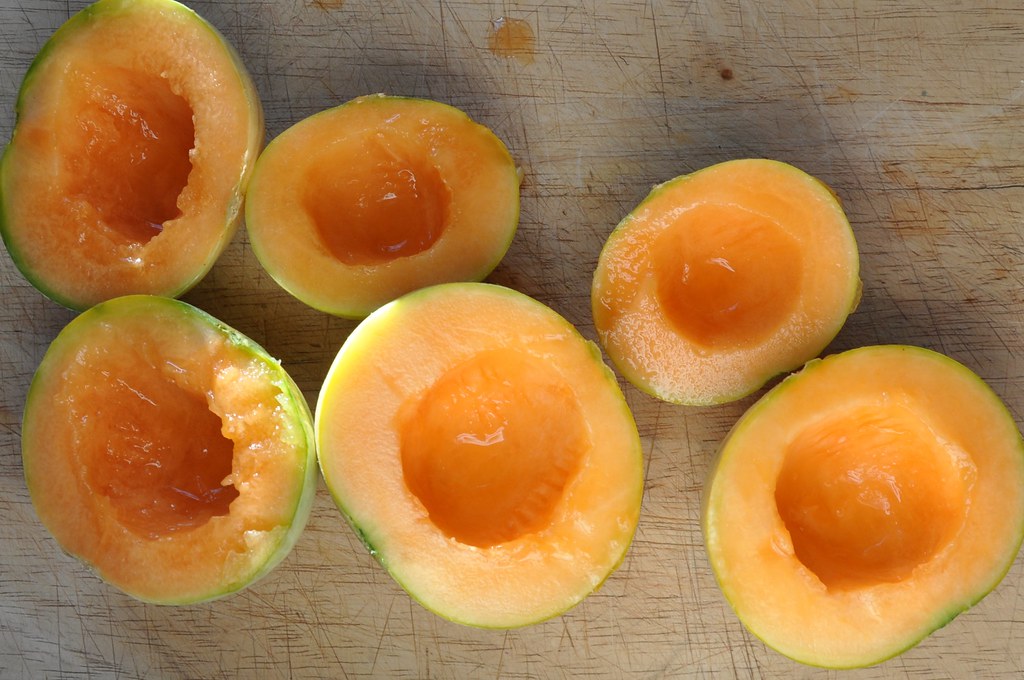
Melon1Melon3
Melon2
The ingredients.

I was thinking about this tiny woman the other day as I composted my melon vines and planted an autumn crop of carrots. I thought about her some more as I turned the last melons into soup and dropped off duplicate ingredients at the neighborhood food bank. You see, it wasn't until after I'd started Stone Soup that my mom shared with me that when my Grandy lived in northern California she fed every hobo who knocked at her backdoor.

This soup is my own creation, named in memory of my great grandmother, Marguerite Butt Campbell Craft.

In the bowl:
Melon4
Marguerite's Melon Soup
with yogurt and mint

Marguerite's Melon Soup
Serves 4

2 cups of melon such as juicy, sweet cantaloupes
1/4 teaspoon cayenne powder or to taste
squeeze of a lime or two
Thick plain, whole milk yogurt such as a Greek yogurt
Mint, chopped

Whirl it in a blender. Chill. Top with yogurt and mint.

Monday, September 21, 2009

Glorious, garlicky soup

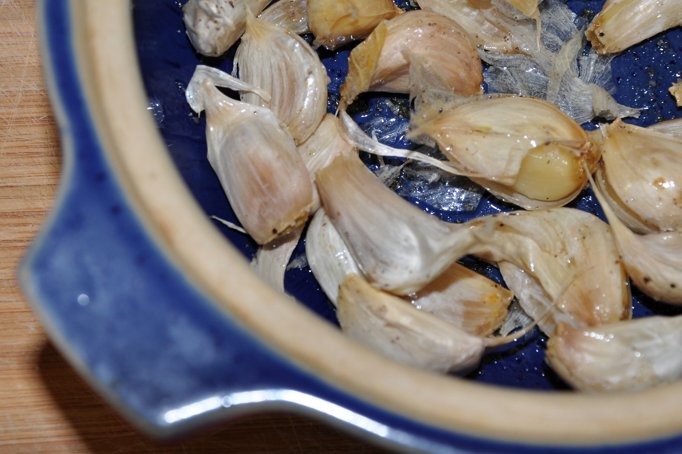
Garlic soup1
Photos courtesy of Dance in the Kitchen.

Sunday often tastes like the dregs in the bottom of the coffee cup. The day has a bitter grittiness to it: The weekend is over and the family is tired of the activities, the chores, and each other. But occasionally a perfect day comes along filled with mellow autumn sunshine, stolen naps, and garlicky soup for the many runny noses in my home.

In the bowl:

Garlic soup2

44-Clove Garlic Soup with Parmesan Cheese


44-Clove Garlic Soup with Parmesan Cheese
Adapted from Bon Appetit, February 1999 and Smitten Kitchen

Serves 4

26 cloves of garlic, unpeeled
2 tablespoons olive oil
2 tablespoons butter
2 1/4 cups sliced onions
1 1/2 teaspoons fresh thyme, chopped
18 garlic cloves, peeled
3 1/2 cups chicken stock or broth
1/2 cup cream
1/2 cup Parmesan cheese, finely grated
lemon wedges

Roast 26 cloves (I used a whole head) of garlic in a small ceramic or glass dish. Add olive oil, salt and pepper. Cover with foil or lid and bake until garlic is golden brown and tender, about 45 minutes. Cool. Squeeze garlic between fingertips to release cloves.

Melt butter in soup pot over medium-high heat. Add onions and thyme, and cook for 6 to 10 minutes. Add roasted garlic and 18 raw garlic cloves. Cook 3 more minutes. Add chicken stock, cover and simmer until garlic is tender, about 20 minutes. Working in batches, puree soup in a blender and transfer back to the soup pot. Add cream and bring to simmer. Season with salt and pepper.

Divide grated cheese among your bowls and ladle soup over it. Squeeze lemon wedge into each bowl and serve.

Friday, July 10, 2009

First summer soup

Cherries
Photos courtesy of Dance in the Kitchen.

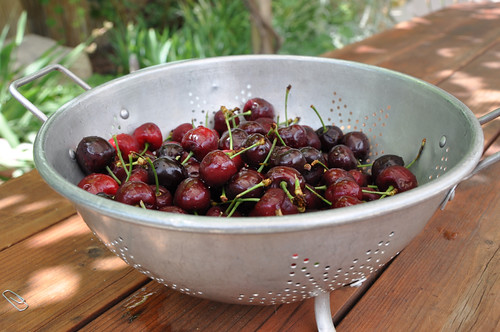
With three pounds of cherries pitted using a paper clip, I made cherry brown butter bars that were a hit at our backyard barbecue (three people asked for the recipe), and a soup that never made it into the bowl. Here's why:

I gave my love a cherry
That had no stone
Steeped in a broth of chicken
That had no bone
I added sugar, salt and pepper
And simmered it on the stove
I called the soup supper
For my love

How was that soup of cherry and chicken broth?
My love took a sip and began to cough
He spat into the sink and cried
It tastes of dirty socks
You're right, I answered
Let's order pizza from Black Rock.

What's NOT in the bowl:

Cherry soup reaction

Cherry soup adapted from Chez Panisse Fruit by Alice Waters.

Friday, June 26, 2009

Soup in a boot

"Boots" courtesy of saracino.

Reno was once a cowboy's town where even the lawyers wore boots. Where the brush was once so thick a rabbit had to climb a tree to look out, now stand rows of houses, and this month's cattle drive through town was made up of a bunch of buckaroos who probably wouldn't have enough trail sense to spit downwind. Most of them paid $1,600 to participate in the Reno Rodeo's annual publicity stunt. I hope they heard some colorful cowboy talk and ate a tasty stew.

"Cowboy Slang"
By Edgar R. Potter

Hard up: His boots were so frazzled he couldn't scratch a match without burnin' his feet.

Crazy: As crazy as popcorn on a hot skillet.

Fast gal: Must think her butt is a gold mine since everybody's a diggin' at it.

Lazy: Quit spittin' on the handle an' get to work.

Hot: Hot 'nough to sunburn a horned toad.

Talking: His tongue would get a real frolicsome.

Coward: All gurgle an' no guts.

Braggart: Had callouses from pattin' his own back.

Women: I don't like to have my haunches spurred by no drip-nose of a gal.

Grub: To make a sonofabitch stew yuh throw everything in the pot but the hide, horns an' beller.

In the bowl:

Boeuf bourguignon

Beef stew with red wine
Adapted from Barefoot in Paris by Ina Garten

Serves 6 to 8

1 tablespoon olive oil
8 ounces bacon, chopped
2 1/2 pounds beef chuck, cubed
salt
pepper
1 pound carrots, sliced into 1-inch chunks
2 onions, sliced
2 teaspoons garlic, minced or pressed
1/2 cup Cognac or brandy
1 bottle red wine (I used a Malbec)
2 to 2 1/2 cups beef broth
1 tablespoon tomato paste
1 teaspoon fresh thyme
4 tablespoons butter
3 tablespoons flour
1 pound frozen pearl onions
1 pound mushrooms, stemmed and thickly sliced

Preheat oven to 250 degrees

Heat the olive oil in a Dutch oven. Add bacon and cook until browned. Remove. Salt and pepper beef and toss it into the bacon fat. In batches, sear the beef. Remove to the same plate holding the bacon.

Throw the carrots, onions, 1 tablespoon salt and 2 teaspoons pepper into the pan and cook for 10 minutes. Add the garlic and cook 1 minute more. Add the Cognac, stand back, and ignite with a match to burn off the alcohol. Put the meat back in the pot. Add the wine and enough broth to almost cover the meat. Add the tomato paste and thyme. Bring the pot to a boil, cover it and put it in the oven for about 1 1/4 to 1 1/2 hours or until meat and veggies are tender. Remove from oven and place on the stove.

Combine 2 tablespoons of butter and flour and stir into the stew. Add onions. Saute mushrooms and add to the stew. Bring to a boil, then lower flame to a simmer and cook for 15 minutes. Spoon into bowls and sprinkle chopped parsley on top.

Friday, June 5, 2009

Wring me out

"Rainstorm" courtesy of Frank.lin.


Rain every afternoon.
Thunder and lightening between me and my husband.
My one-year-old learns to use a squirt gun.
A nasty bug steamrolls over one son.
My mother-in-law mops up vomit at the movies.
Then, finally, the sun shines and I make soup.


In the bowl:

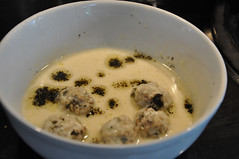
Turkish yogurt soup with tiny meatballs

Photo courtesy of Marcel Levy

Turkish yogurt soup with tiny meatballs


Turkish yogurt soup with tiny meatballs
Adapted from "The Essential Mediterranean" by Nancy Harmon Jenkins

Serves 8

1/2 to 3/4 cup finely chopped onions
4 tablespoons olive oil
1/4 cup long-grain rice (I used medium grain)
Boiling water
Sea salt
1/2 pound ground lamb
2 tablespoons minced parsley
1/4 cup minced fresh dill
2 tablespoons minced mint
Freshly ground black pepper
1/2 teaspoon red pepper (I used 1/8 tsp. cayenne)
1 large egg
2 to 3 tablespoons bread crumbs
5 cups chicken broth (I used 7 cups)
1 egg
4 cups whole milk yogurt
1 egg yolk
2 tablespoons butter
2 tablespoons dried mint

Saute the onions with 2 tablespoons of oil over medium-low heat for about 20 minutes. Add the rice and 1 cup of boiling water with salt to taste. Cook for about 10 minutes or until the rice has softened and absorbed most of the liquid. Set aside.

In a bowl mix the lamb, parsley, dill and mint, lots of black pepper and the red pepper. Stir in the rice. Add the egg and enough bread crumbs to make a mixture that is moist but will stick together. Form into small meatballs, about the size of a gumball.

Combine the chicken broth with 1 cup of water and bring to a simmer. Add the meatballs in batches and let simmer until they rise to the top, indicating they're done. Remove them with a slotted spoon and set aside.

In a bowl mix the egg yolk and yogurt. Whisk in 1 cup of cold water. Measure out 1 cup of soup broth and stir it in, then pour the yogurt into the soup and stir. Simmer very, very gently for about 10 minutes. In the last few minutes add the meatballs and simmer just long enough for them to heat thoroughly.

Ladle into bowls and dribble a small amount of mint butter over the top.

Friday, May 22, 2009

Silly soup song

Editor's note: The Slow-Cooked Sentence is devoting itself to song this week as part of its Joy+Ride, a month-long quest that involves planting, polishing and singing.


In the bowl:

Great Big Gobs of Greasy Grimy Gopher Guts
Photo courtesy of meganpru


Sing along with me and my kids. I dare you.

The Recipe: Gopher Guts
Serves: One campsite

Great big gobs of greasy, grimy gopher guts
Chopped up monkey meat
Concentrated birdie feet
Chopped up eyeballs
Baked in a pot of blood
And I forgot my spoon!

Great big gobs of greasy, grimy gopher guts
Chopped up monkey meat
Concentrated birdie feet
Chopped up eyeballs
Baked in a pot of blood
And I forgot my spoon!
But I gotta straw!
(Slurrrp!)
(Aaaaah!)

Friday, May 1, 2009

Soup, slop and sanitation


"Songs We Sing From Rogers and Hammerstein" illustrated by William Dugan. Golden Press, 1957. Image from Vintage Kids' Books My Kid Loves.


I made clam chowder last night and it was a stinker. Perhaps it was because (one) I refused to run to the store for four stalks of celery or (two) I lazily tossed in the potatoes without peeling them. But whatever the reason, it was bland, boring and kinda dirty tasting. (Even though I distinctly remember scrubbing the potatoes!)

We ate the chowder, anyway.

But the leftovers? Into the slop bucket. Well, to be more exact, ours is a compost bucket, but when I was growing up we raised the occasional pig or two, so our scraps turned to slop. And how our first pig loved that garbage, nudging her nose into curdled milk, congealed Cream of Wheat and gobbling up the crusty ends of peanut butter-and-jelly sandwiches. Doesn't that remind you of "Charlotte's Web"?

Wilbur lifted his nose and sniffed. The smell was delicious... He walked to the trough and took a long drink of slops, sucking in the milk hungrily and chewing the popover. It was good to be home again.

While you can go on loving Wilbur, I'll love Star, our family's big, black sow who gave birth to a run of piglets who were so darn cute and pink. Star was smart enough to escape from her pen, so now and then my brother or sisters or I would spot her trotting down the dirt road, a line of babies behind her. We'd yell to mom, who'd hop in the car and chase her down. You know, I can't remember how my mom got Star and her babies back home. I like to imagine her as big and tough as Pecos Bill's true love, Slue-foot Sue, roping and riding that sow into the pen again.

Eventually, Star's antics grew tiresome and the piglets outgrew their cuteness because one day the pig pen was empty, the slop bucket was fed to the chickens and a conversation between a mother and child went something like this:

"What's for dinner?"

"Star."

We ate the pork chops, anyway.

But today -- as the swine flu spreads and worries grow about a possible pandemic -- people are hesitating when it comes to pork, according to The New York Times. Several nations closed their borders to pork and Wall Street analysts predict a drop in pork sales in the grocery stores, the paper reported this week.

Although pigs were the original source of the new virus, experts said the animals don't appear to be playing a role in its transmission now.

"The virus is passing from person to person ... most likely by the spread of respiratory droplets," the Times reported.

So I'm not passing up bacon, nor am I running out to buy face masks. I won't even demand that my children's teacher be quarantined following her vacation in Mexico. But I have taken the precaution of posting hand-washing signs in our home's bathrooms. Should you be overcome by a similar desire, here's one poster and links to the rest:


Have a swine-free, sanitary weekend!

Friday, April 24, 2009

In which a heart hurts

Anatomical heart by Leonardo Da Vinci.


Today's bowl contains a sparkling, life-sustaining, ruby soup and I hope my father will get to eat a bowl. He's at the hospital today where doctors will dye his blood and watch as it's pumped through the chambers of his heart. If the heart is strong, he'll come for dinner. If it's weak, doctors will operate.

As I sliced beef into half-inch cubes I thought of this heart caged in the chest I fell asleep against as a child. As I cut beets and stained my fingers I thought of that blood, bubbling with oxygen, feeding my father. And as simmering broth turned brilliant red I prayed for the first man I loved.

In the anthology "My Mistress's Sparrow is Dead," Pulitzer Prize-winning author Jeffrey Eugenides wrote about the heart:

"The perishable nature of love is what gives love its profound importance in our lives. If it were endless, if it were on tap, love wouldn't hit us the way it does."

Under the hood of my first car.

Childhood memories of my dad involve muscle: hammering together rabbit cages, carrying loads of firewood to the truck, changing the oil in my VW Bug. The picture I carry in my brain is of his body bent over the engine of our car. Broken down on the side of the highway, he once jerry-rigged it with a crochet hook. The slow speed of his driving and his bloodshot eyes brought the car to attention of police, so trips often included time on the side of the road answering a cop's questions.

Though my dad's still strong and ingenious, he's also old. His hair is the color of winter and his hands are knotted. He's nearing the age of his father who died following a heart bypass, the age of his mother when she suffered a second heart attack. Death lurks in my family's genes. I warn my husband that I'll die first, that I'll die from a broken heart. My grandma almost did. After my grandpop died and she had suffered the heart attack, she asked not to be resuscitated should her heart stop again. One day it did. But forgetting her request, doctors shocked her heart into beating again. She lived for twenty more years and remarried, but the family knew that part of her heart no longer beat, but lay buried next to her lover.

Again, Eugenides:

"We value love not because it's stronger than death but because it's weaker. Say what you want about love: death will finish it. You will not go on loving in the grave, not in any physical way that will at all resemble love as we know it on earth."

I sleep next to the second man I love. On most nights I sleep on his right side, so when I curl up against his chest I can't hear his heart's rhythmic thumping. Sometimes, though, my husband and I lay like spoons with his arm thrown over my side and his hand cupping my left breast, my heart playing a staccato against his palm. If the heart had a song for living, for the joy of filling cavities with blood and sending thin, brilliant blood through unblocked veins and arteries, it would be Med Sud I Eyrum Vid Spilum Endalaust by the quintet from Iceland Sigur Rós:

The album cover.

I'm playing it today as the soup simmers. I'm playing it.

Again.

Again.

Again.

Loud.

In the bowl:

Ruby Soup


Ruby Soup
Adapted from Smith and Smith Farm's newsletter

Makes 4 quarts

1/2 pound grass-fed beef, cut into 1/2 inch dice
1/4 cup olive oil, divided in half
3 quarts beef stock
4 small beets or one large beet with tops
pinch of red chili flakes
juice of one lemon
1 large potato, peeled and cut into 1/2 inch dice
1 14 ounce can peeled, diced tomatoes
1 small onion, sliced
3 small carrots, sliced
3 cups cabbage, shredded
1 tablespoon tomato paste
3 cloves garlic, minced
3 tablespoon parsley, minced
1 tablespoon dill, chopped

Heat half the oil in a stockpot and brown the diced meat. Add the beef stock and tomatoes, bring to a boil, turn down heat and cover. Simmer for half an hour.

Trim and wash the beet greens, discarding the stems. Scrub the beets, cut them in quarters, place in a saucepan with the greens, the chili and a half cup of water. Cover and steam until the beets are tender but still firm, 5 to 10 minutes. Add the lemon juice and allow to cool, then slice the beet wedges into 1/8 inch slices. Set aside.

Heat the remaining oil in a large skillet and saute the onion and carrot for 5 minutes. Add the cabbage and continue cooking until the cabbage has softened. Add the cabbage mixture, potatoes and beets and beet greens to the stock and simmer for 5 minutes. Add the tomato paste, salt and pepper to state, and continue to simmer for 5 more minutes.

Turn off the heat. Stir in the minced garlic and chopped herbs, cover and let stand 10 minutes before serving in warmed soup bowls.

Friday, April 17, 2009

The keeper of the keys

Illustration from "Laurel's Kitchen"
by Laurel Robertson, Carol
Flinders and Bronwen Godfrey.


One February day I committed to making a weekly stone soup, a promise to feed my family and one other. My pledge was made in alarm over the number of people lining up in the neighborhood to receive free food each week. Since then, I've made seven pots of soup, sharing the recipes with you and sharing a second set of ingredients with the local food bank.

Between this week's bookends of warm days, it snowed and I made soup, a pea soup the same dusty green as the awakening apple tree and flavored with the ham bone from Easter. It was a deliciously thick with baby lima beans and chewy barley, and we ate it all before I could take a picture. As I thumbed through "Laurel's Kitchen" to pass the recipe along to you, I was diverted by the essay in the front of the book. It's an essay I've read many times, but this time it resonated in a new way given the uncertainty of our world, our jobs, our homes. Written in the 1970s, it was arguing that American women held the key to the food and resource crisis.

A neighborhood that meets its needs cooperatively takes a much smaller bite out of the world resources. Car pools form naturally; a communal garden springs up. Joint wholesale food purchasing comes easy; families may even find they can live under one roof. One lawnmower, one Rototiller, one sailboat does for a whole block. The barter system can flourish: fresh-baked muffins for minor car repairs, knitting lessons from the elderly lady down the block in exchange for a lift to the grocery store. ... Outgrown clothing gets passed around among the children until it's threadbare and gradually, in the evening, people can even be seen out-of-doors, visiting with one another... Women are the people who can best accomplish these changes, by bringing warmth, self-sufficiency, and interdependence to our homes and communities.

Soup weather's thawing, days are warming, lengthening, and so is the food line. I'm getting pulled away from recipes and into the garden where seeds are hidden. What does this mean for me and my promise? Why not turn that future crop of zucchini into a cold ratatouille, you ask? Because I hold serious doubts about my abilities as a farmer. Like a ground squirrel I bury seeds only to forget about them for weeks and then later wonder why the squash isn't growing. But I will forge (or forage) ahead into the world of lighter soups, cooler soups, soups that still hold a stone in the bottom of their bowls.

(What would have been)
in the bowl:

Hearty Pea Soup
(had we not eaten it)


Hearty Pea Soup
adapted from "Laurel's Kitchen"

Note: While the original recipe is a delicious vegetarian soup, I couldn't resist using the ham bone from Easter dinner.

Makes 8 to 9 cups

1 onion, diced
2 tablespoons oil or bacon fat
1 bay leaf
1 teaspoon celery seed
1 cup green split peas
1/4 cup barley
1/2 cup lima beans
10 cups water
ham bone (optional)
2 teaspoons salt
dash of pepper
1/2 teaspoon basil
1/2 teaspoon thyme
1 carrot, chopped
3 stalks celery, diced
1/2 parsley, chopped
1 potato, diced

Saute onion in oil until soft, along with bay leaf and celery seed. Stir in peas, barley and lima beans. Add optional ham bone, 10 cups water and bring to a boil. Cook on low heat, covered, for about one hour and 20 minutes.

Add salt, pepper, vegetables and herbs. Turn heat down and simmer another 30 to 45 minutes. Thin with additional water or stock if necessary.

Friday, April 10, 2009

Soup, never simple

How does a Catholic girl get mistaken for being Jewish? Marry into a name.

In fourteen years, I've received a cold call from a rabbi, begged ignorance of Yiddish, been told I should move to the Bronx where there are lots of nice, young Jewish families, asked which synagogue I attended during a craigslist purchase, and now the latest from the Sunday school coordinator:

"You don't have to answer this question, but we've been wondering: With your names -- Rachael, Chaja, Sam, Max -- how did you end up here?"

A conundrum, to be sure.

While my husband would have us all remain happily ignorant of his heritage, it's not easy in a world where rabbis and real-estate agents want to pin stars on the rest of us. So rather than fight the stereotype and protest the label, I've decided to learn about the Jew in us.

With that introduction comes this week's Passover soup, a steaming bowl of chicken broth, thin slices of carrot, snips of dill and matzo balls. (And what's for dinner tonight? Fish, of course. After all, it is Good Friday. Click here for some incredible pictures of Holy Week.)

In the bowl:

Matzo Ball Soup

On the side:

Grilled sourdough with extra-sharp cheddar and fontina

Matzo Ball Soup

Matzo Balls
Makes 8 to 12 matzo balls

1/2 cup matzo meal
2 eggs
2 tablespoons olive oil
1 teaspoon salt
1/4 teaspoon black pepper
2 tablespoons chicken stock or seltzer (recommended by Smitten Kitchen)

For soup
2 to 3 quarts chicken stock (I used Swanson's)
1 carrot, thinly sliced
sprigs of dill

Mix matzo ball ingredients in a bowl. Refrigerate for about 20 minutes. Bring a pot of salted water to boil. With wet hands, shape matzo into 1-inch balls and drop into simmering water. Cover the pot and cook for 40 minutes.

About 10 minutes before the matzo balls are cooked, heat the chicken stock and carrot. (If you've made the matzo balls ahead of time, add them to the stock and bring the whole thing to a simmer.) Ladle soup and a couple matzo balls into a bowl, garnish with dill.

Friday, April 3, 2009

Turning up the heat

"Sexy Scissors" courtesy of HeadOvMetal.


Five minutes from my house a barber shop offers topless haircuts, or at least that's what the sign said. The word was scrawled in large black letters on cardboard and posted above a painted barber shop sign. It caught my eye as I drove home with groceries.

Topless usually doesn't raise eyebrows in Nevada, but this one apparently was operating in a strip mall that included a Christian bookstore, an H&R Block, a supermarket and a laundromat. I had to investigate. So I bundled up the toddler, deposited the big kids at school and headed toward the strip mall, all the while thinking about boobs and buzz cuts. This was the conversation in my brain:

Is it really that erotic to receive a haircut while checking out titties in the mirror? Would I offer to cut my husband's hair while topless? Hah, I'd probably end up with a chest hairier than his! How much can you charge for such a cut, anyway? Wait a minute. I have given topless haircuts -- to my sons when they were very small. Remember chasing them around the yard with scissors, until I grabbed one of them, stuck a boob in his mouth and, as he nursed, quickly snipped his hair.

The first point of investigation on my walk was Razor's Edge Barber Shop, located across the street from where I spotted the sign. As I passed, I glanced inside: Two men were getting their hair cut by two other men. They all wore shirts.

So I crossed Pyramid Way and headed north to New Image and The Establishment, both located in the strip mall. At New Image, a sleepy woman sat like a lumpy potato in a barber's chair waiting for the first customer of the day. Could I imagine her taking off her shirt? Uh-uh. I kept walking, past a bar, a laundromat, an empty store-front, and then came to The Establishment. The dark tinted windows prevented me from seeing inside.

I took a deep breath.

I opened the door.

My face flushed.

"Hi, I'm looking for the topless barber shop."

"Oh, that was an April Fool's joke," a woman said. "One of the barber's played it on the other barber. We cut men and women's hair while wearing clothes."

"Oooh, I wondered about the sign. Did you get any reaction?"

"Nah. You'd think there'd have been a long line, but nothing. Must be the economy."

Face sizzling, I slipped outside. My cheeks radiated heat, my brain harangued:

What was the point of that, Rach? Heat. Heat. Heat. Embarrassing heat. Erotic heat. Spicy heat. Like this week's soup with smoky chipotle chilies, sliced thin, like lines of burning filament in a bowl, in a blog post.

In the bowl:

Chipotle Turkey Stew

Chipotle Turkey Stew
Adapted from Sunset magazine, January 1999

1 pound cooked turkey or chicken (I used smoked turkey)
6 cups chicken broth
1 onion, chopped
2 tablespoons olive oil
1/2 cup masa or flour
15 ounces tomatoes, diced
2 teaspoons dried oregano
2 tablespoons canned chipotle chilies, minced
sour cream and cilantro (optional)

Saute the onions. Pour in the broth and bring to a simmer. Ladle out about a cup and whisk the masa into the broth. Then slowly whisk that thickened broth into the main pot. Add tomatoes, oregano, turkey and chilies. Garnish with sour cream and cilantro.

Friday, March 27, 2009

Rambling through red

Crimson

It's two in the afternoon, sunny and cold, and the kitchen door is open wide to the backyard. I'm wearing a fleece jacket as I scrub bits of cooked oatmeal from a pot. My one-year-old climbs the back steps and stands at the doorway in his red hat, strings together gibberish, grins and toddles off again.

Heating the outdoors for 20 minutes is a small price to pay (I think), for chores without a toddler's interference. Another five minutes pass and I glance up, spot the flash of crimson against drab greens and browns. He's fine, giving me time to get dinner started before the older kids get out of school.

I love my son in this hat, intensely red and oddly shaped, with its two small hills resembling the top of a heart. It's a complicated thing, loose enough to keep him from yanking at it in irritation, yet securely attached by long ties that cross under his chin and clasp in the back of his neck with Velcro. He wears it everywhere, and as spring approaches, the thought of packing it away makes me a tiny bit sad.

I imagine all mothers must feel sentimental for innocuous items their children wore. I know my own did. When I had my first child, she pulled out a box of small clothes, my clothes, carefully folded and waiting more than two decades to be worn again. There was a blue flannel plaid ("Your camping shirt," my mom explained), so soft and worn it quickly tore. My mom took it back, patched it and returned it to me. But after the fifth child, even the patch needs patching.

A shirt, a hat, they symbolize a time, a place, a child, a mother, they are our madeleines, and the thought of tossing an outgrown snow hat into a thrift bag feels sacrilegious, a rejection of these chilly spring days in the kitchen and the flashes of red as my own flightless robin hops about the backyard.


Russet


I'm happy when the robins visit my yard. They pinch the last of the shriveled berries off the Hawthorne trees and stab the grass for worms. The robins' arrival means that the worms, huddled deep in the earth below the frost line, should be uncurling and tunneling upward.

"When spring comes and frost leaves the soil, the earthworms become migrants again," naturalist Edwin Way Teale wrote in his 1951 book "North With the Spring." "At the same time, the robins return from the South. This is part of the endlessly meshing gears of nature's machine -- the appearance of both earthworm and robins when the thermometer rises to a given point. All over the North, the return of the humble earthworm, the completion of its vertical migration, is a symbol of the arriving spring."

The robin's song is the only bird call I know, a recognition made from desperation now eight years stale. I was pregnant with twins, so swollen and heavy that I could not roll over in the night without holding my belly and a kind push from my husband. Usually, I gave up and slept on one side, only to wake stiff and sore at 4:30 a.m. to the sound of a bird. One bird, singing loudly and happily in the cold dark of predawn. As night disappeared, so did its call, and I would drift back to sleep.


Burnt Orange


Here is a recipe for a beautiful soup to honor the red of the tulip, the toenail ready for a sandal, the robin's breast and my son's hat.

In the bowl:


Masoor Dal
Red Lentil Soup with East Indian Spices

Masoor Dal
Adapted from Feeding the Whole Family by Cynthia Lair

Serves 4

2 teaspoons butter
1 onion, chopped
1-2 tablespoons garlic, minced
1 teaspoon turmeric
1 teaspoon cumin
1/8 teaspoon cayenne
1 cup chopped tomatoes (I substituted tomato puree)
1 cup dried red lentils
4 cups water
1 teaspoon salt
1 teaspoon each cumin and mustard seeds
1/2 teaspoon butter
1/4 cup cilantro, chopped

Heat butter in a large pot. Saute onion and garlic until brown. Add spices and stir for a few minutes. Add tomato and cook until they begin to brown. Wash and drain lentils. Add lentils and water to pot. Simmer for 45 minutes, stirring often. Stir in salt. Heat 1/2 teaspoon butter in a small skillet and fry seeds until they pop. Stir fried seeds and cilantro into soup.

Friday, March 20, 2009

Soup, soccer and scavengers

Two turkey vultures courtesy of Lost Bob.


There are three things that mark the arrival of my personal spring, and it's not the lemony daffodil, nor the robin and its morning worm. My spring came this week with the start of soccer, the return of the turkey vultures and today's soup made from Saint Paddy's Day leftovers.

Soccer imposes a new routine, a maddening, demanding structure that wrings the patience out of the family chef and chauffeur. But first practice is mercifully free of the tedium to come. First practice is about possibilities: of soil and grass and colorful balls bouncing through the twilight as the players dream of a winning season.

The turkey vulture really isn't such an odd choice to herald spring at close inspection. Firstly, this big, ugly bird makes an annual migration to my neighborhood, spending its days drifting on the warm winds and its nights roosting in our tallest trees. Last week, I spotted my first vulture and today I counted thirteen thawing their stiff wings in the sun. Secondly, the turkey vulture is a scavenging bird of prey and carries the scientific name Cathartes aura, which means breezy cleanser, and isn't that a perfect description of spring?

And then there is my spring soup, a light broth of simmered corned beef that holds the last slices of meat and chunks of potatoes and carrots, and is topped with a dollop of sour cream. The inspiration for this recipe came from The Mustard Seed, a tiny deli in Silver Springs, Nevada that served as the heart of its community until it closed. If you have the remains of Saint Patrick's Day dinner in your refrigerator, give it a try.

In the bowl:


Saint Patrick's Day Soup


Saint Patrick's Day Soup
Adapted from The Mustard Seed

Broth from simmered corn beef or chicken stock.
Left-over potatoes, carrots, cabbage and meat, cut into small chunks.
Canned hominy.
Salt and pepper to taste.

Sour cream (optional)

Bring broth to simmer, add hominy, cooked vegetables and corned beef and heat thoroughly. Spoon into bowls and top with sour cream.

Friday, March 6, 2009

Out of hardship, happiness

Proof of our folly: passport and alien card.


"We're alike. I, too, believe that everyone should have a chance at a breathtaking piece of folly once in his life. I was twenty when they said a woman couldn't swim the Channel. You're twelve; you think a horse of yours can win the Grand National. Your dream has come early; but remember, Velvet, it will have to last you all the rest of your life."

My husband said it was like salmon spawning: He needed to live in The Netherlands for a year in order to retain his Dutch citizenship. So we quit our jobs, stuffed suitcases to the gills and moved half-way around the world.

It was absolute craziness.

For despite my husband's newly updated passport and job, he couldn't find a crack in the Dutch society to skitter through and thrive there. Having lived outside the country, he wasn't eligible for the cheaper rents most of the Dutch paid, but neither did he make the salary of most ex-pats. Instead we struggled. Oh, how we struggled in that gray, gray world. We burned through more than $14,000 in savings in one year. I was so lonely I'd sometimes spend a whole day not speaking but a few words to another soul:

The checker at the grocery store: Een tasje? (A bag?)

Me: Nay, dankje. (No, thanks.)

We ate pots of beans and spent the weekends window shopping. Dining out meant dropping some coins into machine for a kroket. We kissed our travel-plans goodbye when we realized that we could barely afford the train ticket needed to cross town for the Dunkin' Donuts I was homesick for. And every month we bled red and were forced to withdraw money from our savings account to make ends meet.

Yet, joy was able to pierce this sad fog I lived in. I felt it when I spotted my shadow for the first time in weeks, and when I fell asleep to the scratches and coos of pigeons roosting on the attic roof. It left a small, permanent smile in the corners of my mouth when I became pregnant.

But then one day the savings account was empty: Our race had been run, lost and left us breathless. So we repacked our suitcases, turned in the key to our apartment and flew home. Poorer in our wallets, but richer in experience.

I think today's economic crisis is a time to take great leaps of folly (on a national and family scale) -- and for cooking beans. So while a pot of pintos simmers on your stove, let some new ideas simmer in your head. Here are two worthy of thought: The advantages of renting and The era of cheap and abundant food appears to be drawing to a close.

These brothy beans are delicious straight out of the pot.

A pot of beans


Adapted from instructions by chef Rick Bayless.

2 cups of dried beans
1 onion, chopped
1 tablespoon dried oregano
2 tablespoons bacon fat
Enough water to cover the beans by about four inches

Bring to a boil, then turn down to a simmer and cover, leaving the lid cracked. You want the beans to barely bubble, so just a whisper of steam should escape from the lid. Keep an eye on them, adding water when needed. (You should have about an inch of water above the plumped beans.) Simmer until beans are soft, maybe two, four, six hours depending on how old the beans are. About a half-hour before they're done, add salt to taste.

Oh, I forgot to mention that you must sort through the dry beans, discarding any pebbles or moldy beans. Then give them a quick wash and follow the recipe.

Inspired by this week's pot of black-eyed peas and Sunday Scribbling's writing prompt: Listen up, this is important!
Blog Widget by LinkWithin