Friday, February 13, 2009

Primordial soup

Finch painting courtesy of merwing✿little dear.

My fingers paused on the keyboard and my eyes darted to a flash of feathers. Just beyond the computer and on the other side of the window pane, were a half-dozen playful finches chattering and fluttering as the stole seed. These birds, small enough to cup in my hand, are symbols of the genius of Darwin.

The world commemorated Charles Darwin's 200th birthday this week with town celebrations, a one-man show, and a wealth of diverse news articles highlighting the peculiarities of this man's life. What I found fascinating in this flood of information was how Darwin balanced his professional and private life. He seamlessly merged his insatiable scientific curiosity with the demands of his family. Darwin's specimens were found in the family vegetable garden, his laboratory included a sandbox and swing, and his children helped him with his experiments. But his pragmatic approach to his work didn't develop in response to parenting. As a young man collecting and studying animals and plants on the HMS Beagle, he regularly ate the specimens he collected.

"Young Tortoises make capital soup — otherwise the meat is but, to my taste, indifferent food." -- Charles Darwin, October 9, 1835.

It's fitting to honor the man who contributed so much insight into our primordial soup with a pot of my own. But not just any recipe would do. I wanted a soup that tasted of that balance Darwin achieved and I'm trying to strike: a soup infused with the flavor of the garden, loved by children, quick to make, yet could evolve into a more complexly flavored dish.

You'll find that recipe below. And while the potatoes bake, why not celebrate Valentine's Day by listening to a beautiful story of love within the Darwin family. It can be found here.


Baked potato soup
+
toppings

Vintage poster
courtesy of atomicjeep.


In the bowl:

Cottey College's baked potato soup,
courtesy of one of its alumna, my sister Kyna Moser.

On top:

Anything you'd put on a baked potato,
such as cheddar cheese, sour cream, bacon bits, chives ...

Baked potato soup

Serves 4

6 ounces butter
2/3 cup half-and-half
1 1/3 cups milk
2 tsp. salt
2/3 cup flour
3 1/3 cups vegetable broth
pepper
4 baked potatoes, peeled and cubed

Melt butter. Stir in flour until smooth and cook for 1-2 minutes. Add broth while whisking. Add milk and half-and-half. Broth will thicken. Add potatoes and heat thoroughly. Serve.

This is a rich soup, but can be easily modified without harm. In lieu of milk and half-and-half, I've used powdered milk and water. I've eliminated the salt and used chicken bouillon as my broth. I've sauteed onions, celery and carrots in the butter, and added clams and clam juice to make clam chowder. You get the idea.

Wednesday, February 11, 2009

Collisions

"Bubble Love" by jurvetson.


The other day my daughter walked into the kitchen as I washed dishes and announced:

"I've started puberty."

"Oh?" I said, pulling hands out of soapy water.

"I have hair growing under my arms," she explained.

"Oooh. Well, congratulations!"

This girl is terribly excited about growing up. On her last birthday, she received the American Girl's "The Care and Keeping of You," and read it cover to cover. She discovered "It's Perfectly Normal" on the bookshelf and spirited it away to her room to study the pictures in private. "The Period Book" still sits on the shelf, but I bet it'll disappear soon, now that she's taking sex-ed at school.

"Mom, what's AIDS? Capital A-I-D-S," she asked, as I snuggled with her in bed last night.

"It stands for Acquired Immune Definicency Syndrome," I said. "It's a sickness that attacks you're immune system so your body has a hard time fighting off other illnesses."

"Will I get it?"

"Probably not if you use a condom," I said, then explained what a condom was and how it worked.

"Eeeeew. Gross!" she said. "I bet it's uncomfortable for the woman. Can they break?"

"Naw, they're actually pretty strong."

And I told her the story of how, when I was a little older than she is now, my brother and I found condoms in my dad's dresser drawer. We blew them up like balloons and tossed them through the air, our hands slick with lubricant.

"They never popped," I said.

We giggled, and our laughter floated up and bounced against the older memory.

Monday, February 9, 2009

Hurried haiku


Ivan!

Silky smiles smirk,
as he giggles, runs. With brush,
I chase happy hair.


Friday, February 6, 2009

Life as hard as rocks

"Rocks in still life, early morning" by cobalt123.

Nowadays, I'm nervous. My friend lost her home, my brother-in-law lost his job, and I know we're just a stone's throw away from their situations. Trying to keep my jittery nerves in check isn't easy. I plumb websites like The Simple Dollar for tips on frugal living. I listen to public radio's Marketplace regularly for its excellent economic news. I'm trying to beef up my resume after 10 years of mommyhood. And I cook more soup.

"Worries go down better with soup." -- A Jewish proverb.

Do you remember the story "Stone Soup"? The gist of it is this: Once upon a time some tired soldiers straggled home to a village empty-handed, in a land destroyed by war. They were hungry, but the villagers didn't think they had food to share, and slammed their doors. The soldiers pulled out a big pot, filled it with water and put it on a fire to boil. Then they added a large stone to the pot. The villagers peeked out of their doors.

"What kind of soup is that?" they asked.

"Stone soup. You can have some when it's ready," said a soldier, "though it would taste better if we had an onion or two."

"Well, I have that," grumbled one old woman, coming out with a shriveled onion and tossing it into the pot.

And so, one vegetable at a time, the villagers added food to the pot, and everyone feasted.

During the Great Depression, people placed a large, porous rock in the bottom of their soup pots. On days when they had food, they believed the stone absorbed some of the flavor from the soup. On days when there was no food, they boiled the stone, releasing flavors and making a weak broth. Nowadays, there are groups of friends who make soup together, always with a small stone at the bottom of the pot. The person who finds the stone at the bottom of her bowl plans the next soup gathering.

"A soup like this is not the work of one man.
It is the result of a constantly refined tradition.
There are nearly a thousand years of history in this soup."

Willa Cather, "Death Comes for the Archbishop"

As I poured over cookbooks for tasty bowls of soup, a plan simmered. As I counted the people lining up at the doors of a neighborhood church to receive free groceries, a plan simmered. As I thought about that fable of cooperation amid scarcity, a plan simmered. As I reminded myself how fortunate I was to have a steady income, a warm home and a pot of soup on the stove, a plan simmered.

And now it's ready to share:

Firstly, I'm going to cook more soup. Sometimes I'll take a picture of the soup and share the recipe with you. Secondly, I'm going to buy twice the ingredients needed for my soups in order to regularly donate half of it to the church down the street.

Soothing. Simple. Sustenance. Sharing. Stone soup.


Florentine white bean
+
polenta

In the bowl:

Food Made Fast: Soup’s Florentine white bean

On the side:

The Barefoot Contessa Family Style’s rosemary polenta

Excerpted from Food Made Fast: Soup by Georgeanne Brennan

Serves 4

2 tbsp. olive oil

3 ounces pancetta or bacon, chopped

1 small yellow onion, finely chopped

2 carrots, finely chopped

2 cloves of garlic, minced

1/2 tsp. dried oregano

1 tbsp. tomato paste

4 cups chicken broth

2 cans cannellini beans, drained and rinsed

2 cups spinach, chopped

salt and pepper

2 tbsp. parsley, minced

rind from Parmigiano-Reggiano cheese (suggested by The Splendid Table’s Lynne Rossetto Kasper.)

Fry bacon until lightly browned. Add onion and carrots, and saute until soft. Add garlic and oregano and cook for a few more minutes. Stir in tomato paste, add broth and beans and bring to boil. Lower heat, toss in the Parmesan rind (loaded with umami) and simmer. Add the spinach shortly before serving and cook until it is wilted but still bright green. Season to taste with salt and pepper and ladle into your bowl. And don’t forget to fish out the Parmesan rind and set it aside for your next soup!

Wednesday, February 4, 2009

Hungry bellies

Children line up for free soup and bread during the Depression.

At 8:50 every Wednesday morning, people bundled against the cold and burdened by their belongings form two lines along Fourth Street. One line is a group of neighborhood children cocooned in their coats and carrying backpacks heavy with homework. The other is made up of adults standing outside a movie theater-turned-mega-church.

"What are they waiting for?" my daughter asked.

"Food."

"You mean, like communion?"

"No, just food. They're hungry."

The New York Times reported this week that despite the recession, the number of people on welfare rolls remained at or near the lowest in more than 40 years. Eighteen states cut their welfare rolls, even as more people received food stamps. (Nevada wasn't among those. It actually added people to its program last year. For a state-by-state comparison, click here.)

"This clashing trend," the Times reported, "suggests a safety net at odds with itself. The program’s structure — fixed federal financing, despite caseload size — may discourage states from helping more people because the states bear all of the increased costs."

To help cash-strapped states deal with the needy, Congress is considering subsidizing the welfare rolls. The economic stimulus bills pending in Congress would provide matching grants to states with increased caseloads.

While politicians debate and bureaucrats react, more hungry people are lining up on Fourth Street. Outside the doors of Sparks Christian Fellowship, more than 100 people gather for their two grocery bags of non-perishable food they're eligible to receive six times a year. Across the street, Greenbrae Elementary School also gives away food. More than two-thirds of the students receive free lunches, and some of those children eat breakfast and dinner there, too.

These are today's soup lines, and they're in my neighborhood.

Monday, February 2, 2009

Cake confession

The Levy children celebrate their sin-free souls.

Saturday we celebrated the kids' First Reconciliation with a sinfully delicious chocolate cake topped with gobs of gooey marshmallow frosting.

The cake recipe, originally published in Gourmet magazine, is Epicurious.com's most popular recipe, receiving more than 1,000 reviews. The frosting recipe, also from Gourmet, was one I had made before with great success.

But, apparently, the devil was in the details. The middle of my cake fell during baking, (perhaps because I didn't make an altitude adjustment). And my mixture of egg whites, sugar and corn syrup refused to whip itself into a mountain of fluff.

An emergency trip to the store for a jar of marshmallow creme saved the cake, and I don't think even God would've tasted the difference!

Thursday, January 29, 2009

Jesus in a tortilla*


Yesterday, my three older kids and I attended a retreat for children preparing to make their First Reconciliation. By volunteering to shepherd five second-graders through the sessions, I enjoyed an hour of knitting and eavesdropping.

Below is a snippet of a conversation between a boy and his teacher, who was explaining the story of the Lost Sheep. She asked if any of the kids had ever been lost, and the boy piped up that he once had been lost in a grocery store.

"How did you feel when you were lost?" she asked.

"Scared."

"Who found you?"

"Nobody. I found my mom."

The teacher went on to explain how the story is a parable: We are the lost sheep and the Good Shepherd is Jesus. We become lost from Jesus when we sin, she said.

"How do we find our way back to Jesus?" she asked.

The same small boy raised his hand.

"I would run up and down the aisles looking for him."

* Based on the alleged siting of Jesus Christ's face in a tortilla in 1977. For more information about the Shrine of the Miracle Tortilla, click here.

Tuesday, January 27, 2009

"Winter" by Sam


Today I'm featuring a poem written by my 7-year-old son Sam. It was found in the bottom of his backpack among the wad of crumpled school work.

"Fiore D'inverno" by Shock2006

Winter looks like hot cookies.
Winter tastes like hot chocolate.
Winter smells like cookies.
Winter feels like a rainy day.
Winter sounds like soft pillows.

Monday, January 26, 2009

Elusive heat

"Simplicity" by suvodeb.


Once upon a time there was woman who woke one morning and couldn't get warm.

She drank two cups of coffee. But she was still cold. She drank a cup of black tea. But she was still cold. Outside snow fell. Inside, her cold fingers tapped on the keyboard, and she shivered thinking of the laps she'd committed to swim at noon.

"How shall I convince myself to stick a toe in the water?" she asked.

Then she remembered a small cafe called the Aroma Club that served hot chocolate spiked with chili. The drink was sinfully thick and surprisingly spicy, with each sip making love to her mouth and leaving a slow burn in her throat. For weeks afterward, she tried to recreate the experience.

She melted an entire Lindt chili chocolate bar in milk. But it was much too bland.

She bought a box of Ibarra's "genuine Mexican chocolate" from the Latino market down the street. But it was much too sweet.

She became a cooking chemist, combining cinnamon and chili and coriander with cocoa. But it was much too spicy.

However, the woman wouldn't despair. Instead, she packed her swimsuit, goggles and a promise. And when she finished her laps, she cranked up the heat in her car and drove across town to the cafe where, she knew, they got it just right.

Friday, January 23, 2009

Unraveled


I hauled myself out of bed, pulled on my purple bathrobe and walked right into one of my sons.

"Mom, what's for brefkist?" he asked.

"God, I don't know. Give me a few minutes to wake up."

In the bathroom, I pried the retainer from my teeth, brushed them and popped a thyroid pill. My kids' belly thoughts dominate their mornings -- and their evenings, for that matter. It's the first question asked as they shuffle into the kitchen, rubbing eyes and squinting in the light. It's the last question posed as I tuck them in at night.

"What's for brefkist?"

"God, I don't know. We just ate dinner."

Then from each bed come three different belly prayers:

"Can we have Dutch baby? We haven't had that in a loooong time."

"Please, don't make oatmeal again."

I toss kisses on their foreheads and head for the door, eager to close it, to put to sleep the mama part of me, even for just a few hours.

"Can we have pancakes with chocolate chips?"

"We'll see."

But this morning's request that I serve as short-order cook was unraveling the young day. My mutterings turned to lecturing as I made my coffee. The lectures rose in pitch as I banged a pot onto the stove and measured out the oatmeal. And before I could catch myself, I was yelling at everyone and threatening to go on strike over packing lunches.

In desperation, I grabbed my knitting bag and headed for the couch with a warning that people needed to leave me alone. After five minutes of purling and knitting my husband ventured into the room.

"I'm trying to find my good mood," I said.

And after five rows, I did.

Wednesday, January 21, 2009

Inspirations

Photo courtesy of i:tzharr.

Dragon puffs of warm air rose from our mouths this morning as I walked my children to school. The cold, gray days of January have returned after a false spring, and I kicked mulch over the moss phlox that had been tricked into opening a few pink blooms.

"Go back to sleep," I tell it.

I'm mentally hibernating this winter -- stoking ideas, dreaming up possibilities, weighing changes. Some of my mood is triggered by the recession as I watch the corner gas station shutter its windows, and the food line lengthen outside the neighborhood church. My husband tinkers with our budget in order to squirrel away a few more dollars against a pay-cut. I buy more beans, and imagine squeezing freelance writing into my child-dominated days.

But my hibernating also comes from discovering silver threads of age in my hair, of the strand of fear that twisted itself around my excitement while sledding, of the stiffness I feel when I climb out of bed in the morning. Given family genetics and age, my life may well be half-lived, and this realization has me seeking inspiration from late bloomers like Cezanne, whose greatest work came late, and Mark Twain, who published "Huckleberry Finn" at forty-nine.

But it's not just the dead and famous who inspire me. During my holiday hiatus from this blog, I found things online that warmed my imagination -- whether with beauty, irreverence or plain yumminess -- some of them created, not for money or fame, but for the sheer joy of creating.

Here's what's got me happily hibernating:

You Won't Remember This Either.
My toddler's fascination with dogs.
Indecent Haiku.
Pumpkin pancakes recipe.
This Joy Ride: poetry+photos+inspiration.
These wine glasses featured in a video of the Wall Street Journal's wine columnists.
Late Bloomers.
The Indian Magic crabapples we planted this winter.
The hat worn by Aretha Franklin during the Inauguration. Oh yeah!

Tuesday, January 20, 2009

Poetry and pineapples


As Barack Obama sat down to the traditional Inaugural Luncheon, I arranged rings of pineapple in caramelized brown sugar and wrote a limerick to our new leader. I hope you do something to make this day special.

On this wintr'y day I bake
a sweet inaugural cake,
to celebrate a new prez,
a black man, no lez!
Of hist'ry, I happ'ly partake.

Here is the recipe from "Chez Panisse Fruit," with my modifications: Melt 4 tablespoons butter with 3/4 cup brown sugar in a cast-iron skillet. When the mixture starts to caramelize, turning a darker shade of brown, remove from heat and let cool. Arrange slices of pineapple rings evenly in the bottom of the pan and place a maraschino cherry in the center of each ring. Set aside.

Preheat the oven to 350-degrees.

To make the cake batter, sift 1 1/2 cups flour, 2 teaspoons baking powder, 1/4 teaspoon salt in a bowl. In a large mixing bowl, cream 1/4 pound (1 stick) butter and 1 cup white sugar until pale and fluffy. Mix in 1 teaspoon vanilla. Add 2 egg yolks, one at a time. Gradually add the dry ingredients and 1/2 cup whole milk in stages.

In another large bowl, whisk together the egg whites and 1/4 teaspoon cream of tartar. Beat until the whites form firm peaks. Fold the whites into the batter in two batches. Pour the batter over the topping in the skillet and bake until the top is slightly brown and the cake pulls away, about 50 to 60 minutes. Let the cake cool for 15 minutes. Run a knife around the edge of the pan and invert the cake onto a serving plate. Serve with lightly sweetened whipped cream.

Wednesday, January 14, 2009

Ouch!

Vintage postcard of "winter sports near Reno, Nevada."


We took our family sledding at the foot of Mount Rose this past weekend. Again and again, we hiked up the hill, and screamed and whooped our way down it. Our sleds careened into willows, bounced over berms and sent us flying. Some quick thinking kept one son from hitting a tree, and some quick steering kept another from crashing into a giant snowball, but our list of injuries is evidence of how hard we played:

One bruised elbow.
One fat lip.
Two welts on two cheeks.
Some bruised ribs.
One sore neck.
Two bonked heads.

If you dare to challenge the mountains on your own sleds, I suggest you bring a can of Sterno and the ingredients for s'mores. They're delicious in the snow.

Monday, January 12, 2009

Smoking

"Ignition 2" courtesy of Tambako the Jaguar.

The flue was open, the newspaper crumpled, the firewood angled just so, but there was no match. Not one. I rummaged through the junk drawer, rifled through the jar of coins and rubber bands, peered into the bottom of the bag of charcoal. No match.

"What the hell," I mumbled under my breath.

I twisted a piece of newspaper into a small stick, laid it on the electric stove and waited as it smoldered, filled the room with smoke, then finally burst into flame. Carrying the burning paper, I quickly walked from the kitchen to the fireplace and lit the kindling. The kids ran around opening windows to let the smoke escape into the cold winter night, giggling with shock and delight.

"Don't ever, ever, under any circumstances, do what I just did," I told them as we snuggled around the crackling fire and toasted marshmallows.

All that's left of that night is the lingering smell of a campfire in our living room and some ashes, but my mind has stayed clouded and smokey. How, I asked my husband, do I air out my brain after a month crammed with parties and packages and (at the tail-end) puking? How do I spark smoldering ideas? As usual, his response came as an emailed link to a great little video on ideas and a warning that it was "nothing the kids should watch."

So I watched it one night and it worked. Thinking about smoking ideas like brain crack reminded me of my long winter in Moscow, Idaho in 1993. I was working for the Daily News, living in a converted chicken coop and playing with fire. On most Friday nights you'd find me sitting on a bar stool in John's Alley, flirting with the Nez Perce bartender and tucking away Heinekens in honor of my long-distance and half-Dutch boyfriend (who may as well have been half a world instead of half a state away).

I closed the bar with the bartender one night and brought him home to my coop. He leaned against the wall and I sat on top of my furnace and we talked until he leaned down and kissed me. As our mouths touched and my fingers reached up into his hair I wondered and weighed the moment: Was this worth losing what I loved? His mouth opened and he tasted of ashes and smoke, of passions burning and dying. I pulled away and sent him home.

Then I brushed my teeth.

Which got me thinking about another fire, older and fainter, that burned in our trailer's potbelly stove when I was a girl. My dad made the hottest, most raging fires in that stove hoping, perhaps, that waves of heat would lap the edges of the room I shared with my two sisters. But our bedroom never thawed though the stove's metal glowed red as an ember.

So there I was at the frozen end of the trailer, shivering as I slipped into my flannel nightgown, teeth chattering as I brushed them. Then I'd sprint down the hall to the potbelly stove. I'd scooch as close to that glowing wall as I could and let the heat burn into my skin. Still cold, I'd sandwich myself in heat by inching my body between burning stove and radiating wall until my mom would tell me to step back because my nightgown was smoking.

"Don't do that," she told me.

But later I noticed that her own nightgown was toasted brown.

Tuesday, December 16, 2008

Hot heads

Bento art courtesy of Sakurako Kitsa.


One of my sons was feeling puny.

"I don't think I should go to school," he said.

"Hmmm," I replied. "How about you get dressed and eat some breakfast, and then we'll see how you feel."

In between spoonfuls of cereal he took his temperature four times; the last one read 102-degrees. He thrust the digital display in my face and announced he had a fever.

"Hmmm," I said, and pointed out that each time a different number came up. "You're going to have to go to school."

His response was five minutes of wailing -- the last three from his bedroom -- and then a return to the kitchen and a request that I take his temperature. I held the thermometer to his temple and after the requisite number of beeps it displayed 101-degrees.

"I'm sick," he said, beaming.

"Hmmm," I said, digging around in the medicine box and unearthing another thermometer. "Let's try this one."

The suggestion triggered more howls, but (with protest) he opened his mouth and I slipped the thermometer under his tongue. More waiting, more beeps and then a reading of 99.4.

"Again," he pleaded.

98.9.

"Let's try the other one."

99.6.

"One more time."

99.2.

"You changed it!" he shouted. "You promised I could stay home and now you changed the thermometer so it's different!"

He screamed and stomped. I snapped lids and slammed cupboards.

"Enough!" I roared. "You're going to school because I don't want you to stay home! We've taken your temperature ten-fucking-times and you're not sick! Now get your jacket on!"

Ten minutes later I pulled up to school and he hopped out, face wiped free of tears. As he headed for the playground, he turned and blew me a kiss. I sent one back and hollered that if he felt crummy to go the nurse and she could take his temperature.

Wednesday, December 10, 2008

Guaranteed

Photo courtesy of Ana oMeLeTe

Catching a cold is one of the few things I can count on during the month of December. So while I sit on the couch with my cup of lemon-honey tea and box of tissue, I'm sending you elsewhere.

To chuckle: If You Give the Federal Government $700 Billion is a delightful parody of that insipid mouse-and-cookie book.

To change your habits: Polar bears aren't the only ones feeling climate change according to the National Arbor Day Foundation's
New Garden Zone Map.

To chuck your Christmas cookie-making plans: The sweets in the comic strip Questionable Content are loaded with more than just chocolate chips.

To challenge President-Elect Obama to appoint a secretary of agriculture who will address our nation's nutritional and environmental deficits, aka corn consumption, sign the petition sponsored by Food Democracy Now.

Friday, December 5, 2008

Kaleidoscope

Photo courtesy of Travels in Italy.

One of the things that first enchanted me about my husband was his foreignness. When I met him he was a wild-haired art major who had transferred to a university filled with tobacco-chewing cowboys. While dating we shared a joint filled with sweat-soaked marijuana that he had hidden in his shoe on a return flight from Amsterdam. And when we married he taught me how to say "I love you" in throat-scraping Dutch.

Our only daughter embodies not just our love for each other, but also our love of Holland, where she was conceived. We fill her with stories of a past she can't remember: How as a tiny seed inside of me, she made me so sick I puked into the Prinsengracht. How she grew and I became so heavy and awkward that I fell off the back of a bike while riding sidesaddle.

And although we live a world away from Amsterdam now, we help her create her own Dutch moments. Sometimes they are planned, like tonight's coming of Sinterklaas. Other's are serendipitous, split second shifts in reality and suddenly The Netherlands is in Nevada. Below my husband tells of one moment this morning when his daughter -- with eyes the color of the North Sea and hair as warm as a rare puddle of Dutch sunshine -- overslept.

I was going to walk her to school because she had an early choir practice at 8 a.m. I look at the clock at 7:25 and realize I haven't seen her around downstairs. I go up and sure enough she's still out cold. So I wake her up and she rushes through breakfast and chores. But it's two minutes to eight by the time we get going. She gets mad when she realizes I'm taking my bike (which usually means a 10-minute walk to school), because she was hoping we'd take the car so she wouldn't be too late. So I say, "C'mon, hop on," and get on my bike. She's hesitant at first, but she sits sidesaddle on the rack and we make it to school in record time.

Ik voelde me weer echt Hollands. Een leuk moment.

This time, my husband reassured me, she didn't fall off.

Thursday, December 4, 2008

A winter's tale or how I fell in love

The results of a pogonip, or "ice fog." Photo courtesy of English-Word Information.

It was way past midnight and a thick, cold fog encircled us. Perhaps it was our first date or maybe our second, I can't remember now. What I can recall is the warmth of his hand through my glove as we walked down the street, and how ice crystals sparkled under streetlights. I breathed in the sharp air.

"We're in a pogonip," I said as clouds of my warm, moist breath froze in his mustache. He chewed a crystal and I laughed.

"Pogonip," he said, repeating the Indian word for ice fog, shaping lip and tongue around unfamiliar letters, owning them, owning me.

For more winter tales, go to Sunday Scribblings.

Wednesday, December 3, 2008

Seasonal SNAFU*

Illustration by Richard Scarry. Image courtesy of Mykl Roventine.

"Does this mean we'll only get two Christmas presents?" one son asked.

The family was sitting at the kitchen table, discussing ways to shift the focus away from the glorious pile of presents under the tree to a season of giving. Already, our children had agreed to choose from their own toys and books an item or two to give to a child who will not receive much, if anything, on Christmas morning. But now things were getting dicier: We wanted our kids to each pick a nonprofit group so that friends and family had a choice of giving a donation in lieu of a gift.

"Does this mean we'll only get two Christmas presents?" he asked again.

"I don't know if people will do this or not," I said.

Banking on Santa always pulling through, the kids made their selections and a family letter explaining our effort to chip away at the commercialization of Christmas was sent. Story finished, right? Hah! Our invitation to help shrink this season of excess was read by some as offensive and judgmental. Why, family asked, were we telling others how to give?

My first reaction was disbelief that we were being criticized for trying to teach our children charity and moderation. Then anger: Fuck you and fuck Christmas! I thought. I poured myself a glass of wine, grabbed a chunk of fudge, and hid in a bubble bath until the Buddha found me. Or, more accurately, words from "Buddhism for Mothers," by Sarah Napthali.

"Anger in fact paves the way for future difficulties. For starters, it's not good for our karma: every time we act angrily we increase the chance we'll act angrily again, conditioning ourselves to become belligerent."

I got out of the tub, dumped the wine down the sink and chocolate in the trash. The phone rang. It was one of my sisters, and I as shared my story, she shared what she was learning from the classic self-help book "How to Win Friends and Influence People" by Dale Carnegie: That I had everything to gain from saying sorry, from seeing how our letter had hurt feelings, generated stress and forced others to defend themselves.

"Never begin by announcing 'I am going to prove so-and-so to you.' That's bad. That's tantamount to saying: 'I'm smarter than you are. I'm going to tell you a thing or two and make you change your mind,'" Carnegie wrote.

"Tomorrow, before asking anyone to put out a fire or buy your product or contribute to your favorite charity, why not pause and close your eyes and try to think the whole thing through from another person's point of view? Ask yourself: 'Why should he or she want to do it?' True, this will take time, but it will avoid making enemies and will get better results..."

I needed to say sorry -- not for trying to make do with less at Christmas (which I believe to be a worthwhile goal) -- but for our insistent invitation that others join us. So, still feeling bruised, I called and apologized.

"When you feel hurt but do not hurt the other, you are truly victorious," Buddha said.

And for the night, the true spirit of Christmas triumphed.

*Definition found here.

Wednesday, November 26, 2008

Corn people

Photo courtesy of boopsie.daisy. Photographer's work is available for sale at Etsy.


I've been gobbling up Michael Pollan's "The Omnivore's Dilemma: A Natural History of Four Meals," but thought I'd take a break from my reading binge and share why I'm grateful for this good read.

The book begins by examining the conquest of corn and industrialization of the food chain. Pollan argues that we are walking, talking stalks of corn -- or more precisely, processed corn. How's this possible? Apparently, corn is incognito: It's in the syrup that sweetens soda and the wax that coats our apples. Corn feeds the steer, the chicken, the pig, the turkey, and even salmon.

How do scientists know we are "corn chips with legs," as one biologist put it? There's an isotope in corn that allows it to be tracked within our human tissue, much the same way scientists can determine the ancient diet of mummies using a piece of fingernail. But is the triumph of corn so terrible? Pollan believes it's to blame for America's growing waistline and our sickening environment.

A quarter century of government farm policies has encouraged the overproduction of this crop, and the industrialized food chain has made processed foods the cheapest in the supermarket. Corn-made calories can find our way into our bodies as a sugar, a starch or as a form of animal fat. "Very simply, we subsidize high-fructose corn syrup in this country, but not carrots," Pollan writes.

Growing only corn has ruined the farmer's soil, the quality of local water, the biodiversity of the Midwest, and the health of all the creatures living downstream. Cheap corn created the feedlot, where steer are fattened up before slaughter. Surviving on corn diets, many suffer from bloat and develop ulcerated livers.

Given such sobering news, I'm going to propose a game of hide and seek. Spend a little time searching for the corn in the products you eat and use. Involve your kids, keep a running tally, write down the ones that really surprise you, and, finally, share what you've discovered. Click here for a printable list of corn aliases, courtesy of Corn Allergens.

"There are some forty-five thousand items in the average American supermarket and more than a quarter of them now contain corn," Pollan writes. "This goes for the nonfood items as well -- everything from the toothpaste and cosmetics to the disposable diapers, trash gas, cleansers, charcoal briquettes, matches, and batteries, right down to the shine on the cover of the magazine that catches your eye by the checkout: corn."

The hunt is on!

Tuesday, November 18, 2008

A stranger in the neighborhood

Photo courtesy of meaduva.

Something streaks across the driveway. My eye catches a fleeting image of a man, a naked man, rounding the corner of my house and heading into the backyard. In the kitchen I freeze. Adrenaline races. Brain screams. Oh, God! I'm alone! The door is unlocked!

I crouch down and dart for the door, turn the lock, and skitter into the hallway where there are no windows. I grab the phone and dial.

"911. What is your emergency?"

"There's a naked man in my yard."

"What?"

"There's a naked man in my yard!"

"Do you know him?"

"No! No! He's naked!"

The dispatcher tells me police are coming. She asks me if I can still see him. I slip to a window. Peek out. He's there, in the corner, peering over the fence. He's got something red wrapped around him. He moves toward the house. I duck.

"He's coming closer to the house!"

The dispatcher keeps me on the line until I see a cop walk across my lawn and another slip around the back of the house. Minutes pass. I peer out a window and see police with a man, shirtless, wearing jeans, no shoes. There's a knock at the door.

"Is this the man you saw in your yard?"

"I think so, but he was naked."

"Well, he's wearing pants now."

"Wait! I had some clothes on the line. Let me see if they're still there."

In the backyard I can't find the jeans my sister loaned me. I am four months pregnant and have outgrown my clothes, so she was sharing her maternity pants, the kind with the elastic panel that replaces zipper and button. I tell the cop the pants are mine. He tells me to wait.

Inside, I pace. My heart quiets. I take deep breaths.

The cop returns and tells me a story. Apparently, the man and the high-school girl next door had been fooling around when the girl's father came home and discovered them in bed. The father started beating up the guy and so he fled, naked, into my yard.

"I've had plenty of calls for people running naked in public, but this is the first time it actually made sense," the officer said.

Did I want to press charges? I laugh and shake my head no. The jeans are returned, but I never wear them again.

Epilogue

Late this summer I spotted the girl in her own pair of maternity pants. She walked slowly down the street, heavy with the burden she carried. Holding her hand was a man. I didn't recognize him, but then again, he was wearing clothes.


Prompted by Sunday Scribblings' topic "stranger."

Friday, November 14, 2008

Anniversaries

Photo courtesy of *PaysImaginaire*

My youngest son and I have reached milestones.

Last November, he slipped into this world, the youngest of four, the final child, our grub. A year has brought metamorphosis: The squishy and portable baby has become an squawking, walking boy. About the same time our last larvae was born, I began blogging regularly, turning thoughts into words, sometimes poetically, sometimes awkwardly, but writing, all the same. This commitment has been a major accomplishment for I am as proud of my 69 posts as I am of my four children.

What does this second year bring for the two of us? For my son, I know it will bring an explosion of communication, and the deciphering and decoding of those first words will delight and confound us. (Curious about my own vocabulary, I entered my blog into Wordle, an online toy that created a word cloud out of my paragraphs, giving greater prominence to those words I use most frequently.) So, what does the new year hold for me? An exploration of fiction, a return to freelancing, and a continued commitment to this blog and to those who read it. Thank you for your interest, encouragement and love.

Tonight, my son and I celebrate our accomplishments by eating cake. And because we should all celebrate and eat cake more often than we do, I hope you raise a fork wherever you are on this earth and join us. Huzzah!

Monday, November 3, 2008

The perfect cup of cocoa

Photo courtesy of chatirygirl.

I have sipped my way to hot chocolate heaven and found the perfect steaming mug. During this quest I have sampled many a cup, and taken many a detour into foreign recipes that had me mixing egg into the chocolate milk, adding dollops of dulce de leche, creating instant mixes, and whirring scalding concoctions in my blender. And in the end I found it, a recipe that achieves the perfect balance of chocolate and sugar, and it's so damn easy you'll want to kiss me.

Pour some milk in a pot. Toss in a few handfuls of chocolate chips, more if you want a richer chocolate taste. Heat. When the chocolate begins to melt, whisk until your happy with the results.

While I may have found my perfect cup, I urge you to get a little cocoa crazy and try out some of the drinks I sampled in my mug madness. Recipes can be found at Rediscover Hot Chocolate. If you find one that's particularly delightful, please share it!

Wednesday, October 29, 2008

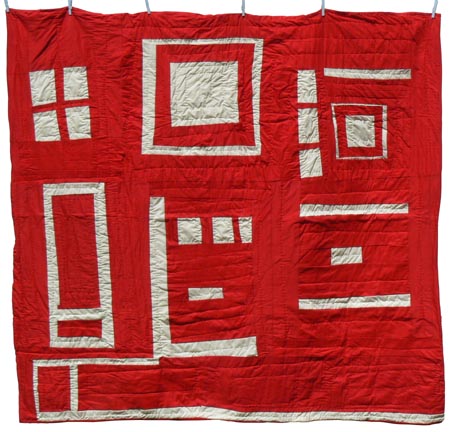
A house, divided

An abstract version of the "house" quilt pattern, circa 1950s or '60s.
This quilt and others can be found at Folk Artisans.

Really, the yard signs tell the story.

There, among the fading petunias, were the plastic signs in navy and white, their respectful, conservative white lettering spelling out support for the Republican ticket. And in between them, looming over them, was a piece of plywood three times as large, and sprayed on the front in florescent pink were the words "Nader/Gonzalez."

"Don't expect to see that sign still standing when you come home tonight, boy!" the father said.

The young man only shrugged, and left his father standing in the drive way. In the past few years the man had turned old, strong still, but now old. His beard and head were filled with gray, and he spent many warm autumn afternoons sitting in a plastic lawn chair watching the traffic head home. He'd raise one hand in recognition of a neighbor's car, while the other rested on his belly, balanced between his thighs, suspenders slung over broad bare shoulders.

When I first moved onto H Street, the father mowed his postage stamp yard shirtless, sitting atop one of those riding lawn mowers. When he was done, he'd climb into his semi-truck and ease it around the block while checking out the neighbors' yards. But as his shoulders stooped and his son's broadened, the boy took over the lawn care, and the neighborhood inspections came less frequently.

His McCain signs were the first to go up on the street, divided -- almost house by house -- over the country's political future. The neighborhood has been written up in the International Herald Tribune. The city's been spotlighted on National Public Radio. Pundits say that who wins the county, wins the country. And while he could wave and smile to the Obama supporter, his son's homemade sign -- now dominating the yard -- mocked him.

"It's been World War III around here," his wife told me one evening as we chatted in the street.

Fists banged the table. Accusations flew. Someone threatened to put an Obama sign in the yard as well.

"Everyone's entitled to their own opinions," the mother said, taking a long drag on her cigarette. "First Amendment, you know. But me? I'm like Switzerland. I'm staying neutral. My vote is gonna remain private."

The young man stomped off to work. The old man stomped off to get another McCain sign. And that evening and the many since, the sun's orange rays glowed on both plywood and plastic.

Wednesday, October 22, 2008

Coloring a cold

Photo courtesy of Stryker w@sp

A nasty head cold, a persistent cough and a rollicking stomach bug are making their way through the family this week. This tiny poem came out of committee.

Sharp pencil hits floor.
Baby grabs. Mom squawks, "No! No!"
Mom grabs. Baby squawks.

Thursday, October 16, 2008

Wednesday, October 15, 2008

My skin or my soul

Photo courtesy of amazonactivist.

Shelly followed me around the playground, not close enough for anyone to imagine we were friends, but behind me like some mangy, maggot-eating dog with its tail between its legs, and behind her came a cloud of stink, the smell of old, stale dirt melted with sweat to form a crust over the skin. The other kids were beginning to notice.

"Why's she following you?"

"Who?"

"Shelly. Are you friends?"

And the word was spit out like dirt. For even here, where everyone lived in trailers and most backyards included a junk car, there was a pecking order among us children, a ranking built on insults and exclusions, and at the bottom of the hierarchy was Shelly. She was the fifth-grade version of the thick, polluted froth found along the seashore. She was the brown foam of fat that collected at the edges of a boiling soup pot. She was scum.

And I was her secret ... something -- not friend, though. I felt sorry for her, sorry that she lived in a dirty family with dirty brothers who ate their boogers. I felt sorry for her when I saw her mother, whose skin was gray-brown as the cigarette smoke that hovered around her, and who smelled like B.O, sorry that she had a mother who bought cigarettes instead of soap for her children, lots of smooth, white, clean bars of soap to wash dirt out of matted hair and grime out of clothes. I felt sorry for Shelly, but I didn't like her.

She was surly and sour, stomping on the bus every morning and throwing herself into an empty seat where she'd stare out the window. She had dirt on her neck and knees, her arms, her face, everywhere. I wanted to take a fingernail and scrape the skin, erasing the dirt and leaving a white streak on her arm and crud under my own nail. Her stink settled around her and kids held their noses and moved. Some gagged and choked. Shelly scowled, eyes narrowed to slits and teeth bared, yellow and fuzzy for lack of a toothbrush.

"You have to be kind to her," Mom said, "like Jesus loved the poor and outcast."

I wrinkled my nose and breathed into my jacket for the rest of the bus ride, but I didn't change seats.

I'd been secretly writing notes to Shelly for a little while now, letters penciled, then folded and slipped to my teacher, who slipped them to Shelly. The teacher had approached my mom and me with the idea after her own efforts to share soap and clothing went unused. Maybe, she said, another child would have more success with this angry, filthy girl.

Shelly's only friend was a tape deck and a stack of Beatles tapes. She'd cradle the tape deck against her ear and listen to it on the bus. She listened to it on the playground as she walked the perimeter. But the music that warbled from the small microphone was an insult to the headbangers, ready to pound and pump head and fist for AC/DC. And so when she walked near some boys, one -- David, skinny and round shouldered, face coming to a nosy point like a rat's -- stuck out a leg and tripped her.

She sprawled into the gravel, tape deck bouncing out of her hand, popping open, tape flying. She jumped up, snarling, smarting, palms scraped and bleeding, blinking away tears. David tossed his sheet of hair out of his eyes and laughed.

"Leave her alone," I said.

"Shut up, scum-bag. She's scum, and her music's scum, and you're scum, too."

He kicked at the cassette-recorder, sending small rocks and dirt flying, and spit. Shoulders hunched, he walked away. But David remembered. Shelly remembered. And as kids began to avoid me, Shelly slunk closer, shadowing me during recess, shuffling behind me, not looking, not talking, but there all the same. My fall within the school hierarchy was clean and quick as a knife cut.

I had never been popular, but I had a true friend, a best friend I thought would shield me against the pecking order, but instead she stood back and let me bleed. First, she avoided me at lunch, then at recess, too. I phoned her after school one day to ask why, and she said kids were calling me scum.

"Do you want one friend that loves you, or a lot of friends who just like you?" I asked her.

"I want to have a lot of friends."

I hung up the phone and cried.

Most of the kids in the school were poor, and many of us ate meals bought with Food Stamps. I wasn't scum, I was clean, took a bath, used soap. But now, like Shelly, I was alone -- she with the Beatles and I with my books.
I burrowed into books in order to forget I had no one to talk to. I carried them on the bus, took them on the playground, hid them in my desk. This was my routine until a new girl arrived and chose me as her friend. Once again, I had someone to share lunch with and talk with during recess, and, once again, I was being shadowed.

"Why's she following you?"

"Who?"

"Her. Are you friends?"

I turned and looked at Shelly, stared at her dirty clothes and tangled hair and her cloud of stink, and then spoke to her for the first and last time.

"Go away!" I said. "Stop following me. I'm not your friend."

Blog Action Day is an annual nonprofit event that aims to unite the world’s bloggers, podcasters and videocasters, to post about the same issue on the same day. It aims to raise awareness and trigger a global discussion. Global issues like poverty are extremely complex. There is no simple, clear answer. By asking thousands of different people to give their viewpoints and opinions, Blog Action Day creates an extraordinary lens through which to view these issues. Each blogger brings their own perspective and ideas. Each blogger posts relating to their own blog topic. And each blogger engages their audience differently. For others, click here.


Tuesday, October 14, 2008

Time warp

Photo courtesy of jared.

If I could live at a different time in history, I would choose to watch the universe give birth to itself. I would like to see stars explode, spewing hot gases and dust into a dark, cold space. I would like to watch great swirling clouds of gases cool and glom and wring themselves of water. I would like to see particles of dust congeal into solid ground that I would one day stand upon, and I would like to be blinded by the shafts of light and warmth from the first rays of our sun.

Particles of stardust reside in my body, in my children's body, and in yours. In our dark flesh, we carry the glitter and gas that marked the dawn of time, when the universe heaved and shook with infinite possibility.

To read other people's choices for living in a different historical time, check out Sunday Scribblings.

Thursday, October 9, 2008

Forbidden

Photo courtesy of mywoods.


Buried deep under her blankets, Connie woke to whooping and hollering from her little brother, who was clomping down the hall in boots, pajamas sticking out from the end of his snow pants.

"Connie! Get up! Get up! It snowed!"

Jason tugged at the blankets, and Connie poked her head out. Snow! She jumped up and scratched at the frost on the window until she could see outside. The snow was deep enough to cover sagebrush and clumps of cheatgrass, turning the desert into a giant version of Connie's own lumpy bed. With snow this deep, she knew the bus wouldn't make it down the long dirt road and school would be canceled.

It didn't take long for Connie to join Jason on the hill, really just a bump no bigger than the family's Honda Civic, but steep enough to ride a sled onto the alkali flat. When they got tired of sledding, they took turns pulling each other across the hard-pan until the sled tipped Jason into a tumbleweed. When Connie tried to help him up, he screamed that she had done it on purpose and began chasing her across the desert with part of the sticker bush until he gave up and went inside.

Connie slipped around the side of the trailer and in through the back door, and called her best friend, Michelle. They liked to say they lived on the same street, and they did, technically. Connie lived at one end of Shadow Lane and Michelle lived at the other, and between their homes were four miles of washboard road, two stop signs and one abandoned sheepherder's shack. Nothing else. Besides sharing a street, they both had annoying little brothers, they both were skinny, and neither had started growing breasts like some of the girls in fifth grade. Michelle's mom had given her a training bra, which Michelle used to sling pebble-sized jackrabbit turds at her brother.

Holding the phone to her ear, Connie stretched its cord down the hall and into the kitchen where her mom was pulling stickers out of Jason's forehead.

"Mom, Michelle invited me over. Can I go?" Connie asked.

"Only if you take your brother, and only if you walk," her mom said. "Dad had to take the truck because of the snow, and I'm not driving the Honda on these roads."

Jason grinned and Connie glared.

"Did you hear that, Michelle? I can go! But you better find your slingshot, because my brother has to come."

The whole walk there, Jason complained. By the end of the first mile, he had pulled off his hat and gloves, and by the second mile, Connie was carrying his coat. When they reached mile three (the sheepherder's shack), the snow on the road was beginning to melt.

"Come on, Jason! If the snow melts, we can't go sledding."

She yanked on his arm and squinted. Sunlight bounced off the snow, bright and sharp as diamonds, stinging her eyes and making them water. Far off she could see the second stop sign, which meant Michelle's home was close. Unlike Connie, Michelle lived in a real house, not a trailer, a two-story house nestled in hills that flattened into fields of alfalfa. From Michelle's house they could walk to a ditch, choked by tule and cattails, and follow that finger of blue through the fields and into the cottonwood trees that lined the Carson River until it dumped into the Lahontan Reservoir.

But now bare tree and dry tule were cloaked in snow. The four children sledded until the boys complained of the cold and went inside, leaving the girls to follow the tracks of rabbit and quail down to the frozen ditch. A small bird pecked at cattail fluff. Connie stepped onto the ice and feathery cracks spread under her feet. Michelle snapped off a column of tule and its dry husk released a small cloud of dust. She held it in her fingers like a cigarette.

"Do you think you could smoke a tule?" Connie asked.

Michelle shrugged. "It looks like a cigarette," she said.

"Let's try."

They smiled at each other. Michelle ran back to the house for matches. Connie walked further out into ice and cattail, looking for tule as thin and round as cigarettes. The tall dry stalks folded and bent creating small chairs and couches to sit on, and that's where Michelle found her.

Connie shook the tule free of snow and Michelle held the match to one end. It smoldered, embers glowing and then fading out.

"You have to hold it up to your mouth," Michelle said. "That's what my grandma does. When she lights it, she breathes in."

A second match. Connie took a deep breath and exhaled through the tule, blowing ash and dust at Michelle. They threw themselves back into the tule and snow and hooted.

"Noooo! Breathe in, not out. Here, let me try," Michelle said.

She put the end of the tule in her mouth, took a big puff as the match was lit, and spit out dust. Coughing and laughing she tossed the tule onto the ice.

"This is dumb," she said.

The girls lay on their backs in the snow and looked up at the sun, at birds darting overhead, at the dusty snake of smoke from the house slithering across the sky.

"Wanna try and kiss?" Connie asked.

"Okay."

"Just for practice. So when a boy wants to, we know what to do," she said.

"Okay."

They rolled over so their faces were inches apart.

"You have to close your eyes," Connie said.

They inched closer and bumped noses, red and a little runny from the cold.

"Ouch!"

"I think we have to tilt our heads a little so our noses won't bump," Michelle said.

Lips puckered, pressed, parted.

"Eeeew!"

"That's what you're supposed to do!" Connie said, giggling.

"That's gross. I'm never going to kiss a boy."

They rolled away from each other, and stood up, eyes searching for something to settle on, something other than each other. They locked onto their brothers making angels in front of the house, and headed back through melting snow and scabby patches of desert.

Prompted by
Sunday Scribblings' challenge to write about something forbidden.

Wednesday, October 1, 2008

A wedding

Photo courtesy of WTL photos.

Ellie couldn't get married in her father's church. Not the Father, just her father, God's enforcer of commandments, confession and communion, said it couldn't be done. Never mind that six months earlier her uncle, married 40 years, paid a priest to annul his marriage in order to remarry. Never mind that his six adult children, now all bastards in the eyes of the Pope, weren't there to watch him stand at the altar with a wafer of Christ stuck to the roof of his mouth and kiss his wrinkled bride. No, her dad said, no matter what the state said, in the eyes of God, Frank was still married, and therefore couldn't marry Ellie in the family church with his two small sons as witnesses.

Ellie's dad had built the church right next to her grandfather's mobile home and just 50 feet from her own family's double wide. It was a squat building with a steeple that cast a long, wavy shadow across a desert ruled by dust devils, fierce, erratic winds that tore at their trailer's tin siding, and blew sand through the window cracks so that Ellie woke in the morning with grit in her teeth.

But once when she was nine she woke to a miracle of angels' wings, of a wind that carried sand from the four corners of the desert and built a mountain in her yard. She ran outside in her nightgown and joined her brothers and sisters climbing the slope, bare feet sunk deep into the mountain's soft sides until, breathless and hot, she reached the top where she was high enough to see over the roof of the family's trailer.

Eventually the mountain melted into hill, then puddle, and finally was nothing but a shovelful of sand that her father mixed with cement to form the foundation of the church. Figuring that the mountain was a sign from God, the church was built on the same spot. They filled it with statues of the Virgin Mary, hung a crucifix of Christ writhing in agony upon the cross, and hired a retired priest to come out once a month and mumble a service in Latin.

Ellie loved the church. She loved the black lace she pinned to her hair, loved the narrow, creaking stairs to the loft where she and her sisters, and sometimes an aunt and cousins from Carson City, sang Ave Marias and Kýrie, eléisons, their clear, high notes disturbing the fine sand blown in by the wind so that music and dust floated down onto the bowed heads of the (forgiven!) sinners. But she wouldn't be married there. Instead, she was getting married at the Senior Center, built a few months ago but already smelling of old people. She had risen early and driven over to the center to air it out.

She opened the door and wrinkled her nose at the smell of fish sticks and peppermint and urine. Quickly, she walked past tables and folding chairs that had been set up the night before, past the D.J.'s equipment, and the long table where the wedding party would sit and face the guests. As she went, she opened windows to let the wind in, the sand in.

She inhaled the hot air, sweetened by sage and tumbleweed, and stopped at the card table where the wedding cake would sit. She lifted the heavy silver knife that she and Frank would use to cut the cake. Frank and his boys. The three had to sample every cake in the bakery before settling on spice. Spice cake with cream cheese frosting, she had won that round at least. She locked the door and headed home to get ready for the wedding.

The ceremony was over in 10 minutes. Ellie had spent the whole time trying to remember the name of the man marrying them. Frank had introduced her a week earlier, told her who he was, but now as she stared at his red nose and cowboy shirt, smelling whiskey, she missed her cue, and Frank had to squeeze her hand to prompt her. "Oh!" she cried. "I do." And the guests laughed and the county commissioner? Judge? Bartender? laughed too. And she smiled up at her husband as he bent down and kissed her.

Friends filed past her and Frank and the boys, a family now. When her new sons grew tired of the compliments and handshakes, they joined the other children sliding across the dance floor in their socks, amusing the women who tapped their feet in time to the music and eyed their men, who were tipping back their chairs, tipping back their beer bottles. Ellie danced, with Frank, with her father, with her sons, holding their small hands and dancing in a circle, her dress swirling about their feet, tripping them so they fell in a fit of giggles to the floor.

And then it was time, the D.J. said, to make a toast and cut the cake. Children squeezed through the crowd to get to the front of the cake table. Couples who had slipped out in search of dark corners of the desert and soft sand to push their bodies into wandered back inside. Frank and Ellie wrapped their fingers around the knife and cut the cake.

"Should she be nice, folks?" the D.J. asked as Ellie tossed back her head and laughed, smooshing the cake into Frank's face.

Frank didn't wait for the D.J.'s prompts. He took his own piece and pushed it into Ellie's face, her head snapped back, she stumbled and was caught by her dad. Smiles. Glasses. Eyes. Laughter. All froze. Ellie's father pushed her behind him and turned back to Frank.

"Touch my daughter like that again and you'll regret it."

"Oh, Dad. It was my fault. I did it first."

Ellie moved past him, reaching for napkins to wipe away the frosting, praying she could erase the angry look on her husband's face, praying for the wind to bury her in sand.

In response to Sunday Scribblings' writing prompt: Weddings.
Blog Widget by LinkWithin