Friday, December 31, 2010

A year, reviewed

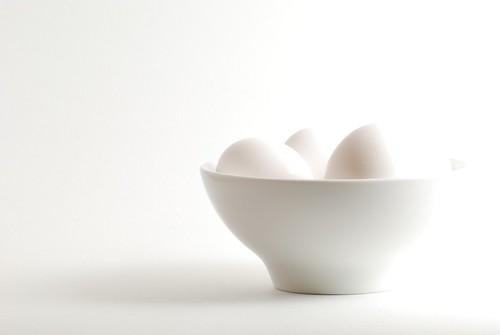
DSC_0034
Favorite foods.

Your favorite posts this year:
  1. Caught on Chat Roulette
  2. Women hold up half the sky
  3. Hot cocoa taste test
  4. Made for TV drama
  5. Five things needed to induce sleep in a toddler
  6. Failure or alas I cannot get published
  7. My skin or my soul
  8. Icebox cupcakes
  9. Petrichor
  10. Silly soup song
My favorite slow-cooked sentences:  
  1. We are stardust, we are golden
  2. My heart, plucked
  3. Tenebrous
My favorite photo-inspired post:

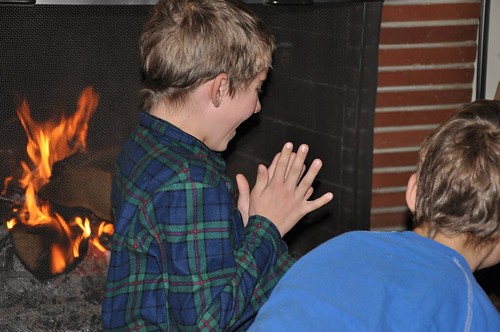
brothers

My favorite readers:

You.

The Slow-Cooked Sentence had more than 3,400 visitors this year, with more than half of them regular readers. Many of you discovered The Slow-Cooked Sentence through three other blogs, Our Seattle, Arthouse Easel and Earthy Crunchy, and I thank them for the regular referrals.

My favorite blog of 2010:

Chez Danisse authored by Denise Parsons, a writer and artist living in San Francisco. Denise knits scarves, she once raised worms and her writing is ethereal, contemplative, dreamy. I like reading it.

Wednesday, December 29, 2010

Mud and sunshine

DSC_0066
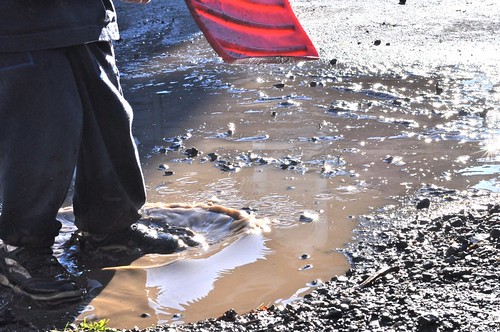
He scooped a puddle with the snow shovel and in the process reminded me that it's the action and not the outcome that matters.

Friday, December 17, 2010

Sweet, sound advice for the season

Destroy and conquer what ails you. Peanuts by Charles Schulz.

 There's no better way to relieve stress from:
  1. the hustle of last-minute shopping,
  2. the bustle of boxing up packages to be mailed at prices that outstrip the gifts' values,
  3. the worry that school work won't be wrapped up before the term's end,
  4. the anxiety of traveling snow-covered roads,
  5. the runny noses and coughs that linger,
  6. the stack of empty pizza boxes piling up because there's no time for decent meals
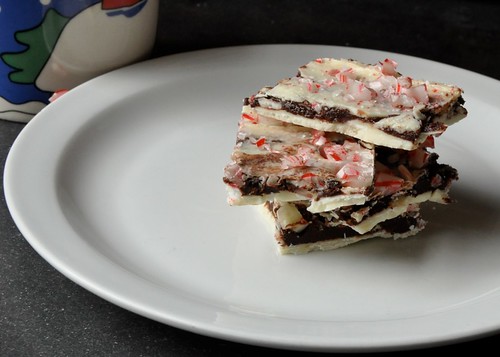
than to take a handful of candy canes and smash them with the bottom of a soup can. Unwrap and pulverize the peppermint candy into sweet shards and dust. Listen to the solid thud of the can as it slams against the floor. Watch as the smooth, slender sticks splinter and crack. Feel the sense of satisfaction spread with the destruction.

During this season of artifice that builds to a crescendo of over-indulgence and credit debt, it feels good to break something down. So carry on! Melt dark chocolate into thick whipping cream, add a splash of peppermint extract and heat it until it turns into a smooth, rich ganache that will be sandwiched between thin layers of white chocolate and crushed candy.

This version of peppermint bark, with its layers of chocolate that are heated, then cooled, requires time, time enough to drink a cup of tea, to knit a few rounds, to read a chapter, to take a cat nap. Do this. You'll be doing yourself (and everyone you know) a favor.

DSC_0098

Peppermint Bark
Very loosely adapted from Bon Appetite, December 2008

22 ounces (2 packages) white chocolate such as Guittard Choc-Au-Lait White Chips or Ghirardelli Premium Baking Chips, Classic White
8 ounces bittersweet chocolate
12 candy canes
7 tablespoons heavy whipping cream
1 teaspoon peppermint extract

Put a piece of foil, slightly larger than a 12 x 9-inch rectangle on a baking sheet. 

Stir white chocolate in a double boiler or a metal bowl set over saucepan of barely simmering water (do not allow bottom of bowl to touch water) until chocolate is melted and smooth. Remove from over water. Pour half the white chocolate onto the foil. Using an icing spatula, spread chocolate to fill rectangle. Sprinkle with half the crushed candy canes. Chill until set, about 15 minutes

Stir bittersweet chocolate, cream and peppermint extract in heavy medium saucepan over medium-low heat until just melted and smooth. Cool to barely lukewarm, about 5 minutes. Using icing spatula, spread bittersweet chocolate in even layer. Refrigerate until very cold and firm, about 25 minutes.

Rewarm remaining white chocolate. Working quickly, pour white chocolate over firm bittersweet chocolate layer; spread to cover. Immediately sprinkle with remaining crushed peppermints. Chill just until firm, about 20 minutes. 

Lift foil with bark onto work surface. Cut into desired shapes and sizes. (Can be made 2 weeks ahead. Chill in airtight container.) Let stand 15 minutes at room temperature before serving.

Notes from the cook: Firstly, I rounded up the amounts in this recipe in order to use all the white chips, chocolate and candy canes because I have no patience when it comes to recipes that leave me with leftovers of a special ingredient, which just gets wrapped and shoved into the cupboard to be forgotten. Secondly, the original recipe, as well as those reprinted on blogs like Orangette and Soule Mama, recommended using real white chocolate, which contains the cocoa butter of true chocolate, but lacks cocoa solids, the element responsible for milk and dark chocolate’s brown color and nutty roasted flavor. I didn't and here's why: In a Cook's Illustrated taste test that compared real white chocolate alongside "fake" supermarket brands, the losers weren't confined to the fake brands. 

"Our winner turned out to be not real white chocolate at all but an artificial white chip: Guittard Choc-Au-Lait White Chips," according to Cook's Illustrated, November 2009. "Tasters raved over a creamy texture akin to “crème fraîche” and a strong vanilla flavor. It was the second-cheapest brand in the lineup, costing just 27 cents per ounce, and beat out a real white chocolate from the same manufacturer. We also found that a good brand of imitation white chocolate like Guittard has another decided edge over the real white deal: A lesser amount (or lack) of cocoa butter keeps it from oxidizing too quickly and extends shelf life." 

I couldn't find Guittard Choc-Au-Lait White Chips at my grocery store, so chose Ghirardelli Premium Baking Chips, Classic White, a fake chip that tied for second place, beating out the real white chocolate bar made by the same manufacturer. This chip’s “sweet cream” flavor was “rich,” and “milky,” with a “buttery” texture, though some noticed a slightly “waxy and chalky” aftertaste when prepared in mousse.

Wednesday, December 15, 2010

Going the distance

A package
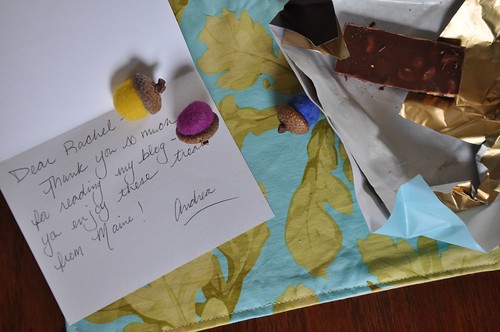
A present arrived in the mail from a fellow blogger and it made my day. Andrea Lani is someone I began reading some months ago and although I'm still getting to know her, I've discovered we share things in common:

She's a writer who wishes always to be writing more.
"Why have I not submitted anything in the last year 
(other than the fact that I haven’t written anything in the last year)?"

She has twin sons.
 "I can’t think of time when I’ve felt less equal to the task of parenting (actually I can...the first two years of the twins’ lives...)"

She loves the wilderness.
"When I take a short walk into nature and sit down with my journal to jot down my observations or sketch whatever is before me ... my thoughts slip off their hamster wheel in my head."

She's opinionated.
"I am a huge proponent of public school anyway, and if you let me I'll get on my big (probably offensive to many) soap box about how public school is our most basic democratic institution and that (like water) if the people who care about education (or clean water) only send their kids to private school (or buy bottled water) then there will be no political pressure for public school (or tap water) to meet high standards and it won't be there for those who need it, but who may not come from a family who has the time, interest or motivation to make it work (or it will just flow rusty from the tap)."

    I like to read what Andrea writes, so I subscribed to her blog, Remains of the Day, which is a place where she sweeps ups her thoughts and the crumbs under her table. Blog friendships are tough to define, being removed by time and space, yet I'm finding on-screen friends much easier to make and maintain in my newly transplanted state. This dilemma interested me, so I went in search of more on the topic and found this article in The New Atlantis written by Roger Scruton, who argues that the ease I've had in slipping into these blogging friendships is because they're easy come, easy go.

    "When attention is fixed on the other as mediated by the screen," Scruton writes in summer 2010 issue, "there is a marked shift in emphasis. For a start, I have my finger on the button; at any moment I can turn the image off, or click to arrive at some new encounter. The other is free in his own space, but he is not really free in my space, over which I am the ultimate arbiter. I am not risking myself in the friendship to nearly the same extent as I risk myself when I meet the other face to face. Of course, the other may so grip my attention with his messages, images, and requests that I stay glued to the screen. Nevertheless, it is ultimately a screen that I am glued to, and not the face that I see in it. All interaction with the other is at a distance, and whether I am affected by it becomes to some extent a matter of my own choosing."

    Scruton's "Hiding Behind the Screen" is a thoughtful and long piece of writing that goes on to examine the negative side-effects of social networks, and I enjoyed it -- but not as much as I enjoyed Andrea's peanut-studded chocolate bar, though I admit would've been better had she been there to share it.


    +++

    I follow a changing handful of blogs via Google Reader, an aggregator that allows me to effortlessly keep up-to-date on the writers I follow. If you don't use such a device, think about employing one because it saves you time and energy by regularly checking websites for updates and creating a unique information space or "personal newspaper."

    Friday, December 10, 2010

    Tare or in which Christmas is unwrapped

    tair
    noun

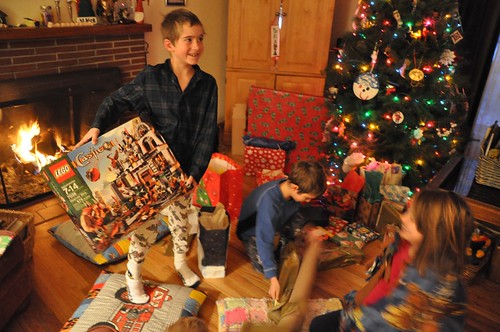
    Unwrapping Christmas
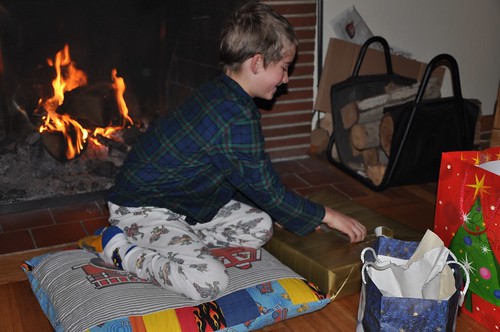
    Santa delivers. Christmas, 2009.

    1. The weight of the wrapping or the container that holds the object.

    Two months ago, my son Sam decided to ask Santa Claus for an Apple laptop despite being told that the jolly elf wouldn't deliver such a gift. All this 9-year-old boy knew was that Santa granted wishes and this was his heart's desire. Sam reasoned that classmates had received Nintendos and computers, so he couldn't understand what price and parental veto power had to do with it.

    Because he believed in the power of Santa, Sam remained optimistic despite my warnings of disappointment, my explanations that some things one must buy oneself, my skepticism over the gift's usefulness given his weekly computer time limit of 45 minutes.

    A wish granted
    Sam, when he believed
    When wishes came true, 2009.

    Optimistic, that was, until this past weekend.

    "Mom, is Santa real?" he asked as he followed me around the grocery store.

    I pretended not to hear the question and sent him to pick out brussel sprouts.

    "Mom, do you believe in Santa?"

    I told him I believed in everything Santa represented: love, kindness, magic, giving. We talked about why Santa doesn't bring gifts for parents, why children are given different gifts and why those gifts aren't always fair and equal, we talked our way out of the grocery store, down the road and back into the kitchen where he asked, again, if Santa was real.

    I looked at Sam, his ocean eyes somber, his mouth drawn into a serious line. This was my son who once confided in me that he wanted to be Santa when he grew up because he would be able to eat cookies and milk all the time and live forever. Now he had poked holes in the wrapping of his belief, but the tare was heavy and he couldn't or wouldn't take that final step to expose the lie told in love.

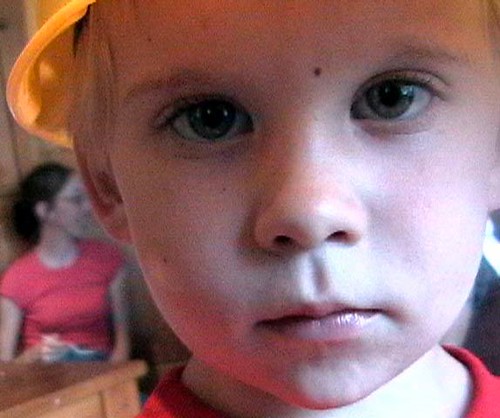
    sam-closeup
    Sam, aspiring to be Santa.


    I sighed, smiled, then shook my head no. Five minutes later I found him curled up on the couch, silently crying. I stroked his hair and rubbed his back.

    "Thank  you," he whispered.

    "For what? For disappointing you?"

    "Now I won't wonder why I don't get some things other kids get, and I won't try to explain it."

    Wednesday, December 8, 2010

    The pocket tree

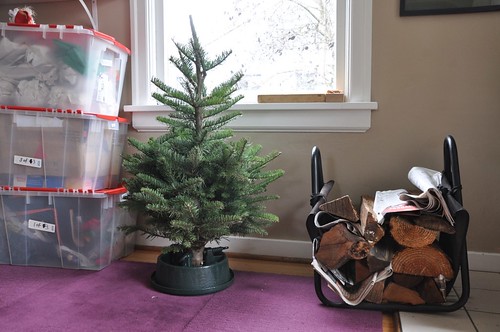
    The tree

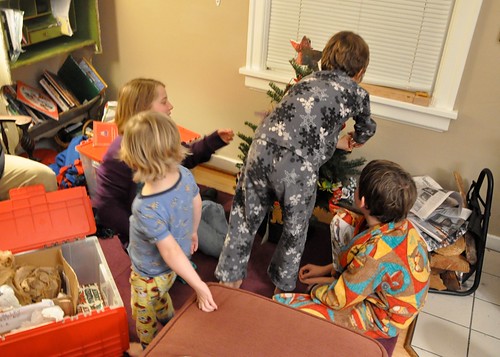
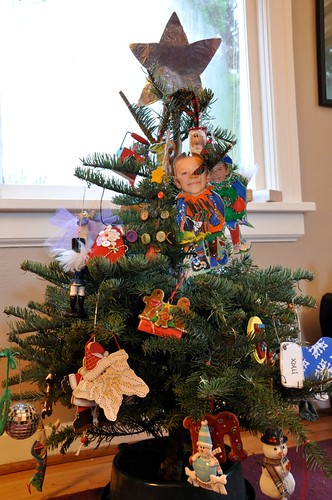
    The men in my family came home with a tree just 2 feet tall. The boxes of holiday decorations hauled out of the attic dwarfed the tree. My 3-year-old son dwarfed the tree. The cat dwarfed the tree.

    What were you thinking? I asked. The tree was too tiny to hold a string of lights, too tiny for most ornaments, too tiny to scent the home with pine, but my Grinchy thoughts were ignored. 

    Dwarfed

    In five minutes, the tree was trimmed. My daughter lay at its base and set up the Nativity, my youngest son kissed all the ornaments, my husband hung leftover decorations from the jackalope while my older boys settled down to read Christmas stories. 

    Later, I walked past the tree and caught the faintest whiff of pine, so I stooped over for a big sniff and got poked in the eye. You win, I told the tree, rubbing my eye and laughing at how Christmas is coming despite my protests.

    Our tree, 2010


    Friday, December 3, 2010

    Later today

    dew

    There is a type of sadness that settles over my heart like fog rolling in slowly, casting quiet shadows and muting colors almost imperceptibly, so that my landscape is changed but unnoticed by me, like how I keep forgetting that the sky should be blue instead of gray.

    I've had trouble staying warm lately, even when I wear two shirts, a fleece vest and wrap myself in a wool blanket. I've tried to warm myself by sitting in a patch of sunlight on the rare days it breaks through the clouds, but the light is pale and weak. It wasn't until today that I wondered whether this chill was my sadness, cold and damp, hugging my shoulders, curling around my toes. 

    I know what this is, I know we all manifest our stresses and anxieties in different ways. Right now, my mom has hives because she's working so hard to be strong and positive as she cares for my dad. This sadness is why I can't think ahead, because I can't envision what is out there. I don't know how to prepare myself or my children for what will come in three weeks when I see my parents at Christmas, in three months when my father's chemotherapy is wrapping up, in three years.

    The sweet thing about this sadness is how it contains a radiant and desperate joy that explodes out of me sometimes. I cry until I laugh. I run and the world spins under my feet. Tonight, I danced.

    Marcel worked late, so the kids and I were alone for dinner. We made pizza, ate chocolate pudding for dessert, and then turned the stereo up loud and danced as we cleaned. Paper airplanes whizzed through the air, the littlest jumped about naked, having cut short his bath to join us in the kitchen. We danced to my children's favorite songs -- the Glee soundtrack, We Might Be Giants, Arlo Guthrie. I boogied until I was breathless and laughing, until I flopped on the floor, gulping for air, until I was warm and no longer sad.

    Today

    My father began chemotherapy. I don't know what to write after a sentence like that. That's all there is inside of me right now. I'm a blackboard to write upon, I'm cataloging the moment, not thinking forward or backward, not planning, just here, because tomorrow it'll all be erased.

    Wednesday, December 1, 2010

    The morning's song

    DSC_0258

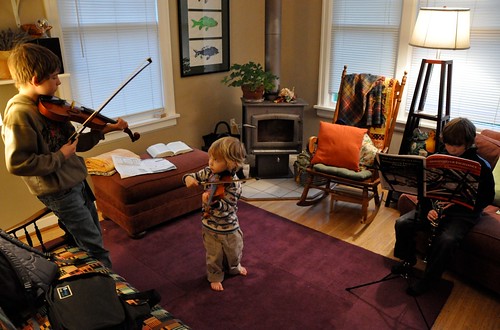
    At 8:30 every weekday morning, the house is filled with the squawks and squeals of the clarinet, the plaintive plucking and moaning of the violin. My sons are learning to make music, a plodding and painful process that I might not survive.

     The clarinet was mine when I was 12. It's been passed down to my three sisters, my daughter and now Max. He plays it loud, really loud. The sound explodes out of the bell with a force that sends me scurrying for the silence of the basement. The violins are loans -- one from a neighbor, the other from a local shop. Someone once told me that the sound of the violin most resembles the human voice, and Sam's version of "Mary had a Little Lamb" sounds like mourners at a funeral wake.

    At 8:45, instruments are shoved pack into cases, backpacks are slung over shoulders and my two older sons throw me kisses and head for school. As I shut the door, I sigh and smile, happy with the sound of silence.  

    Friday, November 19, 2010

    What you do before you friend someone

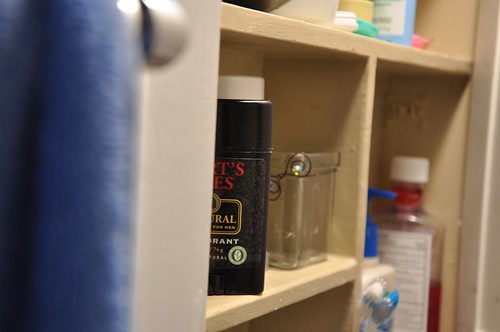
    DSC_0030

    I opened the bathroom door and a squeal erupted from inside.

    "I'm deodoring!" my son said.

    Oops.

    *
    Recently, I challenged myself to record each day with a photo and an observation, much like what happens at habit: a collection of days. Some of the pictures and writing I've used here, others I only posted on my Flickr account, Dance in the Kitchen. You can find them here, if you're curious.

    Wednesday, November 17, 2010

    You get what you get

    DSC_0039

    It was an extravagance, turning a whole chicken into stock, but I wanted a rich, fragrant, meaty broth with shimmering droplets of fat, a soup that cured. It bubbled on the stove all day long.

    I don't like caring for sick kids. I resent their neediness, the tether they become, the disruption they cause, but I am their mother and this is what mothers do: They measure cough syrup, brew cups of herbal tea, take temperatures, rub backs, then wake in the middle of the night to do it all again. Yesterday, I did this but not well, for in between the good-mother stuff, I lost my temper, cursed my children, rudely hung up on my husband and ate handfuls of chocolate chips straight out of the bag. I feel guilty that I'm at my worst when my kids need me most, but there it is.

    I needed this chicken broth to work magic and restore not only health but also good will, which was asking a lot from a bowl of soup, but I can wish, can't I?
      
    "It's not simply its warmth, aroma or digestibility that makes you feel better. Chicken soup really is good for you, but only if it has those pools of golden fat floating on its top," Jennifer McLagan writes in the cookbook "Fat: An Appreciation of a Misunderstood Ingredient." "All poultry fats contain the monosaturated fatty acid palmitoleic acid, which is believed to boost our immune systems. Chicken fat has more palmitoleic acid than other types of poultry fat."

    I seasoned the broth, added thin coins of carrots, dill and plump matzo balls. But some days can't be saved. Some days are bitter, a struggle to live through, a slog. My daughter continued to whimper that her chest hurt when she coughed and my sons didn't return my smile when they returned from school. Although beautiful flecks of fat glittered on its surface, this soup didn't cure what ailed the day, although it made it taste a little better.

    DSC_0058

    Chicken stock

    One whole chicken
    Enough water to just cover it
    A couple bay leaves
    A handful of whole peppercorns
    One onion, quartered
    Salt and pepper, to taste

    Bring to a boil, reduce heat to a simmer and skim the foam off the surface. A whole chicken simmered a long time will yield the richest and most flavorful stock, but you also can use the bones from a couple roasted chickens. About one hour into the process, I pull the chicken out and cut off the breasts, saving them for another meal. Typically, I simmer the chicken until it falls to pieces or about four hours, then strain through a colander.

    Friday, November 12, 2010

    French kissing a mermaid

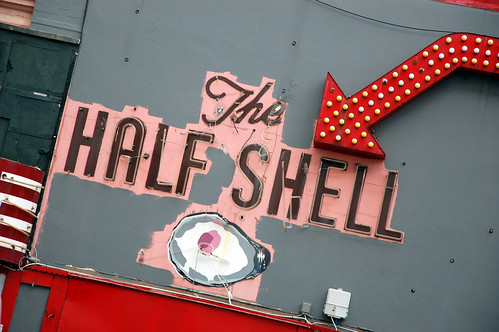
    The Half Shell
    Courtesy of Steve Snodgrass.

    I've eaten an oyster.

    To be completely accurate, I've eaten six.

    Each one was like a wave exploding in my mouth, soft, salty, sharp. I swallowed and felt this rush, this high, this incredible feeling of aliveness like I get when I bodysurf, but this time the ocean was tumbling and crashing inside of me instead of me inside the ocean.

    Man began eating oysters some 140,000 years ago, and I like to imagine that we've been uttering the same sound for oyster since prehistory. After all, the word hasn't changed much: Oyster is a derivative of the Middle English oistre, which comes from Old French uistsre, which itself comes from Latin's ostreum, which comes from the Greek word ostrakon.

    My first oyster shimmered in its shell. I wasn't sure what to do with it, so I watched others sitting at the Walrus and the Carpenter oyster bar then squirted lemon, added a generous pinch of fresh grated horseradish, drizzled vinegar, and slurped. I closed my eyes and managed one bite before it slid down my throat. A slow, silly smile spread across my face, the very same grin I get when I've been tossed head-over-heels by a wave and am yanking up my swimsuit so I can head back out and ride another. More. More. More.

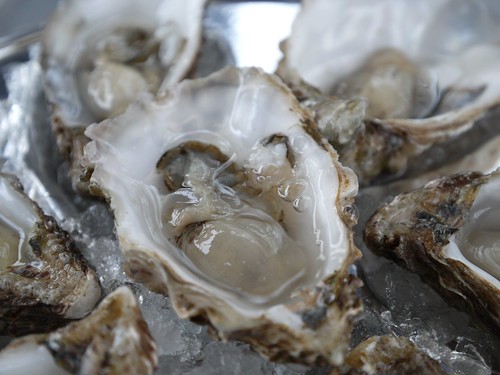
    Oyster
    Courtesy of Swamibu.

    I worked my way from small to large and somewhere in the mix I ate a kumamoto (sweet, buttery and a bit briny) and a baron point (soft textured, with a slightly mineral taste and a musky finish). Apparently, oysters are like wine and cheese, with much of their flavor credited to terroir or the environment in which they're grown, but my virgin tongue couldn't taste the difference; all it wanted was more of the full-contact experience, another soft, salty, citrus-y wave crashing inside my mouth.

    "I feel like I'm drunk and I haven't even finished my glass of wine," I told my waitress. "What's going on?"

    She rattled off various possibilities: The oyster's considered an aphrodisiac, it's raw food, the whole act of eating one is somewhat ceremonial. Then she pointed to the oyster shucker behind the bar, he'll know more, she said.

    The shucker pried open the shell, used his knife to flip the oyster onto its belly -- they look prettier and plumper, he said -- and nestled it in ice. He picked up his next shell, explaining that my "oyster rush" was a physiological reaction to the burst of protein and minerals, that this slippery, squishy shellfish is loaded with zinc, packed with protein and rich in amino acids that trigger sex hormones.

    Hmmm. So that's why author Tom Robbins once wrote that "eating a raw oyster is like French kissing a mermaid," but since my plate was empty and there were no more mermaids to be found, I took the next best thing -- my man -- and went to Sunset Hill.

    Wednesday, November 10, 2010

    I am 40, now

    DSC_0049

    I can't weave straw into gold, but I can make threads of silver. It surprises me, each strand sparkling brilliantly against the duller browns. I hadn't expected to enjoy turning gray.

    ***

    I'm reading "Crime and Punishment." For some reason I'd never read it before, but then there are so many classic novels I've never read, and when I finally begin my reaction is always the same. My gosh, this is good. It's so good, so much better than this book or that book that I just wasted my time on. Why have I waited so long to read this? Then I go around telling everyone how great this novel is, as if I'm the first to discover it, when really, I shouldn't be surprised. It's why they're classics, after all.

    Anyway, I had picked up "Crime and Punishment" again, the night of my birthday (long after song and candles and brownies had been sung, extinguished, devoured), when these sentences made me pause. I re-read them.

    For although Mrs. Raskolnikov was forty-three, her face still preserved traces of its former beauty. Besides, she looked much younger than her years, which is almost always the case with women who keep their serenity of mind, the freshness of their impressions, and a pure and sincere warmth of heart to their old age. We may add in parenthesis that to possess all this is the only way a woman can preserve her beauty even in old age. Her hair was already beginning to grow thin and grey, crows'-foot wrinkles had long ago appeared round her eyes, her cheeks were hollow and shrunken from anxiety and grief, but her face still remained beautiful.

    It's an odd feeling, learning that Dostoyevsky would've considered me old.

    Friday, November 5, 2010

    Cancer cracked me open and I weep

    One Basket
    Courtesy of Kent Landerholm.

    I drive through the intersection of an emergency.

    I hear sirens. I see the red flash of a fire truck, a policeman directing traffic, people looking up. So I slow down and I look up, too. From the roof of a tall building is a woman balanced on her belly, legs dangle, waiting.

    I drive past a man praying next to man taking a picture on his smart phone. I drive through two lights then join a crowd of cars on a freeway where no one knows that blocks away a woman is deciding whether to live or die.

    ***

    I cry as as I wash dishes, as I run, as I write. Two months ago, my father was healthy; now he fights for his life. Life is painful, resentful, but also, strangely enough, beautiful. The discovery of cancer reminds me how fragile and gorgeous and fleeting is my life, my dad's life, my children's. 

    Cancer cracked me open and I weep.

    Until I laugh.

    At the absurdity of life because it wraps a suicide in a good sky day. Because on the way home, my 2-year-old pukes all over himself and his car seat. Because I go to the grocery store and buy things I don't need and forget things I do. Because two months ago, my father was healthy and now he fights for his life.

    At home, I pull the soiled clothes off my son and he walks, naked, into the house. We rock in the sun until my eyes close and my head drops, jerks. I wake. Then nod off again.

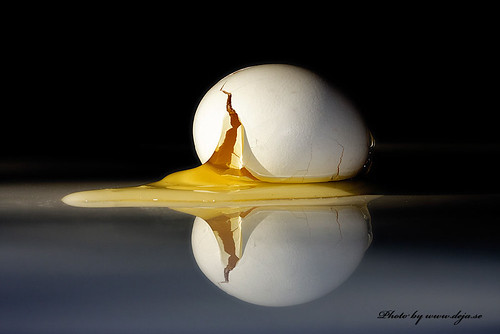
    egg
    Courtesy of Deja Photo.

    I don't know what to  make for dinner. I never know what to make for dinner anymore. Yesterday I came home with leeks and a pound of dried currants. I forgot bread. Four days ago, I bought five pounds of spinach. I forgot milk. Now I stand before the refrigerator and am uninspired. I pour cans of chicken broth into a pot. I saute spinach with garlic. I boil water and begin poaching eggs. In bowls I ladle broth over spinach and egg and hand it to my children. 

    I've never had this before.

    Not eggs. Please, Mom, not eggs.

    I sing.

    I do not like the way they slide. 
    I do not like their soft insides. 
    I do not like them many way,
    and I could do for many days 
    without eggs.

    It's a song they know from the many hours spent listening to the story of a young badger named Frances who refuses to eat anything but bread and jam. They take their bowls. Ten minutes later, one son is halfway through his bowl and looks up stunned. 

    What's wrong?

    Nothing. I just realized this was dinner.

    I smile ruefully and finish my own bowl of soup, salty, garlicky, thickened with the sweet yolk. I get up from the table, walk into the bedroom. It's 7:30 p.m. and I'm so tired. I pull off my clothes, crawl into bed and sleep.

    Wednesday, November 3, 2010

    A conversation with a young superhero

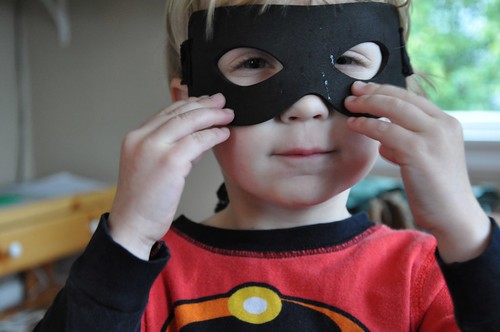
    DSC_0057
    Ivan, in training.
    "How can I fly, Mom?"

    "I don't know. How does a superhero fly?"

    "I can fly up and I can fly down."

    "It's easier to fly down, I'd think."

    "I wanna fly up."

    "Okay."

    "You get the remote control?"

    "To help you fly up?"

    "Yeah."

    "I think you're going to have to do this on your own."

    He ran.

    He jumped.

    He skidded.

    He fell.

    Then settled for piloting a paper airplane.


    Wednesday, October 27, 2010

    We are stardust, we are golden or Rilke's elegies

    Close-Up of Light Echo Around V838 Monocerotis (September 2006)
    "... We are billion year old carbon" by Joni Mitchell
    Image courtesy of Hubblesite.org

    The lab results came back.

    My dad's cancer was supposed to have been cut out of his lung and life was supposed to continue as it always had. The tumor was supposed to be no more than a hard, tiny rock that would be tossed into the trash. Instead the cancer is like dark matter, dark energy, drawing life away.

    I spiral into a place that neither shines nor reflects.


    Once
    for each thing, only once. 
    Once, and no more. And we too,
    once. Never again. But this
    once, to have been, though only once,
    to have been an earthly thing – seems irrevocable.

    -- Rainer Maria Rilke, The Ninth Elegy

    Lung cancer can spread into the neck and cause a droopy eyelid and sunken eye. It can grow into the esophagus and cause painful swallowing. It can twist itself around the heart and cause irregular beating. Or it can travel through the blood stream to the brain, the liver, the bones. My dad's cancer was found in his lymph nodes, bean-shaped filters that trap foreign particles and are part of the immune system.

    I tell everyone I know. I tell everyone I don't know. I tell because I want the news to spread faster than the rogue cells, because I want to imagine that a thousand individual fleeting thoughts focused on my dad's cancer will slow it, halt it, hell, why not erase it?

    Want to know the prognosis for lung cancer?

    It sucks.

    For we, when we feel, evaporate: oh, we
    breathe ourselves out and away: from ember to ember,
    yielding us fainter fragrance. Then someone may say to us:
    ‘Yes, you are in my blood ... 

     -- Rilke, The Second Elegy

    Cancer is going to change my family's story and it makes me scared and angry. We -- my family -- die from heart attacks. It is written in our genetic code that more than likely death will come with a slow thickening of pipes until nothing but a trickle of blood remains and the heart gasps, shudders and breaks.

    I don't want my dad to die. Okay, I know we're all dying, that each change is a sort of death to prepare us for the act of dying, but I don't want him to die. He's a good, strong man and the world's a better place because he's here, so he can't go.

    And so I hold myself back and swallow the cry
    of a darkened sobbing

    Rilke, The First Elegy

    I cradle the phone against my ear, bite my lip, and rock back and forth as I listen to my dad describe the chemotherapy's toxic concoction of drugs that would burn his veins, so doctors will put a port into his neck. He tells me another biopsy has been scheduled and a brain scan because doctors are still trying to define what and where they're fighting the cancer. Yet even as the ground falls from under him, he is strong. This is his life right now, fighting cancer, and he's ready for it, wants the fight. Had the cancer ended with the single surgery he said he would've felt a little cheated. Bring it on.

     Engraving of Orion from Johann Bayer's Uranometria, 1603 

    I want to live my life like my father, with courage, but I'm stuck in the empty, gravity-sucking space that makes up most of our universe.

    When I was a kid and my dad took me camping, he'd hunch over a constellation wheel and then squint at the sky, find some faint cluster of stars and call me over. Then we'd both stare up into the night sky and he'd point out Big Bear and Little Bear, the North Star, Scorpio and the Pleiades, the star-studded belt of Orion, the hunter.

    But it's not story, but science that comforts me now. Strength lies in fact, not in prayer, and I think that's okay. Knowing that we are just specks upon specks floating in a lonely corner of an ever-expanding universe doesn't make me feel hopeless because the universe is in us. You, me, my dad, the cancer are composed of the same ingredients -- hydrogen, oxygen and carbon -- in roughly the same proportion as the recipe for the universe.

    Does the cosmic space,
    we dissolve into, taste of us then? Do the Angels
    really only take back what is theirs, what has streamed out of them,
    or is there sometimes, as if by an oversight, something
    of our being, as well? 

    Rilke, The Second Elegy

    The other night the rain stopped and the clouds lifted, stars peered down from the heavens, and from my kitchen door I traced the outline of the Big Dipper. I wasn't filled with hope or peace or fear or sadness or anger.

    I just was.
    Friday, October 22, 2010

    Happy man on a happy day

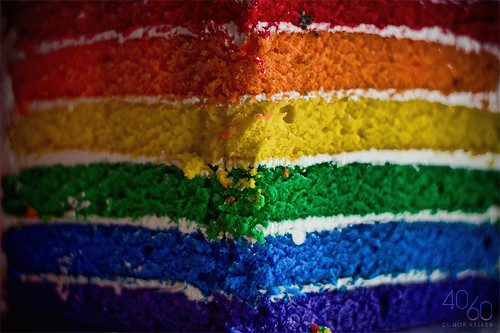
    Rainbow Cake Surprise Explored!
    Photo courtesy of Conor Keller.

    Today's the last day of my thirties, 
    and of the aspects of my life I can control, 
    I wouldn't change a thing. 

    -- Marcel Levy 


    Wednesday, October 20, 2010

    Breathless

    ● d e t a i l s ●
    Photo courtesy of just.jim.

    The weekend's whirlwind trip back to Nevada included three trips to the hospital, a sleepover with my girlfriends, a tea party for thirty, a trek out to the homestead and then we were back in the air again. As the ground rushed away from us and we headed into clouds, Ivan clutched the arms of his chair, leaned back and uttered one word:

    Whoa.

    You said it, cowboy.

    Friday, October 15, 2010

    Air

    Spring comes
    Photo courtesy of Patrick Wilkin.  

    I am listening to myself breathe, air rushing in and out of my nose, my chest expanding, contracting, until my concentration leaves me light headed, dizzy with emotions. Wonder, dread, fear, hope rise and fall like hot air balloons.

    Somewhere, a doctor breaks my father's rib and carves out a piece of lung sick with cancer.

    I sip tea that is strong and bitter, fold clothes, wait.

    Have I ever told you that I once held a lung? It was a small set of warm, pale pink lungs that minutes earlier were inside the chest of a rabbit but were now cupped in my child hands. My dad was butchering a rabbit and was explaining to me the animal's innards as he pulled them out. I held the wind pipe up to my lips, breathed and I remember how strangely firm the lung felt, not at all like a light and hollow balloon.

    For more than a year doctors couldn't figure out why my dad kept coughing; it turned out he was trying to hack out a tumor. Twice, yesterday, my mother texted with updates.

    Message number one: No news. Doing well... just w8ing. I'll let u kno.
     
    Message number two: Only did lobectomy - removed lower lobe of rt lung + 1/2doz lymph nodes. Lab results on nodes due nxt week. Going 2 ICU 2nite. Doc says he is doing well. I'll keep u posted.

    It's easier to imagine the journey of that piece of tissue than to see in my mind's-eye my father sleeping in a hospital bed, missing one-fifth of his lungs. I imagine a brightly lit operating table and a metal bowl nearby, sterile, antiseptic, cool to the touch even through surgical gloves. Someone drops the chunk of lung into it.

    Later, when the surgery is finished and the technicians are on break, they toss the lung to a crow hanging out in one of the cottonwood trees behind the hospital. The crow swallows the lung and catches my father's cough.

    Wednesday, October 13, 2010

    It makes the world go 'round

     Shel Silverstein's "Hug O' War."

    Two-year-old Ivan and I were motoring our way through a morning of errands when we passed two men in their 20s, loping along with rounded shoulder and skinny leg.

    "I wuv those guys," Ivan said.

    I glanced back at the men who were now glancing back at us.

    "You love them?"

    "Yeah."

    I shrugged.

    They laughed.

    And everyone had a better day because of it.


    I've been listening this tribute to Shel Silverstein for two weeks, straight. Here's where you can preview the entire album. And while we're singing on the subject, why not learn about the mathematics of poetry, enjoy Seattle poet John Olson's love of lines, or pick up some tips from budding author Caroline Starr Rose on telling a story in free verse.
    Blog Widget by LinkWithin